

When I tell friends back home that I spent three weeks eating my way across China as a vegan, the usual reply is a raised eyebrow and “But… the meat?” Here is the truth I wish someone had handed me before my first trip: China is both the hardest and one of the easiest places on earth to eat plant-based. It is hard because of hidden animal products that never show up on a translation app. It is easy because a 1,500-year-old Buddhist vegetarian tradition has quietly built an entire cuisine around meat-free cooking — and because young, city-based Chinese have embraced vegan cafés faster than almost anywhere I have travelled.
This is the guide I wrote for myself after four separate trips, north to Beijing and south to Yunnan. It covers where to eat, what to order, and the three traps that catch every first-time vegetarian visitor.
Buddhist vegetarian: the original plant-based China
Long before “vegan” became a Western label, Chinese Buddhist monks were refining su shi (素食, vegetarian food) into an art form. The core rule in a proper Buddhist kitchen is no meat, no fish, no eggs, and — crucially for strict practitioners — no wu hun (five pungent vegetables: garlic, onion, leek, shallot, and asafoetida). Many temple kitchens also avoid alcohol and strong spices.
The genius of temple cuisine is fang zhai (仿斋, “imitation vegetarian”): mushroom, tofu skin, and gluten shaped and sauced to mimic duck, pork, or fish. On my first visit to a monastery canteen near Hangzhou, I was served a “fish” made entirely from pressed tofu skin that fooled my traveling companion completely. The texture was uncanny; the flavour came from shiitake and a slow-simmered soy broth, not from anything that swam.
If you want the real thing, eat at the source. Monasteries and their attached restaurants serve set lunches that are reliably vegan-friendly (check on eggs and dairy, which vary by house). In Beijing, the Lama Temple (Yonghe Gong) area has long had vegetarian restaurants nearby; in Hangzhou, Lingyin Temple’s dining hall is the classic stop. Arrive before noon — these places often close after the lunch rush and do not do dinner.
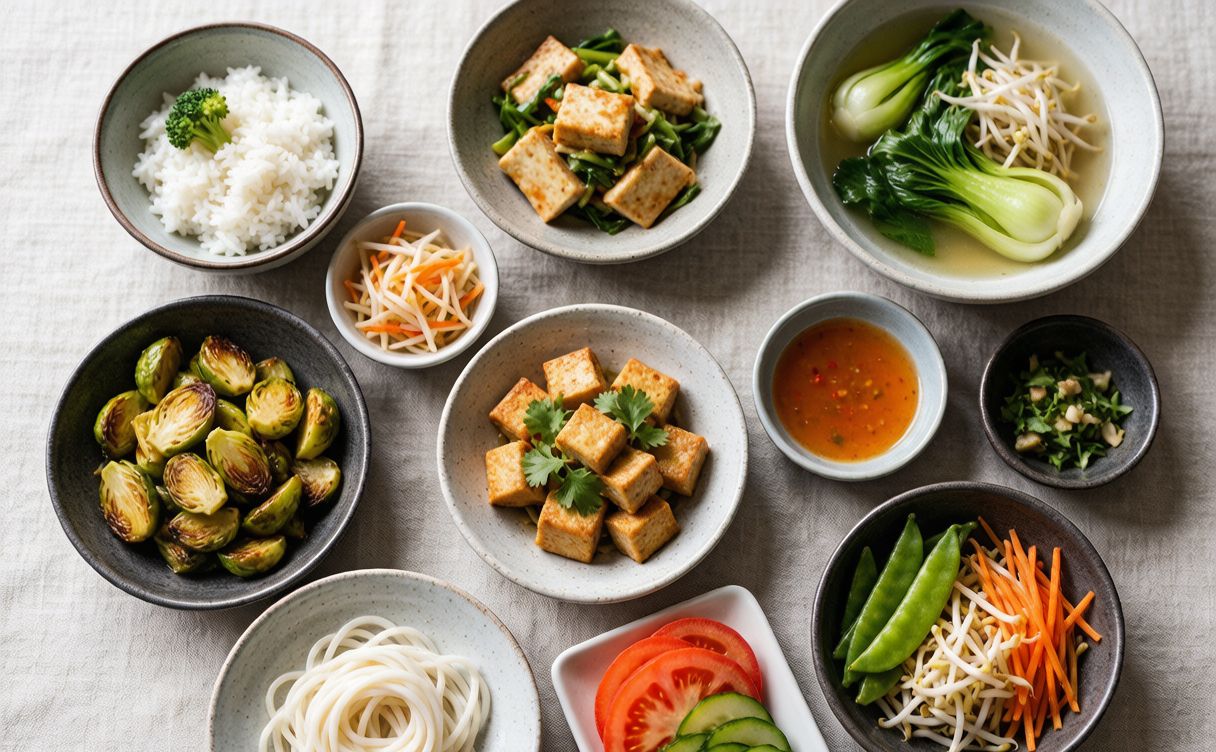
The hidden meat problem (and how to dodge it)
Here is the part nobody warns you about. In mainstream Chinese restaurants, “vegetable” dishes are frequently finished with animal fat or sauce. Three culprits to memorise:
- Oyster sauce (蚝油, háo yóu). This is the big one. Stir-fried greens — qing chao anything — are usually glazed in oyster sauce unless you say otherwise. It is in maybe half the “vegetable” dishes on a typical menu.
- Pork lard / chicken fat. Fried rice, some noodle dishes, and mapo tofu are often cooked in animal fat.
- Chicken or pork stock. Soups, braised dishes, and even plain boiled greens may sit in a meat broth.
- Hidden bits. “Vegetable” dumplings sometimes contain a little egg or pork for binding; Buddhist mock-meat can include egg whites as a binder.
The phrase that saved me more times than I can count is: “Wo chi su, bu yao rou, bu yao hao you, bu yao jirou tang” — “I eat vegetarian, no meat, no oyster sauce, no chicken stock.” Show it on your phone; waiters appreciate the clarity, and it prevents the awkward moment when your “veggie” noodles arrive glossy with pork fat.
A second tip: learn to spot the characters. 肉 (ròu, meat), 鸡 (jī, chicken), 猪 (zhū, pig), 鱼 (yú, fish), 蛋 (dàn, egg), 蚝油 (oyster sauce), 虾 (xiā, shrimp). You do not need to read menus fluently — just these six or seven glyphs will catch most surprises.
What about “vegetarian” restaurants that aren’t? Some places called 素食 (su shi) are fully Buddhist and egg/dairy-free; others are trendy spots that use butter, milk, and honey freely. When in doubt, ask: “You yong niu nai / ji dan ma?” (Do you use milk / egg?)
Beijing: temples, hutongs, and a surprising vegan scene
Beijing rewards the prepared vegetarian. Beyond the Lama Temple’s vegetarian neighbours, the city has a solid cluster of dedicated veg restaurants, many run by Buddhists or health-minded locals. My go-to move: lunch at a temple-adjacent vegetarian hall, then dinner at one of the modern plant-based spots in the Nanluoguxiang hutong district or around 798 Art District, where younger chefs do vegan takes on northern noodles and “Beijing duck” made from roasted tofu and crispy mushroom.
Must-try dishes in the capital:
– Di san xian (地三鲜) done vegan — potato, eggplant, and green pepper dry-fried (confirm no meat stock).
– Bok choy with garlic — ask for su chao (vegetarian stir-fry) and skip the oyster sauce.
– Vegan “duck” pancakes — roasted gluten or mushroom wrapped in thin crepes with scallion and sweet bean sauce.
Pair your food wandering with a broader plan: see my Beijing first-time travel guide and the 3-day Beijing itinerary for temple-and-hutong routes that line up with good veg lunches.
Shanghai: the easiest vegan city in China
If I had to send one first-time vegetarian visitor to a single Chinese city, it would be Shanghai. The expat and local vegan scene is the most developed in the country — dozens of fully plant-based cafés, vegan bakeries, and even vegan xiaolongbao (soup dumplings) that actually burst. The French Concession and Jing’an neighbourhoods are dense with options, and apps like HappyCow map them reliably.
Shanghai also does the classic vegan-friendly dishes beautifully:
– Cong you bing (葱油饼) — scallion pancakes, usually vegan by default (double-check no lard).
– Dry-fried green beans — confirm no pork mince.
– Vegan xiaolongbao — a Shanghai specialty now offered at several plant-only shops.
For timing your visit and neighbourhood choices, my Shanghai first-time travel guide and the best time to visit Shanghai piece are worth a read. And if you want the plant-based angle framed inside the national picture, the Chinese food guide to 8 cuisines explains why coastal regions lean lighter and easier for vegetarians than the meat-heavy north.
Chengdu: spice that doesn’t need meat
Sichuan food gets a reputation for being meat-and-chilli only, but Chengdu is a vegetarian’s secret weapon — the cuisine’s depth comes from doubanjiang (fermented chilli-bean paste), Sichuan peppercorn, and aromatics, not from stock. Many mapo tofu recipes are vegetarian at the base; you just need to request no ground pork (bu yao rou mo).
On my Chengdu trip, the standouts were:
– Dry-fried tofu with peppers — ma la (numbing-spicy) flavour, fully plant-based.
– Suan la tu dou si (酸辣土豆丝) — hot-and-sour shredded potato, almost always vegan.
– Buddhist vegetarian banquet — Chengdu has temple-linked veg restaurants where the mock-meat spread is the most elaborate I found anywhere in China.
One caution: Sichuan cooking often uses pork lard (猪油) for fried rice and some noodles, and a few “vegetable” dishes hide chicken stock. State your restrictions clearly. For where to base yourself near the good veg spots, see best hotels in Chengdu and the broader Chengdu pandas and city guide.
Kunming and Yunnan: the greenest region for plant eaters
If Shanghai is the easiest city, Yunnan is the easiest region. The province’s cuisine is built on wild mushrooms, tender greens, ferns, and tofu — ingredients that need no meat to shine. Kunming’s wet markets in summer are a forager’s dream: I once ate nine different mushroom varieties in a single week, from song rong (pine mushroom) to ji zong, most simply steamed or lightly fried.
Beyond Kunming, the old towns of Dali and Lijiang have embraced backpacker-friendly vegetarian cafés — think avocado toast, banana pancakes, and Tibetan-style barley porridge alongside local veggie stir-fries. In Shangri-La (Diqing, Yunnan), the Tibetan Buddhist culture means many restaurants offer butter-tea-free, plant-based barley and vegetable dishes; just ask, since traditional Tibetan cooking uses yak butter and cheese.
Plan your Yunnan eating trip around the seasons — mushrooms peak in summer and autumn. My Kunming travel guide, Dali Yunnan travel guide, and the national best time to visit China overview will help you time it. If you drift east toward Guangxi, the Guilin and Yangshuo travel guide covers the rice-terrace region where vegetable-forward meals are easy to find.
Practical ordering survival kit
Before you go, screenshot or save these:
1. The vegetarian phrase — “Wo chi su, bu yao rou, bu yao hao you, bu yao jirou tang.”
2. Key characters — 肉 鸡 猪 鱼 蛋 蚝油 虾 猪油 (meat, chicken, pig, fish, egg, oyster sauce, shrimp, lard).
3. Apps — HappyCow for dedicated veg spots; translate camera for menus; and for actually getting food delivered or paid for, see my guide on how to order food in China by app and Alipay and WeChat Pay for foreigners.
A note on “vegan” vs “vegetarian” in translation: the word 纯素 (chún sù) means strictly vegan (no egg, no dairy); 素食 (su shi) usually means vegetarian and may include eggs/dairy. Use 纯素 when you need to be precise.
For food-safety basics around street eats, my street food in China safety guide is a useful companion — the same hygiene rules apply whether or not you eat meat.
CTA
Want a season-by-season breakdown of when Yunnan’s mushrooms and Beijing’s temple lunches are at their best? Download my free China vegetarian trip planner and get the regional timing right the first time.
[/CTA]
CTA
Planning a meat-free route through Chengdu and Shanghai? Book a 30-minute consult with me and I’ll build you a day-by-day veg-friendly itinerary, including the temple banquets worth the detour.
[/CTA]
CTA
Liked this guide? Subscribe to the chinatravelplaces.com newsletter for monthly China food and travel tips written specifically for foreign visitors — no politics, just practical, first-hand advice.
[/CTA]
One trustworthy external reference
For an independent, regularly updated global view of vegetarian and vegan dining, I cross-check HappyCow’s China listings before every trip: HappyCow – Vegetarian Restaurants in China. It is the single best crowd-sourced map of dedicated plant-based restaurants across Chinese cities, and it flagged three Shanghai spots I would otherwise have missed.
China surprised me. I arrived bracing for bland boiled vegetables and left having eaten some of the most creative, satisfying plant-based food of my life — from a monk’s silent lunch hall to a neon-lit vegan xiaolongbao counter in Shanghai. Learn the three traps, memorise seven characters, and the country opens up in a way meat-eaters never quite see.