

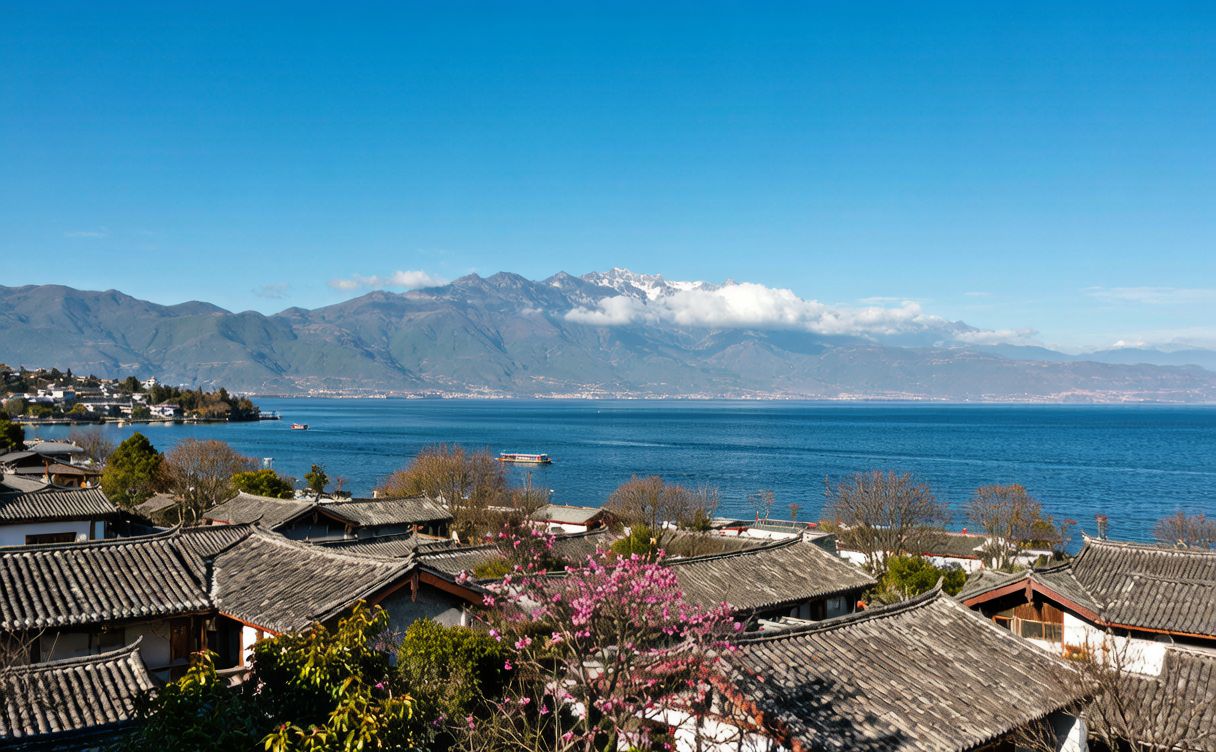
Most travelers rush through Yunnan chasing Lijiang’s crowds or Shangri-La’s altitude. They miss the one place that actually lets you exhale. Dali Yunnan sits in a bowl between the 4,000-meter Cangshan range and the mirror-flat Erhai Lake, and it moves at a pace that feels almost rebellious in modern China. I spent ten unhurried days there last spring, cycling the lake at dawn and drinking too much tea in the Old Town, and I came home convinced it’s the easiest place in the country to simply be.
This guide covers how to get there, what to do, when to go, and the Bai culture that gives the place its character. No itinerary wars. Just the good stuff.
At a glance
- Where: Northwestern Yunnan, ~340 km west of Kunming
- Best for: Slow travel, cycling, photography, café lounging, minority culture
- Top sights: Erhai Lake, Dali Old Town, Three Pagodas, Cangshan Mountain, Xizhou village
- Ideal trip length: 3–5 days
- Best season: March–May and September–November
- Getting there: High-speed train from Kunming (2 hrs) or Lijiang (1 hr)
- Vibe: Relaxed, arty, low-pressure — the anti-Beijing
Why Dali earns a spot on your Yunnan route
Dali isn’t a single town so much as a region. The tourist core is Dali Old Town (下关 is the modern transport hub nearby, but you’ll rarely go there). Spread around the western and northern shore of Erhai Lake are a string of villages — Xizhou, Shuanglang, Wase — each with its own mood. The Bai people, one of China’s 56 recognized ethnic groups, have lived here for over a thousand years, and their white-washed houses with painted door frames are everywhere you look.
What sets Dali apart is restraint. Lijiang’s old town has been polished into a shopping mall with a UNESCO plaque. Dali still has weeds in the cracks and old men playing cards in the alley. You can feel the history without being sold it.
Cycling Erhai Lake: the main event
The single best thing I did was rent an e-bike and ride the Erhai Lake ring road. The full loop is about 130 km, which is a lot for a casual day — most people do a half-loop from Dali Old Town north to Shuanglang, or the reverse. The eastern shore road hugs the water; the western shore threads through farmland and tiny hamlets.
A few practical notes from my own rides:
- Rent an e-bike, not a pedal bike, unless you’re fit and unhurried. The lake is ringed by gentle hills, and 130 km on a single gear will humble you.
- Start before 8 a.m. The light on the water is absurd, and you’ll dodge the midday tour buses.
- Shuanglang on the northeast shore is the prettiest village and a good turnaround point, with lakeside cafés built right over the water.
- Watch for wind. Dali is famously breezy — locals call it “the windy city” (风花雪月, one of their four famous scenes) — and a headwind on the return leg is no joke.
You don’t need a guide. The ring road is well-marked, and getting slightly lost just means finding a pear orchard or a grandmother drying chilies.
Dali Old Town and the Three Pagodas
The Old Town wraps the base of Cangshan and is walkable end to end in twenty minutes, though you’ll want far longer. The main drag, Bo’ai Road and Fuxing Road, are lined with cafés, guesthouses, and craft shops selling tie-dyed Bai cloth. Climb the city wall near the south gate around 6 p.m. for the best panorama of the rooftops against the peaks.
A short walk or bike ride north of the town sits the Chongsheng Temple Three Pagodas (崇圣寺三塔), Dali’s postcard. The three slender towers have stood for over 1,100 years and survived countless earthquakes — the central one leans very slightly, which only adds to the charm. Go at opening time to have the reflecting pool mostly to yourself.
If you want the living culture rather than the monuments, head to Xizhou, a village 20 km north famous for its intact Bai courtyard mansions and the morning market where farmers from surrounding villages trade mushrooms, herbs, and snacks. Try the xizhoubaba, a crispy stuffed flatbread cooked on a charcoal brazier.
Bai culture: more than a museum exhibit
The Bai aren’t a display piece — they’re the majority population in the Dali area, and their customs shape daily life. A few things worth knowing:
- Architecture: Bai homes follow a strict layout — “three rooms and one screen wall” (三坊一照壁) — with intricate woodcarving and hand-painted murals of flowers and birds.
- Tie-dye (扎染): The village of Zhoucheng, north of Xizhou, is the place to watch indigo tie-dye being made. You can try it yourself at a workshop for a few hours.
- Music: The Bai opera (白剧) and the older Nanzhao ceremonial music turn up at festivals. Even if you don’t catch a performance, the sound of the three-string lute drifting from a courtyard is pure Dali.
- Festivals: The Third Month Fair (三月街), held around April–May on the lunar calendar, is a massive traditional trade fair and horse race that’s been running for over a thousand years. Time your visit right and you’ll see Dali at full volume.
For broader context on China’s ethnic regions and how they fit into a wider trip, our China travel guide for first-timers covers the basics before you fly.
Cangshan Mountain: the backdrop you’ll want to climb
Cangshan rises sharply behind the Old Town, nineteen peaks strung north to south, each with a stream tumbling down. You don’t have to be a mountaineer. There’s a cable car from the town’s west side that delivers you to a ridge trail with sweeping lake views. The Cloud Pass (清碧溪) hike from the upper station is an easy walk to a cold mountain stream.
Bring a layer even in summer — it’s 10–15°C cooler up top, and the wind bites. If you’re serious about hiking, the full ridge trail runs for days; most visitors settle for a half-day out and back.
Getting to Dali: from Kunming and Lijiang
Dali is one of the easiest Yunnan destinations to reach by rail. The high-speed train from Kunming to Dali takes about two hours and costs a fraction of a flight, and the line from Lijiang runs in roughly an hour. Both arrive at Dali Station, a short taxi or bus ride from the Old Town.
If you’re planning the classic Yunnan loop — Kunming → Dali → Lijiang → Shangri-La — book your seats early, especially for holiday periods. Seats sell out. Our guide on how to book China train tickets on 12306 walks through the foreigner-friendly steps, and the broader China high-speed train guide for foreigners explains what to expect on board.
A few things worth knowing before you go, regardless of route: review our things to know before visiting China so the practical stuff doesn’t sneak up on you.
When to go (and when to skip)
Dali’s weather is gentler than most of Yunnan. Spring (March–May) brings wildflowers up the mountain and the Third Month Fair. Autumn (September–November) is the most reliably clear, with crisp light over the lake. Summer is green and warm but rainy, and the July–August holidays pack the town. Winter is cold and quiet — good for solitude, less good for swimming or long rides.
The one constant is wind, so pack a shell jacket no matter the season.
Where to stay and eat
The Old Town has the densest choice of guesthouses, from bare-bones backpacker dorms to design hotels behind hundred-year-old Bai walls. If you want lake views, Shuanglang on the east shore has the photogenic over-water hotels, though they cost more and fill fast.
Food leans local: Erkuai (a chewy rice cake, grilled or stir-fried), rushan (a stretched, grilled cheese sheet the Bai make from cow’s milk — yes, Yunnan has cheese), and the ever-present cross-bridge rice noodles. Vegetarians do well here; the Bai cook a lot of wild mushrooms and ferns in season.
A note on respect and context
Dali is part of Yunnan Province in southwest China, and the Bai culture here is one thread in the country’s broader ethnic fabric. Nearby regions like Tibet, China and Xinjiang, China are sometimes lumped into “western China” travel talk, but they’re distinct destinations with their own rules, permits, and seasons — plan them separately. Hong Kong, China and Macau, China, by contrast, run on different visa and currency systems despite being part of the country, so check entry requirements if you’re adding them on.
External reference
For official background on the area’s heritage, UNESCO’s overview of the nearby Old Town of Lijiang and the broader region is a useful read: https://whc.unesco.org/en/list/811
Dali rewards the traveler who slows down. Rent the bike, skip the checklist, and let the lake set the schedule. After the speed of China’s megacities, that might be the most foreign thing about it.
Written by Karl.