

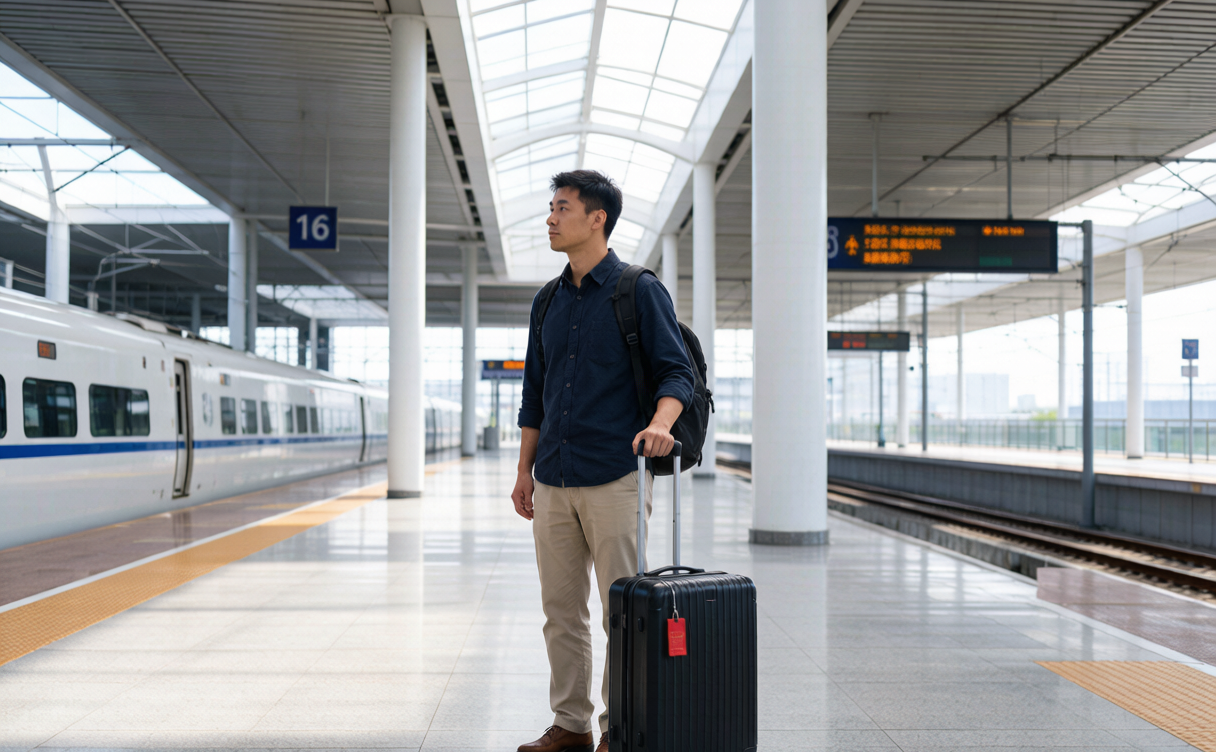
Scope of this page: This guide covers one subject — the practical reality of riding China’s high-speed trains as a foreigner: passport verification, station security and boarding, the on-board experience, and how to pay along the way. It does not walk through the booking app step by step; for that, use the main 12306 booking guide for 2026. China’s bullet trains are fast, punctual, and inexpensive, but the system was not built with foreign passports in mind — the sections below focus on what happens after the ticket exists. All figures are as of Nov 2026.

Key Takeaways
– Book through the official 12306 app (now in English) or Trip.com; both accept foreign passports and international cards.
– Always carry the exact passport you used to buy the ticket — China trains use real-name verification at every gate.
– Arrive 30–45 minutes early; security is airport-style and gates close 3–5 minutes before departure.
– You can change (改签) or refund tickets in the app, but fees climb as departure nears — act early.
– There is no free onboard WiFi; download shows beforehand and keep luggage within 20 kg per adult.
Which Passport Checks Will I Face?
You will face a real-name check at every gate, and the exact passport used to buy the ticket is the only document that clears it. China’s railway system ties each seat to the identity document entered at purchase, so a booking made with a passport number must be matched by that same physical passport at the station.
| Checkpoint | What is verified (unit / document) | Accepted proof (as of Nov 2026) |
|---|---|---|
| Station entry gate | Real-name match against the ticket | The physical passport used for booking |
| Platform boarding gate | Real-name match, repeated | Same passport; gates close 3–5 minutes before departure |
| Hotel check-in | Police registration of a foreign passport | Passport; every hotel and hostel registers guests |
| Transit desk / border check | Identity and onward route | The same passport, carried in hand at the border desk |
Can I use a photo of my passport at the gate?
No. Keep the passport in hand: a photo on your phone will not open the gate. A screenshot of the ticket QR code is useful as a backup when the app buffers, but it does not replace the document itself.
Booking channels matter here only insofar as they affect the name in the system. 12306 (www.12306.cn) is the state railway operator’s own platform and the only source of every seat on every train; in 2024 the app added a full English interface and you can register with a foreign passport number. Trip.com, the international arm of Ctrip, shows the same trains and adds a small service fee (usually ¥15–¥30 per ticket). The detailed registration and search steps belong in the main booking guide — what matters on the day is that the name on your screen matches your passport exactly.
New to China entirely? Our China travel guide for first-timers covers visas, SIM cards, and city-hopping in one place.
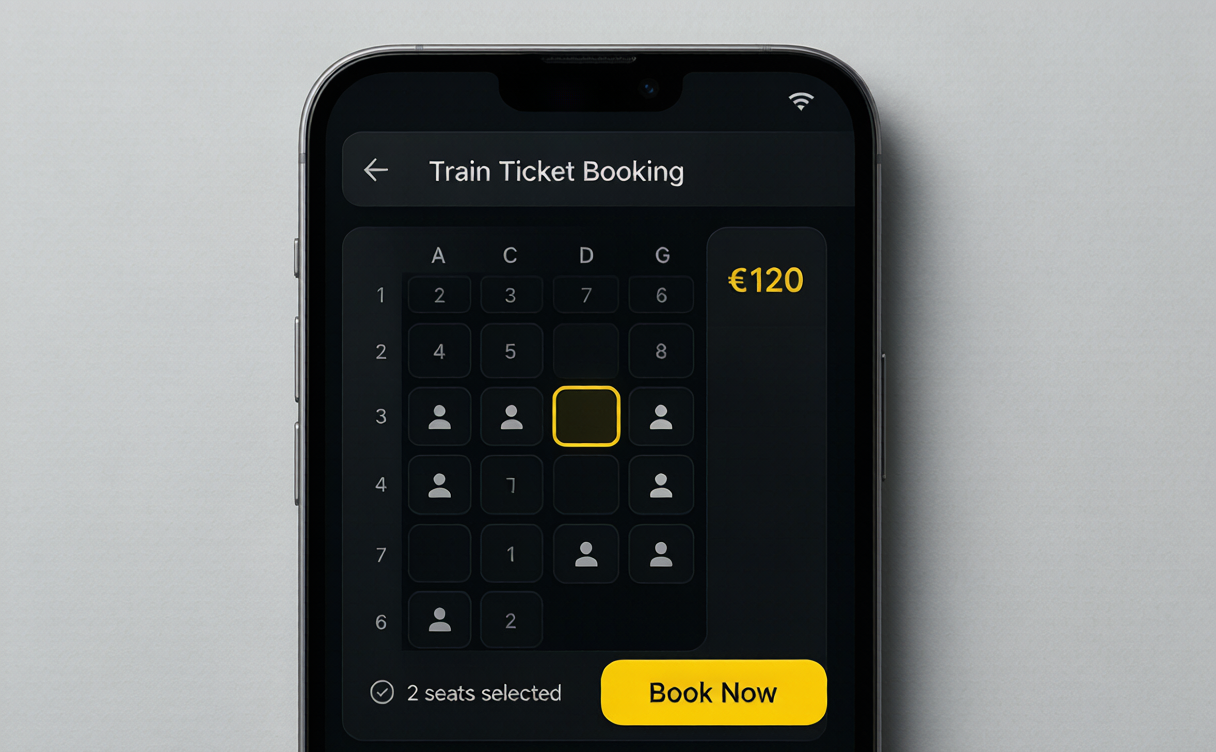
Want the zero-stress option? Book your first China train on Trip.com — no app verification, instant confirmation, and English support if something goes wrong.
At the Station: Security and Boarding
Treat a Chinese train station like a small airport. Security is airport-style: liquids under 100 ml are fine, but sharp objects and obvious weapons are out. You scan your passport at the entry gate (real-name check) and again at the platform gate. Gates close 3–5 minutes before departure — there is no “just made it” grace period.
A typical near-miss looks like this: a traveler arrives at Shanghai Hongqiao just 18 minutes before a train to Hangzhou, clears security, cannot find the gate, and watches the display flip to “Boarding” with two minutes left. The gate is already closed; the replacement is a same-day standby ticket costing 40 minutes and ¥73. Plan to be inside the station 45 minutes early during holidays and 30 minutes off-peak.
On Board: Seats, Food, Luggage and Connectivity
Chinese high-speed trains are labeled G, D, and C. G-trains (gaosu) are the fastest, hitting 300–350 km/h on dedicated tracks; D-trains are slightly slower but cover more routes; C-trains are short-haul commuter bullets around big cities. For a first trip, G is the sweet spot.
What is the difference between seat classes?
Second class is the standard 3-2 layout, first class is a wider 2-2 layout, and business class offers lie-flat pods with meals — a splurge, not a necessity. The Beijing–Shanghai fares below are unchanged from the published figures.
| Class | Approx. price (Beijing–Shanghai) | Notes |
|---|---|---|
| Second class (二等座) | ¥553 | Standard 3-2 layout. Comfortable, cheap, and what most travelers book. |
| First class (一等座) | ¥933 | Wider 2-2 seats, quieter cars. |
| Business class (商务座) | ¥1,743 | Lie-flat pods with meals — a splurge, not a necessity. |
On the seat map, window seats face the direction of travel on one side; if you get motion sick, pick a forward-facing window. Trains run on the right-hand track, so the south- or west-facing side often has better light — minor, but it matters on a four-hour ride.
Is there WiFi on board?
No free WiFi. Some G-trains advertise 5G coverage, but it is patchy at best. Sort out mobile data — an eSIM or a roaming plan — or download shows and offline maps before you board; a six-hour Chengdu–Beijing ride with a dead phone is a long one.
What can I eat on board?
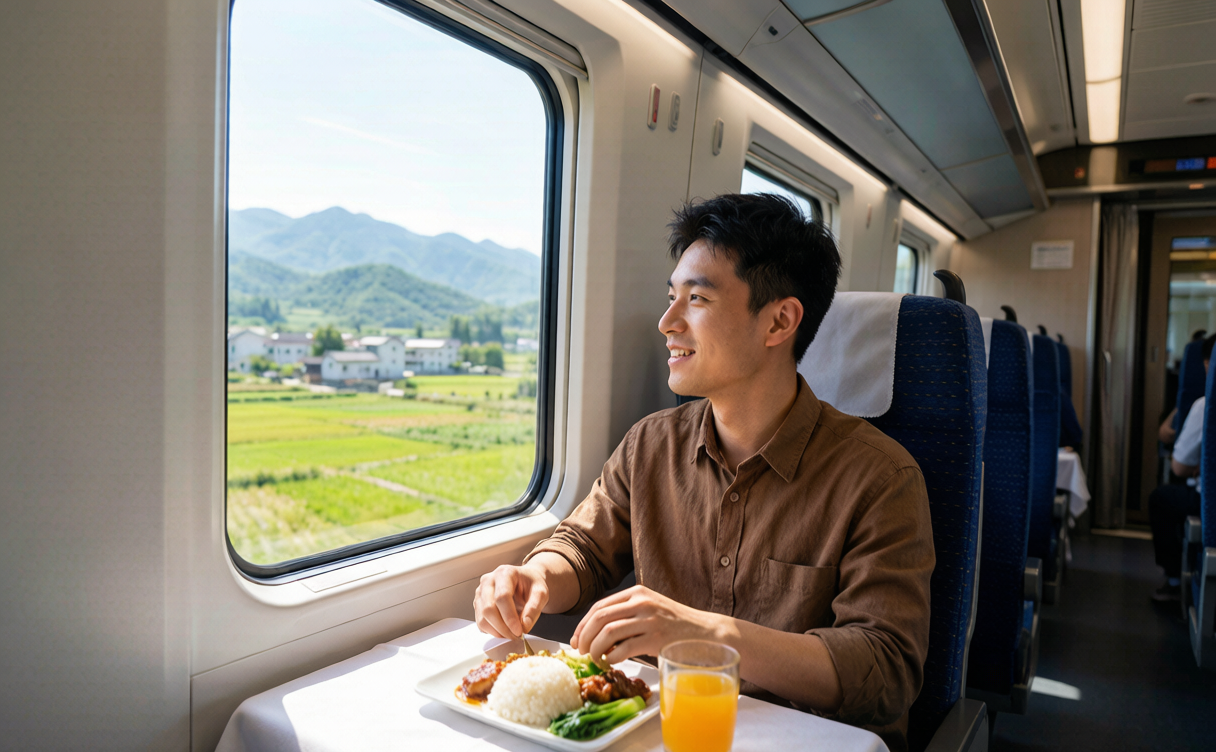
Each train has a dining car and a snack trolley. Hot meals (¥25–¥45) include rice sets, noodles, and the occasional KFC or local chain option at major stations, deliverable to your seat if ordered on the 12306 app before departure. Bringing your own food is completely normal — a jianbing (煎饼) or a sandwich from the station works well.
The luggage allowance is 20 kg per adult, with a longest-side limit of 130 cm. In practice, nobody weighs your bag; the overhead racks fit a 24-inch suitcase, and larger cases go at the carriage ends. Just do not block the aisle.
How Do You Pay Along the Way?
Payment splits into two moments: buying the ticket and spending money at the station or on board. The table separates them; amounts and card support are as of Nov 2026.
| Payment moment | Accepted methods (as of Nov 2026) | Cost / fee (currency) |
|---|---|---|
| Inside the 12306 app | Visa, Mastercard, UnionPay (supported as of 2025) | Ticket fare only |
| Through Trip.com | PayPal, Visa, Mastercard | Service fee ¥15–¥30 per ticket |
| Station snacks, taxis, local purchases | Alipay or WeChat Pay | Retail prices; set up before travel |
| On-board hot meals | Order in the 12306 app before departure for seat delivery | ¥25–¥45 per meal |
You will still need a payment app for station snacks and taxis, so read up on Alipay and WeChat Pay for foreigners before you travel. If you are in China on a layover, the 144-hour visa-free transit policy lets you ride bullet trains between approved cities without a visa — a good reason to get the passport-and-payment routine right.
When Plans Change: Refunds and Changes
Plans change, and the system handles it — for a price. Refunds (退票) are free if you cancel more than 8 days ahead; between 48 hours and 8 days, you lose 5%; within 48 hours, the fee rises to 10–20%. Changes (改签) let you switch to another train on the same route once, free if the new ticket is equal or cheaper, or for the difference plus a small fee if it is pricier. You cannot change origin or destination — that requires a refund and rebooking.
Both actions happen in the 12306 app or Trip.com under “Orders.” Note the cutoff: 12306 sells and changes tickets from 5:00 to 1:00 the next day (closing 23:30 on Tuesdays), so do not count on a 3 a.m. rebook. For the exact button-by-button steps, return to the main 12306 booking guide.
Practical Tips for a Smooth Ride
The best time to visit China affects train crowds as much as weather. Spring (April–May) and autumn (September–October) bring blue skies and manageable stations; avoid the Spring Festival (usually January–February) and National Day (early October), when hundreds of millions of trips cram the network and tickets vanish in seconds.
- Screenshot your ticket QR in case the app buffers at the gate.
- Bring a power bank — not every seat has a working outlet.
- Save a translation phrase like “I’m at car 07, seat F” before you lose signal.
- Keep the passport out of checked luggage — it is needed at both gates.
FAQ: Riding With a Foreign Passport
Will my foreign passport work at the gates? Yes, provided it is the same document used to buy the ticket and the name matches exactly. Real-name verification runs at both the station entry gate and the platform gate.
How early should I arrive? 30–45 minutes: 45 during holidays, 30 off-peak. Gates close 3–5 minutes before departure with no grace period.
Can I bring my own food? Yes. Hot meals cost ¥25–¥45, but bringing a jianbing or sandwich from the station is completely normal.
Is there a luggage limit? 20 kg per adult, with a longest-side limit of 130 cm; overhead racks fit a 24-inch suitcase.
Ready to ride? Start by installing the 12306 app or opening Trip.com, and book your first route this week. Trains sell out fast around holidays — lock in your dates early and travel light. Do that, and you will go from panic at the gate to watching the countryside blur by at 300 km/h — no Chinese needed.
Written by Karl — a guide to China’s high-speed rail experience for foreign travelers. Questions? The comments are open.