

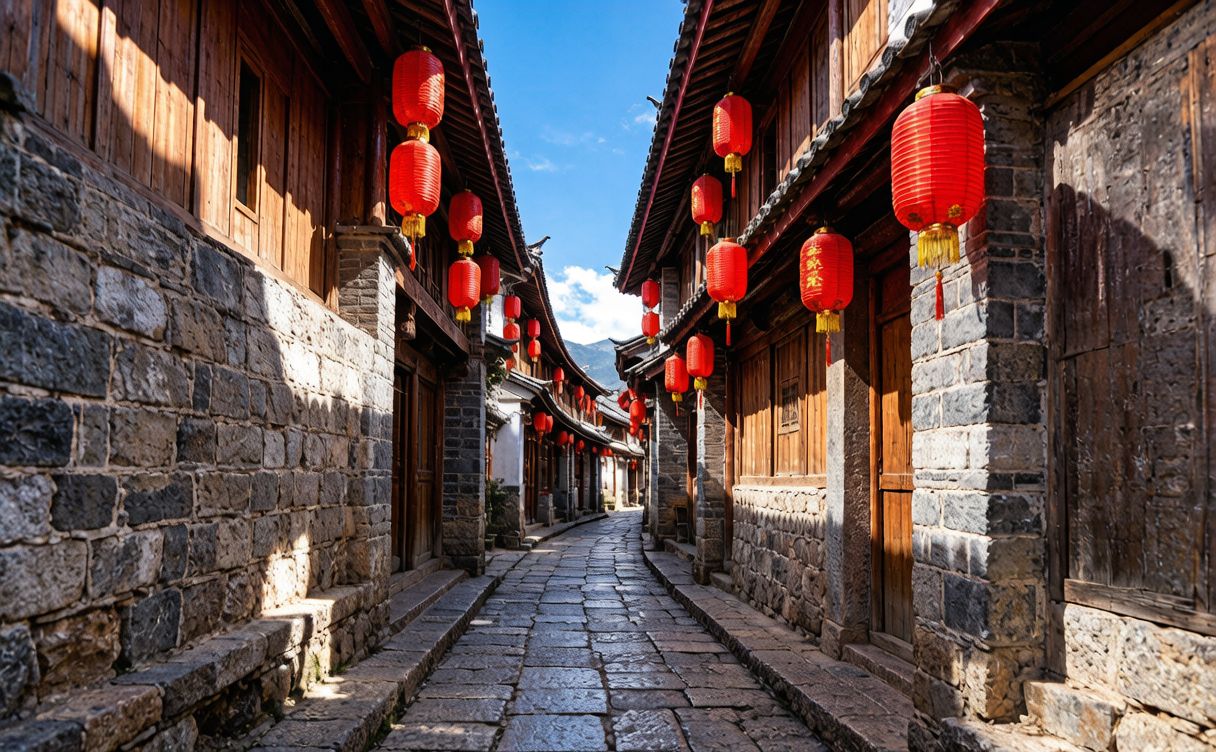
The night I finally understood Lijiang Old Town, I was sitting on a stone slab beside a trickling canal, watching steam rise off a bowl of yak-meat noodles, with the snow peak of Jade Dragon lit silver by a half moon behind the rooftops. No cars, no horns — just the wooden creak of a shop sign and the murmur of Naxi grandmothers chatting in a language I couldn’t place. Lijiang is one of those rare UNESCO towns that still breathes: a maze of cobbled lanes, running water, and timber houses where a living culture, not a costume, carries the place. This is the guide I wish I’d had — how to get there, what the Naxi actually preserve, the cable car up the mountain, and the gorge that starts right at its edge.
At a Glance
- Where: Northwestern Yunnan, China, about 2,400 m (7,900 ft) above sea level.
- Best for: Historic old town, Naxi minority culture, Dongba script, snow-mountain scenery, trekking gateway.
- Getting there: Flight to Lijiang Sanyi Airport (LJG), or high-speed train from Kunming/Dali.
- Top sight nearby: Jade Dragon Snow Mountain (Yulong Xueshan) and its Glacier Park cable car.
- Day trip: Tiger Leaping Gorge, one of the world’s deepest river gorges.
- Watch out for: Altitude — take the first day slow.
Why Lijiang Old Town Matters
Lijiang is not one town but three old quarters stacked together: Dayan (the main “Old Town” most visitors mean), the quieter Baisha to the north, and the water-fed Shuhe to the west. Together they form the UNESCO-listed Old Town of Lijiang, honored for a townscape laid out around a working system of streams and canals that still supplies every household. You can read the official listing and its conservation notes on the UNESCO World Heritage Centre.
What sets it apart from many “ancient towns” in China is the Naxi people. The Naxi are a Tibeto-Burman ethnic group who built Lijiang into a trading hub where the Tea Horse Road met the caravan routes heading toward Tibet, China and beyond. Their heritage is visible everywhere — in the heavy waistedong timber houses, in the mu (木) clan architecture, and most remarkably in Dongba, a pictographic writing system still used by shamans and now taught to curious visitors in small museums and workshops.
Getting to Lijiang
Lijiang is far easier to reach than its mountain setting suggests.
- Flight: Lijiang Sanyi International Airport (LJG) has direct flights from major hubs including Beijing, Shanghai, Guangzhou, Chengdu, and Kunming, plus frequent hops from Kunming. The airport is about 30–40 minutes from the old town by car.
- Train: The high-speed line now links Kunming to Lijiang in roughly 3–3.5 hours, and Dali to Lijiang in about 2–2.5 hours. This is the relaxed, scenic way in if you’re already touring Yunnan. Our China high-speed train guide for foreigners walks through booking and the QR-based entry at stations.
- From Dali or Kunming by road: Buses and private drivers run both routes; the Dali–Lijiang drive along the Erhai and through mountain passes is genuinely pretty if you have time.
My advice: fly into Kunming or Dali first, spend a day or two there to let your body adjust to altitude gradually, then take the train up to Lijiang. Coming straight from sea level to 2,400 m in one afternoon is the classic mistake that leaves people breathless on the old town’s stairs. For the wider seasonal picture, our best time to visit China guide maps out when Yunnan’s light and weather are at their kindest.
Walking the Old Town
Dayan is a web of lanes, and the only real plan is to abandon the plan. Start at the central Square Street (Sifangjie), then drift. Within ten minutes you’ll find canals running under your feet, bridges every few steps, and courtyards where old women weave or sun-dry chilies.
Must-sees inside the maze
- Mu Palace (Mufu): The fortified residence of the Mu clan who ruled Lijiang for centuries. Climb the hill behind it for the best rooftop panorama of the town against the mountain.
- Black Dragon Pool (Heilongtan): A short walk north of Dayan; on a clear morning the reflection of Jade Dragon in the pond is the postcard shot. Go early — the mountain clouds in by late morning.
- Baisha village: Quieter, older, and home to 500-year-old Tibetan-style murals painted when the Naxi court fused Han, Tibetan, and local styles. This is where to feel the town before the tour groups arrived.
- Shuhe: A smaller old town west of Dayan with the same canal bones but fewer souvenir stalls — good for a slow coffee and a walk.
Naxi culture and Dongba script
Don’t leave without seeing Dongba. The script is one of the last living pictographic writing systems on earth — each character is a small drawing, and a trained Dongba priest can “read” a page of them aloud. The Dongba Culture Museum near Black Dragon Pool explains the cosmology; small workshops in Baisha let you try brushing a character onto paper. I paid about ¥30 to write my own name in pictographs and still have it pinned above my desk.
The Naxi also have an unusual social history worth knowing: their traditional mosuo cousins to the north practiced matrilineal households, and Lijiang’s own music tradition — the Naxi Orchestral Music, said to preserve Song-dynasty tunes — is performed live in a few teahouses most evenings. Sit for one set; the slow, reedy ensemble is nothing like the bar street below.
Jade Dragon Snow Mountain & the Cable Car
This is the reason many people come, and it delivers. Jade Dragon (Yulong Xueshan) is a row of glaciated peaks, the highest around 5,596 m (18,360 ft), permanently snow-capped and sacred to the Naxi as the seat of their protective spirit.
The easy win is the Glacier Park cable car, which climbs from about 3,350 m to roughly 4,506 m near the snow line in around 15 minutes. At the top you step onto a boardwalk with close views of the glacier and the razor ridge behind it. Two practical truths:
- Altitude is real up there. At 4,500 m most people feel it — light chest tightness, a pounding heart on the stairs. Walk slowly, skip the running, and consider oxygen canisters (sold at the base and mid-station) if you’re prone to it.
- Book ahead and go early. The cable car caps daily ridership and sells out in peak season; buses leave from a tourist center south of town. Mornings also give you the clearest mountain before clouds build.
Below the peak, the Blue Moon Valley (a series of turquoise limestone pools fed by meltwater) and the Impressions Lijiang open-air show directed by Zhang Yimou are easy add-ons.
Tiger Leaping Gorge Day Trip
One of Lijiang’s best-kept open secrets is that the Tiger Leaping Gorge (Hutiaooxia) starts about 1.5–2 hours away by road, and it’s one of the deepest river gorges on the planet — the Jinsha (upper Yangtze) squeezed between Jade Dragon and Haba Snow Mountain, a vertical drop of more than 3,000 m.
You have two ways in:
- The upper trail (easy): A paved path and viewing platforms at the river’s narrowest point, where legend says a tiger leapt the roaring gap on a rock. Buses and tour vans reach it directly — fine for a half-day.
- The high trail (the classic trek): A two-day hike along the cliffside with guesthouses (Halfway, Tea Horse Guesthouse, etc.) perched over the gorge. Strenuous but spectacular, and doable independently if you’re fit.
I did the high trail over two days in spring and it remains the best walk of my China travels — the first morning’s view back at Jade Dragon over a sea of cloud is worth every aching calf. Pack layers; even in summer the gorge wind is cold. Our China packing list for first-timers has the layering and footwear notes that matter at altitude.
When to Visit & Altitude Awareness
Lijiang sits at a comfortable-ish 2,400 m, cooler and drier than most of China. The sweet windows:
- Spring (March–May): Wildflowers, clear peaks, fewer crowds. My favorite.
- Autumn (September–November): Blue skies, golden light, crisp nights.
- Summer (June–August): Lush and green but rainy; afternoon thunderstorms are common and the mountain clouds in.
- Winter: Cold but often brilliantly clear, with the best chance of an unobstructed snow peak — just pack real warmth.
Altitude is the one thing to respect wherever you go around here. Spend your first Lijiang day flat and easy, drink more water than feels necessary, ease off alcohol for the first night, and don’t plan the gorge trek or the cable car for day one. If you feel a genuine headache with nausea up high, descend — it works. General habits for staying well on the road are in our China travel safety tips.
Practical Notes
A few things I now never skip in Lijiang:
- Stay inside or next to the old town if you can — Shuhe is quieter and still walkable to Dayan by bus. Luggage on the cobbles is a workout, so pack light.
- Cash is handy for small stalls and guesthouses in the gorge, though Alipay and WeChat Pay work in town.
- Get online before you arrive. Google Maps and Western apps don’t run cleanly in China, so sort a SIM or eSIM and a VPN-friendly setup in advance, or you’ll be navigating the lanes truly blind.
- Sun and wind protection. At altitude the UV is fierce and the mountain air is dry; sunscreen, lip balm, and a refillable bottle earn their place.
The Bottom Line
Lijiang rewards the traveler who slows down. Base yourself in the old town, give the canals and the Naxi a real day, ride the cable car up Jade Dragon early, and let Tiger Leaping Gorge be your big walk. Respect the altitude, learn one Dongba character, and watch the moon come up behind the snow. Do that, and Lijiang hands you one of the most complete old-China experiences left — equal parts living town, mountain shrine, and trailhead.
Written by Karl — last updated July 2026. Karl has spent three years helping foreign visitors plan low-stress trips across China, including multiple Yunnan loops through Lijiang, Dali, and the Tiger Leaping Gorge trail.