

When my wife and I first dragged our then-four-year-old across Beijing in the middle of a hot May, I was convinced we were making a mistake. Twelve days, three cities, one stroller that eventually gave up on the Forbidden City’s flagstones. We came home with a kid who could say “ni hao” to every stranger and parents who had learned more about travelling with children in China in two weeks than in a decade of solo trips. This guide is everything I wish someone had handed me before that first flight.
China is, frankly, a fantastic place to travel with kids. It is safe, the food is cheap, high-speed trains make the distances painless, and locals adore foreign children in a way that opens doors you did not know were closed. But it is also huge, confusing, and built for adults who do not need naps. Here is how to make it work for your family.
The Three Cities That Just Work
I have taken kids to a dozen Chinese cities now. If you only have ten to fourteen days and want minimal stress, build your trip around Beijing, Chengdu, and Guilin. Each one is different, each one is easy, and together they show your children three very different versions of China.
Beijing: history you can climb on
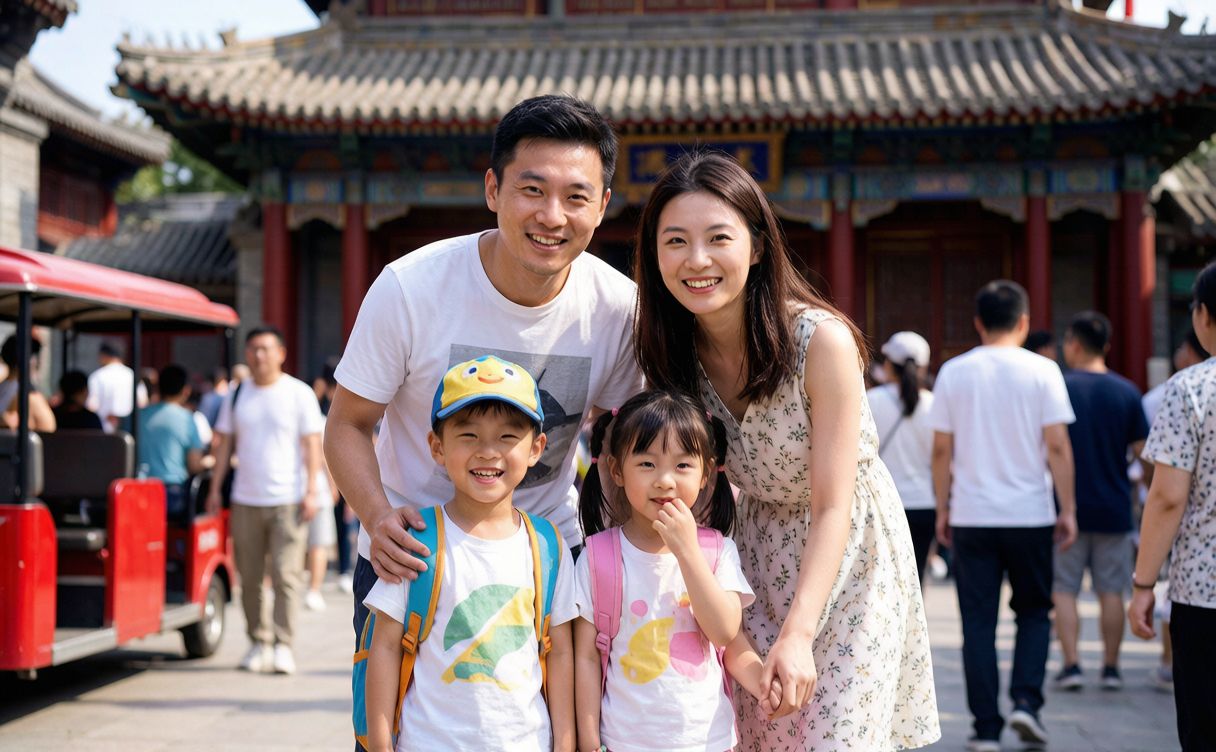
Beijing is the obvious start, and for good reason. The Forbidden City is enormous and overwhelming for small legs, so do not try to see all of it. We entered through the Meridian Gate, walked straight to the inner courtyards, and bailed out via the north gate in about ninety minutes. Our son remembers the giant bronze lions more than the emperors. Pair it with a half-day on the Great Wall at Mutianyu — the cable car up and toboggan down were, no exaggeration, the highlight of the entire trip for a five-year-old.
If you want a calmer day, the Summer Palace and Beihai Park have wide paths, boats, and room to run. For planning the classics without overpacking your schedule, my Beijing 3-Day Itinerary keeps the pacing realistic for families.
Chengdu: pandas, and then more pandas
Chengdu is the easiest city in China with a toddler. It is flat, the food can be mild, and the headline attraction is an animal that children universally love. The Chengdu Research Base of Giant Panda Breeding is brilliant but crowded and best at opening time (7:30 am) before the heat and the school groups. For a calmer, more open-air panda experience, Dujiangyan Panda Base, an hour out of town, lets you see the bears with fewer crowds and actual trees. The dedicated Chengdu Dujiangyan Panda Base page has the ticket and transport specifics.
Guilin and Yangshuo: scenery that explains itself
You do not need to explain karst mountains to a child. They just look cool. The Li River cruise from Guilin to Yangshuo is a slow, seated, air-conditioned boat ride — perfect for a napping preschooler — and the karst peaks do the entertaining. In Yangshuo, rent bikes with a child seat, walk the rice-field paths, and let them poke at water buffalo. My full breakdown is in the Guilin Yangshuo Travel Guide.
Strollers, Lifts, and the Art of the Carrier
This is the single biggest practical question, so let me be blunt. China’s cities are stroller-friendly at street level and stroller-hostile at tourist level. Metro stations almost all have elevators now, but finding them can mean walking to the far end of the platform — follow the blue wheelchair symbol. Shopping malls, airports, and train stations are excellent.
The problem is the attractions. The Great Wall has steps. The Forbidden City has cobbles. Ancient towns have slippery stone. We travelled with a lightweight umbrella stroller and a framed hiking carrier, and swapped depending on the day. Under two, I would skip the stroller for wall-and-palace days entirely and use the carrier. Over three, the stroller became dead weight by mid-afternoon and went back to the hotel.
One trick that saved us: Chinese hotels and even some museums will store a folded stroller at the front desk while you do the steps. Do not haul it up the Wall.
Child Tickets, Ages, and the Height Rule
China runs on height, not age, for almost everything kid-related. The universal cut-off is 1.2 metres (about 3’11”). Under that, most trains, buses, and attractions are free or heavily discounted. Between 1.2 and 1.5 metres, you usually pay about half. Over 1.5 metres, full price.
On high-speed trains, children under 1.2 m travel free if they share your seat, but you still must register them when booking — a common beginner mistake that causes platform panics. For the trains themselves, the China High-Speed Train Guide for Foreigners walks through booking with kids step by step.
Bring your child’s passport everywhere. Unlike at home, you cannot bluff a free ticket — the height check at the gate is routine and they will measure.
Feeding Picky Eaters (Without Living on McDonald’s)
Yes, there is McDonald’s and KFC on every corner, and yes, we used them as a safety net. But you do not have to. The Chinese breakfast culture is genuinely kid-friendly: congee (rice porridge), steamed buns, soy milk, and egg pancakes are mild, soft, and cheap. A bowl of plain noodles in broth — ask for “qingtang,” clear soup, no chili — is a universal child pleaser.
Hotpot and mapo tofu can wait until the teenagers. For Chengdu specifically, tell servers “bu la, xie xie” (not spicy, thank you) and they will oblige. Fruit is abundant and safe to eat peeled; we went through kilos of mandarins and bananas. Convenience stores (FamilyMart, 7-Eleven, Lawson) stock yogurt drinks and crackers that beat airport snacks.
One health note: tap water is not for drinking. Bottled water is everywhere and cheap. We carried a reusable bottle and refilled from bought bottles.
Best Season to Go
Avoid Chinese school holidays like the plague — the two worst windows are the week around National Day (early October) and the Chinese New Year spring festival (late January or February, dates move). Every attraction becomes a shoulder-to-shoulder crush. The Best Time to Visit China guide maps the climate and crowd calendar region by region.
For families, I rate April to May and September to early October (before the holiday) as the sweet spots. Spring in Beijing means blossoms and manageable heat; autumn in Guilin is clear and golden. Summers are hot and crowded but the kids are out of school at home, so if you must go in July or August, lean north (Beijing, Harbin) or up a mountain, and start sightseeing at 8 am.
Health, Safety, and the Stuff Parents Actually Worry About
Let me put the big fear to rest first: China is one of the safest countries I have travelled with children. Violent crime against tourists is rare, and the bigger risks are the mundane ones — heat, crowds, and stomach bugs.
Carry a small medical kit: rehydration salts (easily found in any pharmacy, ask for ” oral rehydration”), children’s ibuprofen in a formula you recognize, band-aids, and hand sanitiser. Pharmacies are everywhere but English is limited, so learn the Chinese names or use a translation app.
Crowd control is the real skill. At popular sites, hold hands constantly and pick a meeting point in case you are separated — and photograph your child that morning so you have a current outfit reference. We gave our son a card with our hotel name and phone number in Chinese characters; it was used once when he wandered two metres and a kindly grandmother “rescued” him.
For the broader picture, including air quality, scams, and emergency numbers, my China Travel Safety Tips covers what families specifically need to know.
For official, up-to-date health guidance before any international trip, I always check the U.S. Centers for Disease Control and Prevention’s China page: CDC — China Travel Health Notices. Pack any prescription meds in your carry-on and bring more than you think you need.
A Few Karl-isms Before You Book
- Slow down. One big sight a day, not three. The best family memories in China came from an unplanned hour feeding koi in a temple pond, not from ticking boxes.
- Apartments over hotel rooms. For stays of four nights plus, a serviced apartment with a washer means you pack half the clothes. Look for family listings near a metro line.
- Download before you fly. Maps, translation, and your train tickets need an app that works in China — sort this at home, because app stores behave differently once you land.
- Embrace the attention. Strangers will want photos with your blonde toddler. It is friendly, not threatening. A smile and a polite no works if you are tired of it.
China with kids is not harder than Europe or Southeast Asia — it is just different, and the differences are learnable. Plan loosely, pack light, and let the pandas and the mountains do the heavy lifting. Your children will remember it for the rest of their lives, and so will you.
Ready to build your family route? Grab my full Beijing plan and start with the easy wins.
Worried about trains, tickets, and child fares? I wrote the guide I wish I’d had.
Still deciding when to go? Let the crowd calendar decide for you.