

I’ll be honest with you: when my friend Daniel — a wheelchair user from Manchester — first asked me to help plan his three-week trip to China, I hesitated. China wasn’t on most accessibility lists back then, and I’d seen enough uneven pavements and step-heavy temples to worry. But we went anyway, and what we found surprised both of us. China in 2026 is not perfect for wheelchair travellers, but it is far more navigable than its reputation suggests — if you know where to push and where to pause.
This is a first-hand, no-spin guide based on Daniel’s trip across Beijing, Shanghai and Guilin, plus the lessons I’ve picked up escorting other travellers with mobility needs. I’ll cover airports, trains, metro, hotels, specific attractions, and the workarounds that actually matter.
The big shift: China got serious about access
China passed accessibility standards decades ago, but enforcement was patchy. What changed everything is the wave of new infrastructure built for the 2008 Beijing Olympics, the 2010 Shanghai Expo, and the ongoing high-speed rail boom. Nearly every station, airport and metro line built or renovated in the last fifteen years has elevators, tactile paving and wheelchair-accessible toilets.
The catch: older sites — and there are many — were not retrofitted. So your experience swings between “better than Europe” and “genuinely impossible” depending on where you go. The trick is choosing the right places and booking the right support.
Airports: the easy part
Chinese airports are genuinely good for wheelchair travellers, and they’re accustomed to assisting. At Beijing Capital (PEK) and Shanghai Pudong (PVG), you can request a wheelchair through your airline when booking, and a staff member will meet you at the gate with a chair (or help you to your own), and push you through immigration, baggage and customs. We did this at PEK and Daniel never stood in a single queue.
Key tips from our experience:
– Book the wheelchair assistance 48 hours ahead through the airline, not at check-in. Chinese carriers (Air China, China Eastern, China Southern) are reliable; international carriers flying into China are too.
– Arrive earlier than usual. Assistance is free but can be slow during peak hours.
– Domestic terminals are just as accessible as international ones — don’t fear internal flights.
– Accessible toilets are clearly signed in both terminals we used, with grab bars and enough space.
One honest gripe: older regional airports outside the big hubs have narrow pathways and hard-to-find lifts. Stick to major hubs and you’ll be fine.
High-speed trains: book the right seat
This is where planning pays off. China’s high-speed rail (CRH) is world-class and almost entirely step-free at major stations — platforms are level with the train floor, and every big station has elevators from street to platform. We took the Beijing–Shanghai line (G-trains, ~4.5 hours) and the Beijing–Guilin routed connection.
How to do it right:
– Use the official 12306 system or a trusted guide like our China High-Speed Train Guide for Foreigners to understand booking.
– Request the priority seat (优先) when buying. On the train app you can add a note, but the surest method is to call 12306 (then press 1 for English) or ask a ticketing counter. Staff will seat you near the accessible toilet and help with boarding ramps.
– Boarding: station “red cap” (小红帽) porters in red uniforms will push you to the platform and bridge any gap. Tip is not expected but a thank-you goes far.
– Sleeper trains (普通火车) are harder — narrow corridors, high bunks. Avoid them for wheelchair travel.
– Carry a printed copy of your passport and ticket; station staff may need to verify manually.
Daniel’s verdict: trains were the least stressful part of the whole trip. The level boarding alone made him grin.
Metro: elevators exist, but hunt for them
City metros are accessible in theory and mostly in practice. Beijing and Shanghai metros have elevators at nearly every station now — but they’re often tucked at a side entrance, not the main one. Google-level signage is rare; look for the blue wheelchair symbol on station maps posted at each entrance, or just ask a guard (“电梯在哪?” — diàntī zài nǎ?).
Practical notes:
– Shanghai’s Line 2 (airport to city) and Beijing’s Airport Express are fully step-free.
– Rush hour (7:30–9:30, 17:30–19:30) is brutal. Trains pack shoulder-to-shoulder; a wheelchair simply won’t fit comfortably. Travel off-peak.
– Some older lines in secondary cities have lifts at only select stations. Plan your route before you leave the hotel.
– Buses are a no-go — kneeling buses are rare and drivers won’t wait.
When in doubt, use Didi. Standard cars won’t fit a folded chair easily, but book a Didi Premier or 7-seat vehicle and drivers will help stow it.
Hotels: ask the right questions
International-chain hotels in China — Hilton, Marriott, Shangri-La, Kempinski — almost always have roll-in showers, grab bars and step-free entrances. The problem is the boutique and older “character” hotels, which often have lobby steps and tiny bathrooms.
What worked for us:
– In Beijing and Shanghai, we booked international chains and confirmed “wheelchair accessible room with roll-in shower” by email, not just the booking site checkbox. A follow-up call sealed it.
– Our Where to Stay in Shanghai guide lists districts; Pudong and the Bund area have the most modern, accessible stock.
– In Chengdu, the options were excellent too — see our Best Hotels in Chengdu picks, several of which Daniel’s group used on a later trip.
– Avoid “courtyard” and “hutong” guesthouses. Charming, but stepped entrances and threshold rails make them impractical.
Always send a photo request of the bathroom to the hotel before you arrive. If they can’t provide one, assume it’s not accessible.
Beijing: what’s easy, what’s not
Beijing mixes the very accessible with the very not. Here’s the honest breakdown from Daniel’s visit.
Easy wins:
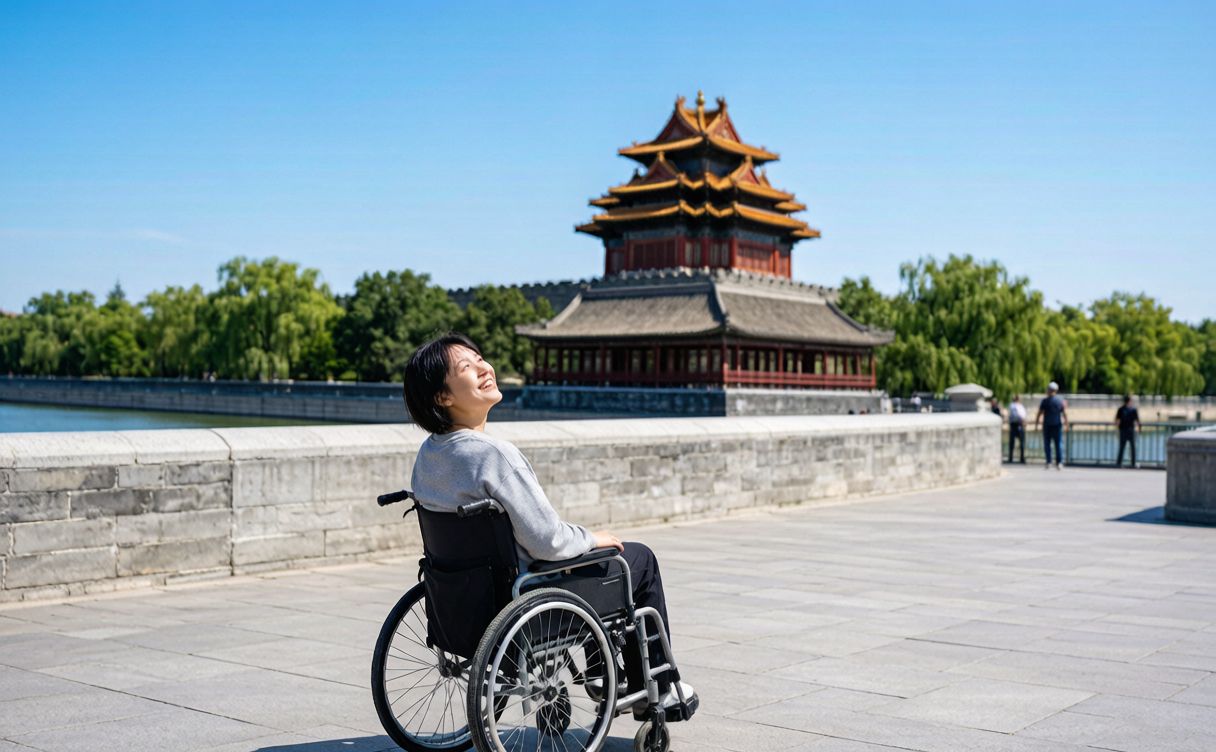
– The Forbidden City has a step-free route — enter via the accessible gate, and most of the vast plaza and main halls have ramps or level paths. The sheer scale means long distances, so rent the electric cart they offer, or bring a power assist.
– Tiananmen Square and the surrounding boulevards are flat and broad — effortless pushing.
– The Summer Palace has accessible paths along the lakeside, though the hill pavilions are stepped.
– Beijing Capital Airport and the Airport Express — covered above.
– Our Beijing 3-Day Itinerary can be adapted by swapping the Great Wall day for a flat alternative.
Hard or impossible:
– The Great Wall at Badaling has some ramp sections but it’s steep and crowded; Mutianyu is worse for wheels. Skip the Wall if pushing manually.
– The Temple of Heaven’s inner halls have steps; the park itself is fine.
– Hutong tours by rickshaw are not wheelchair suitable.
Shanghai: the most wheelchair-friendly city
If I had to send a first-time wheelchair traveller to one Chinese city, it’s Shanghai. Wide pavements, curb cuts almost everywhere, and a flat riverfront.
- The Bund is fully step-free — a long, flat promenade with epic Pudong views. Go at night; our Shanghai Bund Night View Guide covers the best accessible vantage points.
- The French Concession has tree-lined, mostly smooth streets, though some cafés have single steps.
- Yu Garden has narrow, stepped sections — pick the open plaza parts and skip the pavilions.
- Shanghai Disneyland is genuinely excellent for accessibility: rented wheelchairs, step-free queues (ask for the accessible return entrance), and staff trained for it.
- Pudong riverside and Lujiazui are model accessible urban space.
Daniel spent two days just rolling the Bund and nearby streets with zero issues. That’s rare and worth celebrating.
Guilin and Yangshuo: nature with caveats
Guilin’s scenery is iconic, but it’s also karst terrain — meaning hills, steps and boats. Still, parts are doable.
- Li River cruise (Guilin to Yangshuo): the larger cruise boats have ramps and an accessible deck. Smaller bamboo rafts do not — avoid those. Book the big boat through your hotel and confirm ramp access.
- Yangshuo town itself is flat and walkable, with a pleasant riverside path. Our Guilin & Yangshuo Guide notes which areas are paved.
- Reed Flute Cave has ramps inside but a stepped entrance — call ahead; they sometimes open a side ramp.
- Longji rice terraces are a firm no for wheelchairs — thousands of steps.
Guilin works if you keep to the town, the river cruise and the flat valleys, and accept that the terraced mountains are a view, not a destination.
Booking tips that save the trip
After three similar trips, here’s my checklist:
1. Fly into major hubs (Beijing, Shanghai, Guangzhou, Chengdu, Xi’an) — accessibility drops fast at smaller airports.
2. Book accessible hotel rooms by phone/email, confirm with a photo.
3. Use high-speed trains, not sleeper trains, and request priority seating.
4. Travel metro off-peak, or use Didi Premier.
5. Carry a translation card (printed Chinese: “I use a wheelchair, please show me the elevator”) — guards respond fast when they understand.
6. Pack a portable ramp if you use a manual chair and want maximum independence; many small steps have no alternative.
7. Get travel insurance that explicitly covers mobility equipment and wheelchair damage — read the small print before you fly.
The honest challenges
I won’t pretend it’s easy. The real friction points:
– Toilets: accessible stalls exist in stations and malls but are often locked or used for storage. Just knock and ask staff to unlock.
– Pavements: even in big cities, scattered poles, bikes and missing curb cuts force you into the road.
– Attitudes: mostly helpful, sometimes overly helpful (strangers will try to lift your chair unprompted — a firm smile and “我自己来” / wǒ zìjǐ lái, “I’ll do it myself” works).
– Language: English signage is limited outside airports. The translation card and a translation app are essential.
Final word
China won’t hand you a frictionless wheelchair trip, but it will if you plan the cities, trains and hotels with care. Daniel came home having rolled the Bund, cruised the Li River and ridden a level-boarding bullet train — and he’d go back. Start with Shanghai, build confidence, then branch out.
For official standards and traveller rights, see the China Disabled Persons’ Federation (English portal), which outlines national accessibility regulations.