

The first time I heard a wooden staff crack against the air at 6 a.m., I was half-asleep on a tour bus outside Dengfeng. Then the doors opened and there it was: Shaolin Temple, a gray-walled Buddhist monastery tucked against the Songshan mountains, looking far humbler than the kung fu legends I’d grown up watching on cable TV. What surprised me most wasn’t the fighters — it was the quiet. For a place that invented an entire martial art, the Shaolin Temple feels almost shy. Over three days I learned that this is less a theme park than a living monastery, and that the real story is stranger and better than the movies ever sold.
A 1,500-Year-Old Surprise
The Shaolin Temple was founded in 495 AD, during the Northern Wei dynasty, when Emperor Xiaowen built it for the Indian monk Batuo. Less than a century later, another Indian monk — Bodhidharma, or Damo in Chinese — is said to have arrived and spent nine years meditating in a cave behind the mountain. Legend credits him with planting the seed of chan (Zen) Buddhism here and, according to popular stories, with inventing the physical exercises that became kung fu. Historians argue about how much is myth, but one thing is undisputed: this is among the oldest continuously active Buddhist sites in China, and the Shaolin Temple has outlasted every dynasty that tried to ignore it.
When I stood at the entrance gate with its faded calligraphy reading “Shaolin Si,” I realized the buildings in front of me were largely rebuilt. The Shaolin Temple was sacked more than once — most brutally by the Qing army in the 18th century and again during the upheavals of the 20th century — so much of what you walk through is a careful reconstruction. A monk told me, with a shrug that somehow managed to be both sad and pragmatic, “The walls are new. The practice is old.” I liked that answer more than any brochure, and it kept echoing through the rest of my visit.
Why the Dengfeng Kung Fu Monastery Changed Martial Arts Forever
Here’s the part that deserves the hype. The dengfeng kung fu monastery isn’t just a temple that happened to teach fighting — it systematized it. Monks trained to defend the temple and to build discipline through the body, blending Indian meditation with Chinese health exercises. Over centuries this became Shaolin quan, the root style from which dozens of Chinese martial arts branches claim descent. Walk into any kung fu school from California to Cairo and you’ll eventually trace the lineage back to this mountainside.
What I didn’t expect was how physical the devotion still is. At any given hour you’ll see boys as young as six stacked into stances that would wreck my knees, alongside adult disciples who’ve committed years to a single kick. The shaolin monastery china protects today is as much a sports academy as a religious one, and the two identities sit comfortably in the same courtyard. You’ll hear the contradictions if you listen: chants at dawn, shouting drills at noon, the smell of incense mixing with sweat.
What to See at the Shaolin Monastery China Actually Lets You Walk Through
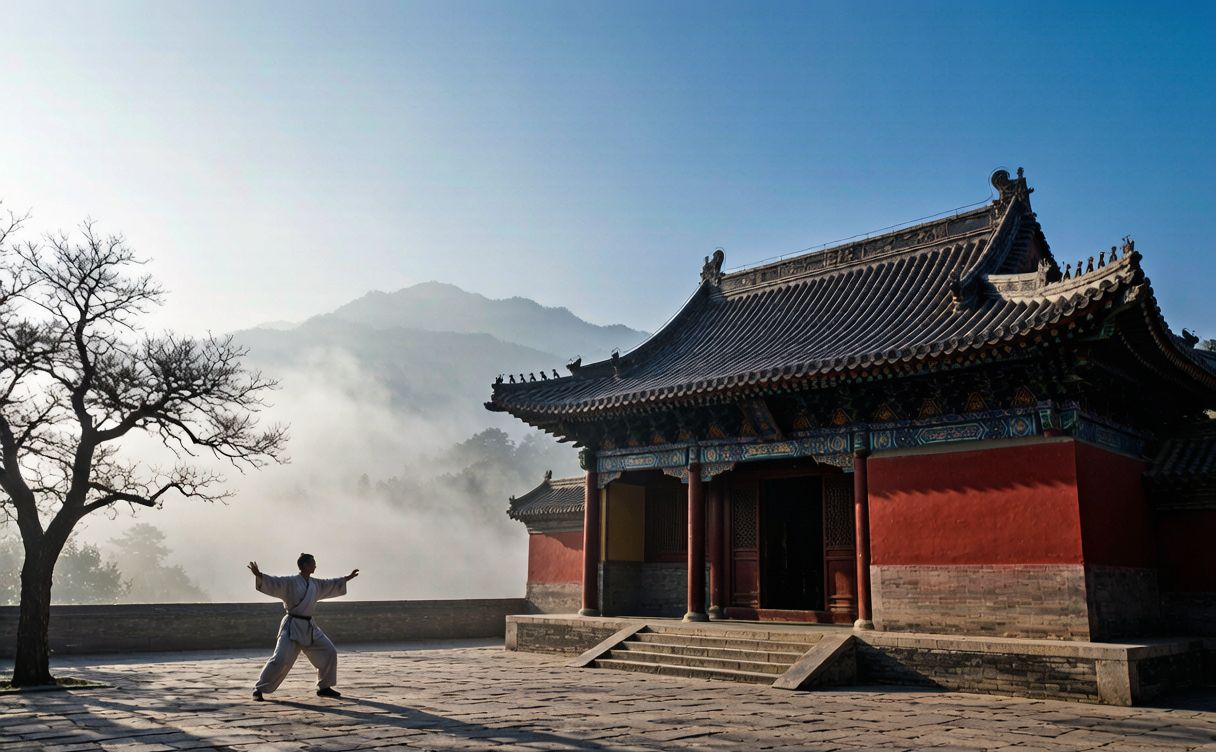
Most visitors arrive on a shaolin temple tour and get herded through the main halls in under an hour. Don’t be that person. The Shaolin Temple grounds are bigger than they look, and the best bits sit a short walk beyond the ticket gate. Budget your time so the temple itself is only the beginning, not the whole story.
The Pagoda Forest
This is the highlight nobody warns you about. The Pagoda Forest (Talin) is a field of more than 240 stone and brick pagodas, each one a tomb marker for an honored monk or abbot, built from the Tang dynasty right up to the 19th century. Walking between them feels like a silent graveyard of miniature towers — some barely taller than me, others three stories high, every one carved with the name and rank of the person it commemorates. I spent forty minutes here alone, and it was the most peaceful part of my visit. The entire Dengfeng complex, including the Shaolin Temple, is inscribed by UNESCO as a World Heritage Site, which is about as authoritative a stamp of significance as a place can get (Historic Monuments of Dengfeng, UNESCO).
The Kung Fu Training Hall
Inside the temple grounds, the training hall is where you’ll see disciples practice weapon forms — staff, spear, broadsword — in a roped-off area while visitors press against the railings. It’s touristy, sure, but it’s also real: these are genuine students, not actors. A monk told me the youngest boarders start at age five and train six hours a day, six days a week. I watched one kid repeat a falling-staff routine maybe thirty times without complaint, and I felt quietly ashamed of every workout I’d skipped back home.
The Daily Performance
The big kung fu show runs several times a day in an auditorium just outside the main gate. It’s choreographed, theatrical, and absolutely worth your time if you’ve never seen bodies do these things — monks smashing marble slabs with their forearms, balancing on spear points, catching swords with their necks. Take it as entertainment, not documentary. I caught the 10:30 show and grabbed a front-row seat that left my neck sore from looking up for forty minutes straight.
Planning Your Shaolin Temple Tour
Give yourself a half-day minimum, a full day if you want to also hike part of Songshan or visit the nearby Dharma Cave where Bodhidharma supposedly meditated. Most foreign travelers combine the Shaolin Temple with a base in Zhengzhou or Luoyang and do it as a day trip. A standard shaolin temple tour from either city runs four to six hours including transport, which is plenty if you’re efficient but tight if you like to linger.
Book your ticket online in advance through the official WeChat mini-program or a major Chinese travel app — on-site lines at peak season can be brutal, and foreign card payment at the gate is unreliable. Carry cash as backup; I learned this the hard way when the scanner rejected my card and a very patient ticket lady waved me toward the cash window with a smile that said she’d seen this a thousand times.
How to Get There from Zhengzhou and Luoyang
Zhengzhou, the Henan provincial capital, is your easiest launch point. For the Shaolin Temple you actually want to reach Dengfeng, not Luoyang proper. The simplest route: take a long-distance bus from Zhengzhou Central Bus Station to Dengfeng (about 1.5–2 hours), then a local bus or taxi the final 15 km to the temple gate. A private car or app-based Didi is the most painless option if you’re traveling with luggage, kids, or anyone who hates standing on the side of a highway.
From Luoyang, it’s roughly 1.5 hours by road to Dengfeng, and many travelers base in Luoyang for the Longmen Grottoes and White Horse Temple, then add the Shaolin Temple as a side trip. If you’re building a broader Henan-and-beyond route, the province pairs beautifully with Xi’an just across the border, and the temple sits neatly between the two ancient capitals. Trains are the backbone of all of it, which is why I tell every first-timer to study the rail network before they book a single hotel.
Best Time to Visit and Ticket Tips
Spring (April–May) and autumn (September–October) are ideal: mild temperatures, clear mountain air, and no school-holiday crush. Summer is hot and packed; Chinese National Day (early October) is the single worst week to be anywhere popular in China, so avoid it entirely. Winter is cold but gloriously empty, and the Shaolin Temple in snow is genuinely cinematic — the kind of postcard shot that makes the frozen fingers worth it.
Ticket tips that actually matter:
– Arrive before 9 a.m. to beat the tour buses that roll in from Zhengzhou and Luoyang.
– The combined ticket covers the temple, the Pagoda Forest, and the kung fu show — don’t buy them separately.
– Skip the “VIP” photo ops with monks in costume; they’re staged and overpriced.
– Wear real shoes. The walk from the parking area to the gates is longer than it looks, and the path to the Pagoda Forest adds another kilometre.
When I stood at the Pagoda Forest on my second morning, the only sound was wind moving through the pines, and I finally understood why people travel hours to a martial-arts story that isn’t really a story at all. The Shaolin Temple is a working monastery that happens to have the best PR department in the history of Buddhism.
Final Thoughts
The Shaolin Temple rewards the curious and punishes the rushed. Go early, walk slowly, and leave room in your schedule to simply watch the training rather than photograph it. You’ll leave with a better story than the one the movies sold you, and probably a sore neck and a new respect for six-year-olds with staffs.
If you’re mapping out a bigger trip, the Shaolin Temple fits naturally into a central-China loop alongside the cave art of the Yungang Grottoes in Datong and the ancient capital of Xi’an — three very different windows into the same long civilization.