

The first time I saw the sun leak over the rim of the world from 1,545 meters up, I understood why emperors crawled up here on their hands and knees. Mount Tai — or Taishan, as the locals call it — isn’t just the tallest hill in Shandong province. For more than 3,000 years it was the literal axis between heaven and earth, the single peak Chinese rulers climbed to tell the gods they were still in charge. I came expecting a hike. I left feeling like I’d walked through a thousand years of state-sponsored religion, one stone step at a time.
Why Mount Tai Is China’s Most Sacred Mountain
Of the Five Great Mountains of China, Mount Tai ranks first — and the Chinese have never been subtle about it. The character tai (泰) means peace and stability, and for two millennia emperors made the grueling pilgrimage to its summit to perform the feng and shan ceremonies: sacrifices to heaven on the top, to earth below. Twelve emperors are recorded as having climbed it in person. Countless others sent proxies. This wasn’t tourism. It was the ultimate PR campaign of the ancient world. Western travelers usually search for it as mt tai china, but the feeling at the top is the same no matter what you call it.
What makes the place feel different from, say, a pretty day hike is the sheer density of devotion baked into the rock. Along the path you pass stele after stele — carved stone tablets left by emperors, poets, and calligraphers who couldn’t resist scratching their awe into the mountain. Confucius is said to have climbed it. So did Li Bai, China’s most famous wandering poet, who wrote that “the world looks small from up here.” When I stood at the exact spot where the eastern cliff drops away into cloud, I got why nobody could shut up about it.
If you want the scholarly backing, Mount Tai was inscribed as a UNESCO World Heritage Site in 1987 — one of the first cultural-natural dual listings in the world. The official UNESCO page lays out its case far better than I can: https://whc.unesco.org/en/list/437/
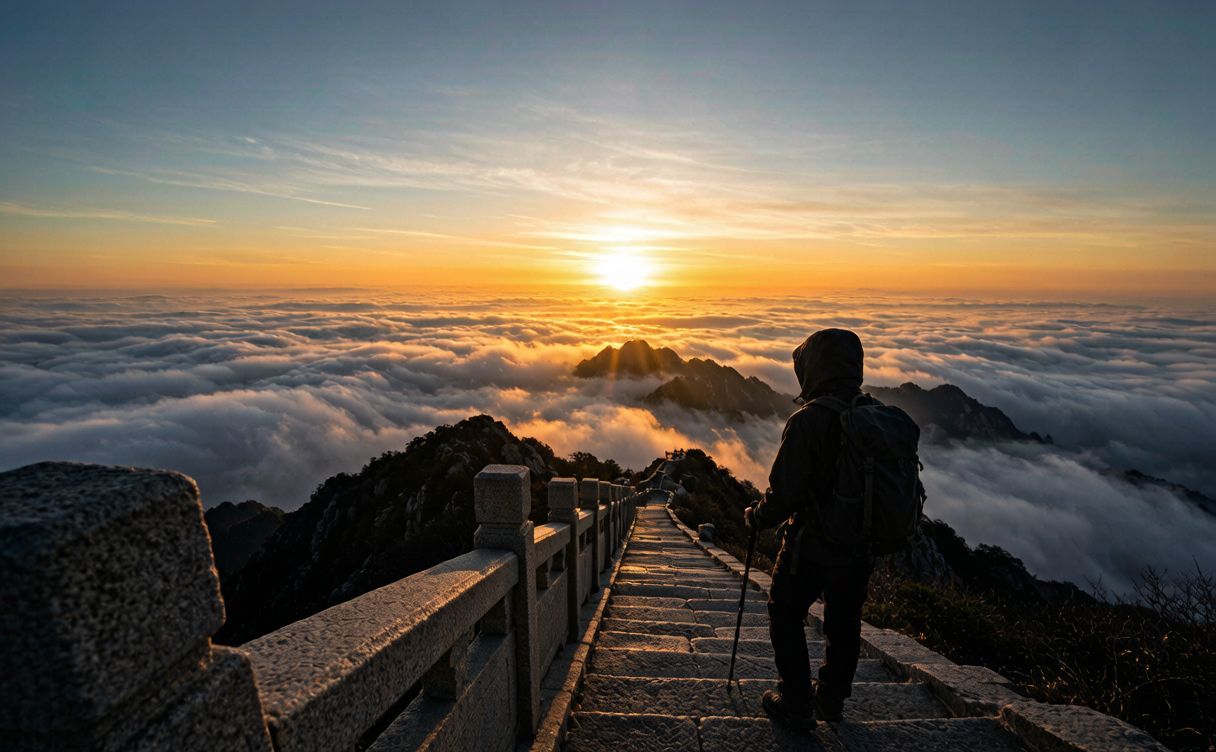
My Climb — and the Sunrise That Made It Worth Every Step
I’ll be honest: I almost skipped the pre-dawn window. My guesthouse owner in Tai’an had pushed me to start at 3 a.m., and at that hour the idea of a 6,660-step staircase sounded like punishment. I’m glad I ignored my own laziness. The summit of Mount Tai clears into a viewing terrace called Riguan Feng (Sun-Watching Peak), and at about 4:50 a.m. the crowd — and there is always a crowd — falls silent. Then the sky does that stupidly beautiful thing where it goes from charcoal to bruise-purple to gold in about ninety seconds.
A local told me, as we huddled in the cold waiting, that on a clear winter morning you can see the sun rise “like an egg yolk balancing on the rooftops of Tai’an.” He wasn’t wrong. When I stood at Riguan Feng with frozen fingers and a thermos of bad tea, the whole valley below lit up and I forgot about my burning thighs entirely. That, more than any temple, is the reason people keep coming.
If you only do one thing on this mountain, do the sunrise. Sleep on or near the summit (there’s a hotel at the top, overpriced and basic, but warm), or start the climb absurdly early from the base. Either way, build your day around that horizon.
Tai Mountain Hiking: Hiking vs Cable Car
Here’s the real decision every visitor to Mount Tai faces: legs or lift? Tai mountain hiking is genuinely strenuous if you go all the way on foot — we’re talking 6,000-plus steps from the Hongmen entrance to the summit, a vertical gain of over 1,300 meters. Fit walkers do it in four to five hours up. Slower, photo-stopping travelers (me) take six or seven.
The Classic Route from Tai’an (Hongmen)
The Hongmen (Red Gate) route is the traditional imperial path, starting right at the edge of Tai’an city and winding past the main temples: Daizong Fang, the Midway Gate to Heaven, and finally the Southern Gate of Heaven (Tianmen) just below the summit. It’s granite steps the whole way, with rest pavilions, snack stalls, and the occasional cheeky monkey. This is the route if you want the full pilgrimage feel and the bragging rights.
The Lazy(ish) Route: Bus + Cable Car
If your knees protest or your schedule is tight, take the tourist bus from the base up to Zhongtianmen, then the cable car from there to near the summit. You’ll still climb the final, steepest stretch on foot — the cable car doesn’t quite reach the top — but you’ll save three hours and most of your quadriceps. Plenty of foreign travelers do this and still catch the sunrise by staying at the summit hotel. No shame in it. The taishan sacred mountain experience is about the place, not the punishment.
Best Time to Visit and How to Dodge the Crowds
Timing is everything on a mountain this famous, and Mount Tai has its own moods worth respecting. Spring (April–May) and autumn (September–October) are the sweet spots: mild, usually clear, and good for that sunrise photo. Summer is hot, humid, and socked in with cloud more often than not, though it’s also when the mountain turns lush and green. Winter is my secret favorite — cold enough to keep casual tourists home, and the rare chance of snow on the summit turns the whole place into a ink-painting.
Avoid the two big traps: Chinese public holidays (especially National Day in early October and Spring Festival) turn the steps into a human traffic jam, and weekends are noticeably busier than weekdays. If you can, arrive midweek and start before dawn. The mountain never empties, but the 5 a.m. silence at the top is worth planning around.
For the broader picture on seasons across the country, our best time to visit China guide breaks down weather and crowds month by month.
What to Pack for a Tai Mountain Hike
Mount Tai weather at the base and the summit can differ by 10°C, and the wind up top is no joke even in May. Pack like you’re visiting two climates:
- A lightweight windbreaker or fleece, even in summer — the summit is exposed and cold at 5 a.m.
- Proper walking shoes with grip. Those granite steps get slick when wet.
- A headlamp or phone light if you’re doing the pre-dawn climb. The path is lit in places but not everywhere.
- Water and snacks. Stalls exist but prices climb (literally) with altitude.
- Cash or a working payment app — small temple donations and the occasional stall still prefer cash.
- A walking stick. Locals sell carved wooden ones at the base for a few yuan, and your knees will thank you on the descent.
When I stood at a halfway pavilion gulping lukewarm water, a retired schoolteacher from Jinan beside me laughed and said the mountain “gives you weak legs going up and humble legs coming down.” He was right about both.
Ticket Tips and Getting to Tai’an
Tickets for Mount Tai are bought at the base entrances or, more sensibly, online in advance through the official platform or major Chinese travel apps. Peak-season admission runs around 125 RMB; off-season drops to about 100 RMB. The cable car and the shuttle bus are separate charges, roughly 100 RMB and 35 RMB each way. Sunrise-chasers note: if you climb at night, you still need a valid ticket, and the gates do check.
Getting to Tai’an is easy. It’s a stop on the Beijing–Shanghai high-speed line, about two hours from Beijing and three from Shanghai by train, then a short taxi or bus to the mountain’s foot. If you’re already exploring Shandong’s coast, it pairs perfectly with a few days in Qingdao — and our Qingdao travel guide maps out the seafood, beer, and beaches that make a good counterpoint to all this climbing.
Where to Base Yourself — and What’s Next
Tai’an is the obvious base: cheap hotels, plenty of noodle shops, and you can roll out of bed straight to the trailhead. Stay one night before and, if you did the sunrise, one night after to recover. The city itself is unremarkable, but it exists purely to serve the mountain, and it does that job well.
For a longer trip, Mount Tai slots neatly into a wider Shandong-and-beyond loop. Our roundup of the best things to do in China includes Tai Shan alongside the heavy hitters, and if you’re hunting for a shortlist of icons worth the train fare, the China bucket list attractions guide is where I’d start planning.
Mount Tai isn’t the highest mountain in China — that title belongs to peaks far to the west — but it might be the most loaded with meaning. Three thousand years of emperors, poets, and ordinary sweat have worn a groove into these stones, and standing at the top as the first light hits the plain, you feel a little of that weight. Go for the hike if you must. Stay for the silence at the summit. And whatever you do, don’t skip the sunrise.