

Most China itineraries sprint between Beijing, Xi’an, and Shanghai and call it a trip. This Qingdao travel guide is for the traveler who wants to slow down on a real coastline, drink beer brewed a few hundred meters from where it’s bottled, and wander streets where red-tiled villas and Catholic spires feel more Bavarian than Chinese. Qingdao sits on the Shandong peninsula, and it’s one of the few places in the country where European and Chinese city planning sit side by side without either one winning. If you’ve only seen China’s inland megacities, the sea air alone is worth the detour.
At a glance
- Best time to visit: late May to early October, with July and August peak for swimming and the beer festival
- From Beijing: high-speed train, about 3–4 hours; flights also run daily
- From Shanghai: high-speed train, about 4.5–6 hours; flights around 1.5 hours
- Local flavor: Tsingtao beer, fresh seafood, Shandong cuisine
- Don’t miss: Zhanqiao Pier, the old German quarter, Golden Beach on Huangdao side
- Good for: beach days, food lovers, beer fans, slower-paced city breaks
Why Qingdao feels different
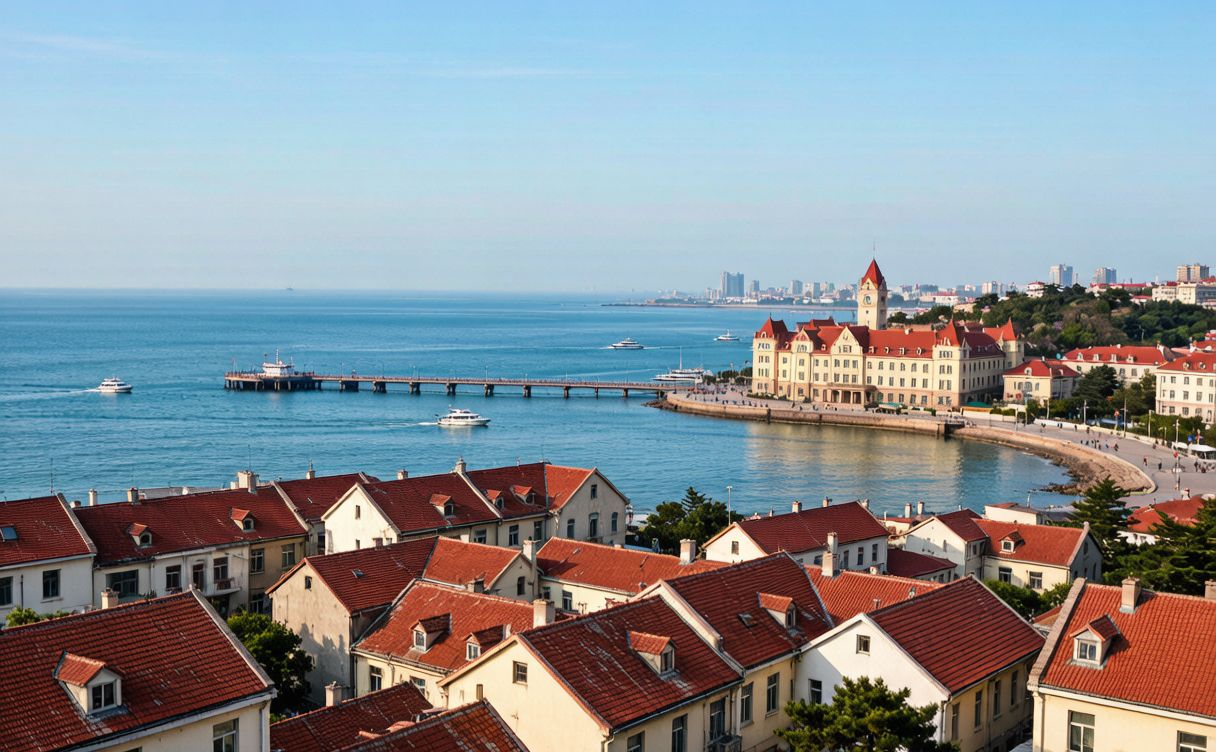
Qingdao was leased to Germany in 1898, and the footprint is everywhere you look. The grid of streets in the old town, the stone churches, the former governor’s residence—none of it was torn down after the leases ended. The city grew around its harbor and brewery, and that open, breezy character stuck. You can stand on a seaside promenade with a wheat beer in hand and watch cargo ships drift past a skyline that mixes Gothic towers with glass office blocks.
It’s also genuinely walkable in a way Beijing and Shanghai rarely are. The hills are gentle, the waterfront is continuous, and most of what you’ll want is within a long-but-pleasant stroll or a short DiDi ride of the center.
The beer: more than a brand name
You can’t really talk about Qingdao without talking about Tsingtao. The brewery was founded by German and British settlers in 1903 as the Germania-Brauerei, and the recipe has barely changed since. The water used comes from Laoshan, a nearby mountain springs region, and that mineral softness is part of why the lager tastes the way it does.
The museum on Dengzhou Road is the obvious stop. It’s built into the original brewery buildings, and the tour ends—as tours should—with two freshly poured samples straight from the line, including a dark beer you won’t easily find outside China. For the full spectacle, time your visit for late July into August during the Qingdao International Beer Festival, when the whole city leans into brass bands, pop-up beer gardens, and a fairground atmosphere out at the Golden Beach venue on the Huangdao side.
If you want the brewery’s own context on its history, the Tsingtao Brewery page on Wikipedia keeps a clean, sourced summary worth a read before you go.
Where to drink like a local: skip the sterile chains and find a street-side barbecue stall in the evening. Order skewers (chuan’r), a plate of clams, and a few cold bottles. The beer is cheaper than water in some spots, and the scene is the real Qingdao.
Zhanqiao Pier and the old town
Zhanqiao Pier is the postcard. Built in 1891 as a military landing stage, it now juts 440 meters into Jiaozhou Bay, capped by the Huilan Pavilion, an octagonal teahouse-style structure that’s on practically every Qingdao souvenir. Come at sunrise or after 6pm if you want photos without a thousand selfie sticks in frame.
From the pier, walk uphill into the old town. The Former German Governor’s Residence (now a museum) is a solid example of the era’s architecture, and the stained-glass Catholic Church of St. Michael—locals just call it the “Cathedral”—is worth standing inside for five quiet minutes. The surrounding streets of Xinhaoxi and Those slopes are where you’ll find the red roofs stacked above the sea.
Beaches: which one, and when
Qingdao’s beaches are rocky-and-yellow rather than the white-sand fantasy, but they’re clean, swimmable in summer, and backed by a proper promenade. The main ones:
- No. 1 Bathing Beach (Huiquan): closest to the old town, busy, good for a first dip and people-watching.
- No. 3 Bathing Beach: quieter, near the aquarium, calmer water.
- Golden Beach (Jinshatan), Huangdao side: the widest and most polished, across the bay via subway or tunnel bus. This is where the beer festival sets up.
Swimming season is roughly June through September. The water is bracing even in August—northern China’s coast doesn’t get tropical—but on a hot day it’s perfect. Lifeguards and marked swim zones operate in summer; respect them, because currents off the breakwaters can be stronger than they look.
Seafood and Shandong food
Qingdao sits in Shandong, home of one of China’s eight great culinary traditions—lu cai—built on fresh ingredients, salt, and subtle broth rather than heavy spice. The star here is seafood: sea cucumber, prawns, clams, oysters, and a local squid preparation grilled over charcoal. The Pichai Yuan market and the streets around it are the classic dinner crawl, though it’s touristy; for a more local feel, head to the 营口路 (Yingkou Road) market, buy your seafood at the wet market, then pay a nearby restaurant a small fee to cook it.
Beer and clams is the unofficial city combo, and you’ll see it everywhere from hole-in-the-wall stalls to hotel restaurants. If your stomach is cautious, our street food safety guide for China covers what’s safe to eat from markets and how to avoid a ruined trip. For the bigger picture on regional cooking, the Chinese food guide to the eight cuisines explains where Shandong fits alongside Sichuan, Cantonese, and the rest.
Getting there from Beijing and Shanghai
Qingdao has two stations—Qingdao Station (in the city, walkable to the old town) and Qingdao North (for the high-speed lines). From Beijing, bullet trains run roughly every half hour and take 3 to 4 hours. From Shanghai, expect 4.5 to 6 hours depending on the service; flights are faster if your time is tight. Either way, book through the official 12306 system or a trusted reseller—our high-speed train guide for foreigners walks through booking, seat classes, and what to expect at the station.
If you’re coming from Shanghai and building a longer route, the best time to visit Shanghai guide helps you sequence the two cities—spring and autumn are kind to both, while Qingdao’s own sweet spot is summer.
Planning your trip
A solid Qingdao stay is 2 to 3 days: one for the old town and brewery, one for a beach and the Huangdao side, and a spare day for a day trip or a slow seafood lunch. The city is easy on the wallet compared to Beijing or Shanghai; our China travel budget per day breakdown shows typical daily costs, and Qingdao usually lands on the cheaper end thanks to low food and beer prices.
Before you fly, skim our things to know before visiting China for payment apps, SIM cards, and etiquette that apply everywhere—including here.
A few practical notes
- Getting around: the metro is clean and covers the core routes; DiDi (China’s Uber) is cheap and reliable for everything else.
- Weather: summers are warm and humid with the occasional typhoon brush; winters are cold, windy, and quiet—beautiful but not swim-friendly.
- Cash vs. apps: you’ll want Alipay or WeChat Pay linked to an international card; small stalls may not take cash. See the payment setup in our pre-trip guide above.
- Crowds: avoid the first week of May and the National Day week in early October if you can—domestic tourism peaks hard then.
Qingdao won’t shout for your attention the way the Great Wall does. It’s a place you settle into: a morning pier walk, a long lunch of clams and beer, an afternoon on the sand, and an evening promenade as the German-era lights come on. For a China trip that isn’t all temples and bullet trains, that pause is exactly the point.
Written by Karl.