

When I first started traveling in China, the single biggest daily puzzle wasn’t finding the sights — it was figuring out how to order food in China without speaking a word of Mandarin. Menus were walls of characters, waiters had no English, and my cash felt embarrassingly old-fashioned. Fast forward a few trips and the whole experience has flipped: a handful of apps now let you scan, translate, and pay for almost any meal in seconds. If you’re planning a China travel adventure in 2026, this guide walks you through exactly which apps to install, how to read a Chinese menu with your camera, and how to pay like a local — even when your phone’s language is set to English.
The apps that actually matter
You don’t need a dozen food apps. For most travelers, three tools cover 95% of situations: Meituan, Ele.me, and WeChat’s scan-to-order feature.
Meituan and Ele.me for delivery and pickup
Meituan (美团) and Ele.me (饿了么) are China’s two giant food-delivery platforms. Think of them as the local equivalents of DoorDash, but far more pervasive — nearly every restaurant, from a hole-in-the-wall noodle shop to a hotel buffet, lists on one of them. Both offer English interfaces if you toggle the language, show photos of every dish, and let you filter by cuisine, rating, and distance. Crucially, each listing carries thousands of real customer reviews and star ratings, so you can order with the same confidence you’d have using a familiar app back home — and the average delivery fee is only a few yuan, often waived above a small minimum.
I once landed in Chengdu at 11 p.m. with a hotel in a quiet district. Within four minutes of opening Meituan, I had a steaming bowl of dan dan noodles on the way — no phone call, no Chinese, no confusion. The app even tracked the rider on a live map to my lobby.
WeChat scan-to-order at the table
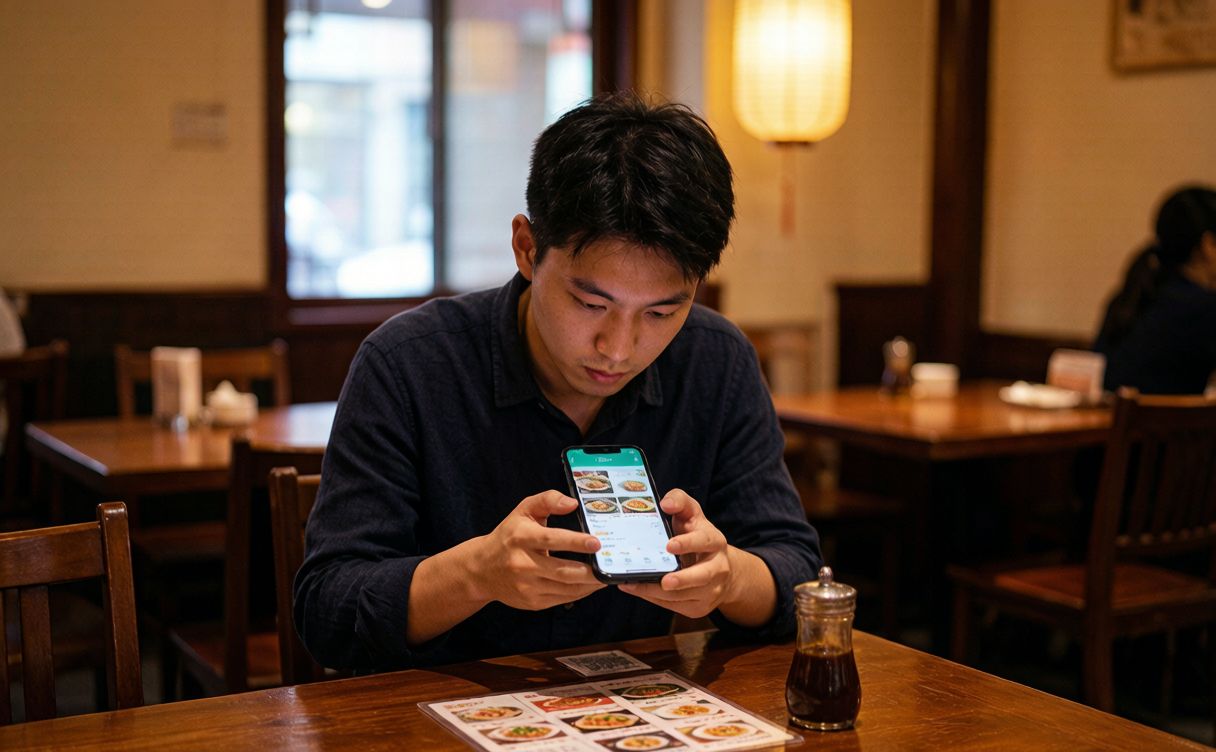
Here’s the habit that surprises first-timers: in most sit-down restaurants, nobody hands you a menu. Instead, a small QR code sits on the table. You open WeChat, tap the “Scan” icon, point it at the code, and a digital menu loads in your browser. You pick dishes, submit the order, and later pay the same way — no waving down a waiter required. This “scan-to-order” (扫码点餐) system is now standard across China, from Beijing hotpot chains to rural guesthouses.
Translating a menu with your camera
The character barrier is the real fear, and it’s easily solved. Both Meituan and Ele.me display dish photos, but when you’re at a table scanning a QR code, the menu text may still be Chinese. That’s where your phone’s built-in translator saves the day.
On iPhone, the Camera app and the Translate app can read Chinese text live and overlay English. On Android, Google Lens does the same. Point your camera at the menu, tap the text, and you get an instant English gloss. For dishes with no photo, this is how I discovered that “麻婆豆腐” was mapo tofu and not, as I’d feared, something unidentifiable and chewy.
A practical tip: screenshot the menu, then run it through your translator’s image mode. That way you can study it calmly instead of holding your phone over the table while other diners wait. When you’ve decided, match the Chinese characters you translated back to the on-screen buttons — they line up character for character.
Paying without cash or a Chinese bank card
Paying is the part that used to terrify visitors, and it’s now the easiest step. You pay through Alipay or WeChat Pay — both now accept international credit and debit cards (Visa, Mastercard, JCB) via a simple setup in the app. You don’t need a Chinese bank account.
Alipay and WeChat Pay for tourists
In Alipay, switch the app to English and you’ll be prompted to link a foreign card. WeChat Pay has a similar “tourist” path. Once linked, you can pay any QR code — the restaurant’s, the street-stall’s, even the subway’s — by opening the app, tapping “Pay” or “Scan,” and confirming. The merchant scans your code, or you scan theirs; either works.
I’ll never forget paying a grandmother selling roasted sweet potatoes (烤红薯) on a Xi’an side street. She had a handwritten QR taped to her cart. I scanned it, typed 6 yuan, and her phone chimed. No cash, no language, just a smile. That single moment convinced me China is one of the most cashless-friendly places on earth for prepared visitors.
For authoritative setup help, see Alipay’s official international guide at Alipay for Tourists, which explains card linking and the Tour Card top-up option step by step.
Practical tips for non-Chinese speakers
A few hard-won lessons from my own trips:
- Download everything before you fly. Install Meituan, Ele.me, Alipay, and WeChat, and link your card while you still have reliable Wi-Fi at home. Doing it on arrival, jet-lagged, is harder.
- Set your delivery address in English plus a screenshot of the Chinese. Drivers rarely read English, so paste the hotel’s name in Chinese characters into the address field. Your hotel reception can write it for you.
- Use photos as your universal language. When ordering in person, show the dish photo from the app to the staff. It removes every ambiguity.
- Tipping isn’t expected. Unlike in the US, Chinese restaurants don’t expect tips, so the app total is the real total.
- Spice and “strange” items. Look for 辣 (là, spicy) and 不辣 (bú là, not spicy). If you can’t handle heat, screenshot those two characters and show them.
If you want to understand the broader food culture before you point your camera at a menu, our Chinese food guide to the 8 great cuisines breaks down regional styles so you know what to expect in each city.
Where to practice first
The best cities to test these skills are also the most tourist-friendly. In Beijing, don’t miss the ritual of duck — our guide to where to eat Peking duck in Beijing points you to spots that take app payment and often have picture menus. Down south, dim sum is made for scanning-and-sharing; the Cantonese dim sum food guide explains the classics so you can order with confidence.
And if anything feels overwhelming, keep our China travel safety tips handy — ordering food is safe, cheap, and fun once you know the rhythm.
One last story to settle your nerves. On my second trip, in a small Chongqing neighborhood, I walked into a restaurant with zero English signage. I scanned the table QR, translated the menu with my camera, ordered three dishes I couldn’t pronounce, paid with Alipay, and ate one of the best meals of my life — all without exchanging a single word. That’s the quiet magic of eating in China today: the apps do the talking, and you just enjoy the food.
So pack light, install four apps, and link one card. Ordering food in China stops being a worry and becomes one of the most rewarding parts of traveling in China — a daily small adventure that ends, reliably, with something delicious in front of you.