

If you’re wondering where to eat Beijing duck on your trip, you’re asking the right question — because in a city with thousands of duck restaurants, the difference between a forgettable meal and a transcendent one comes down to which door you walk through. I’ve eaten my way across Beijing’s roast duck scene for years, from the 1864-founded Quanjude to sleek modern temples like Da Dong, and the gap between a ¥150 tourist-trap duck and a perfectly carved ¥298 one is enormous. The good news: you don’t need a local friend to get it right. This guide cuts through the noise and tells you exactly where to go, what to order, and how to eat it like a Beijinger.
Key Takeaways
– Quanjude (founded 1864) is the historic flagship — go to the Qianmen branch for the real “hung-oven” experience; a duck runs ¥238–¥288.
– Da Dong serves the leanest, most refined “super-lean” duck (¥398), carved from 22-day ducklings — best for a fancy, less greasy meal.
– Siji Minfu is the local favorite for value (≈¥283 per duck), and its Forbidden City branch serves duck with a moat view.
– Bianyifang (the oldest, closed-oven style) and Liqun (a hutong courtyard spot) reward travelers who want tradition over hype.
– Always order the duck soup or salt-and-pepper fried bones from the carcass, and book ahead — the famous spots fill up fast.
Beijing roast duck (Beijing kaoya) is more than dinner here. It’s a 600-year-old ritual that started in the imperial kitchens of the Ming Dynasty and never really left the throne. Two schools dominate the city: the open/hung-oven style (挂炉, guàlú) that roasts ducks over fruitwood in Quanjude, and the closed-oven style (焖炉, mènlú) that Bianyifang pioneered. The first gives you shatteringly crisp skin; the second keeps the meat juicier. Both are worth knowing before you point at a menu.
The short version: which duck should you pick?
If you only have one sitting and don’t want to overthink it, match your priority to a restaurant:
- History and bragging rights → Quanjude (Qianmen branch)
- The leanest, most artistic duck → Da Dong
- Best value with a view → Siji Minfu (Forbidden City branch)
- Oldest technique, juicier meat → Bianyifang
- Atmospheric hutong experience → Liqun
Most first-time visitors to China build their food plans around a few signature dishes, and this is the headline one. If you want the bigger picture of what else to eat, our Chinese food guide to the 8 great regional cuisines is a good companion read.
Quanjude — the history lesson worth taking
Quanjude (全聚德) opened in 1864 during the Qing Dynasty and turned roast duck into a national institution. The Qianmen branch (前门店, 32 Qianmen Street) is the one to visit — it’s the original, and the ducks are still roasted in a hung oven over date-wood and pear-wood charcoal, which gives the skin that faint fruity smoke. A standard duck is ¥238; the “Shengshi Mudan” (盛世牡丹, “Peony”) duck, the one served at the APEC state banquet, is ¥288 and arrives carved into a flower shape.
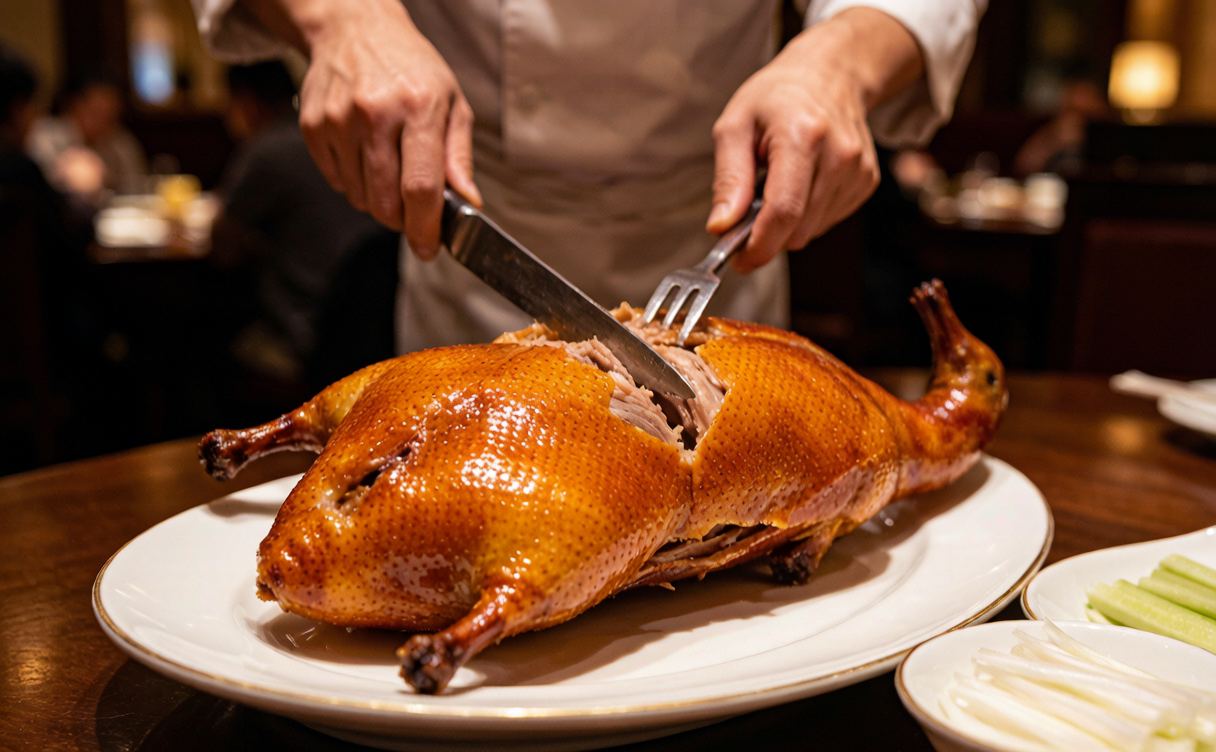
I still remember my first time at the Qianmen branch. I arrived at 10:40 on a Tuesday, twenty minutes before opening, and still queued behind a tour group. When the duck hit the table, a chef in white wheeled over and carved it in about ninety seconds — roughly 100 thin slices, skin and meat together. He handed me a small numbered certificate (they number every duck) and told me to eat the first piece of crackling skin plain, dipped in white sugar. He was right. The sugar kills the grease and leaves pure roasted fat on the tongue. That single bite is the reason people fly to Beijing.
Book via the official site or arrive before 11:30. Other solid branches: Wangfujing (9 Shuaifuyuan Hutong) and Hepingmen (14 Qianmen West Street). Expect to spend ¥200–¥300 per person once you add a cold duck appetizer and a vegetable.
Da Dong — modern, lean, and unforgettable
Da Dong (大董) is the opposite energy: a quiet, arty, fine-dining room where the duck is treated like a sculpture. Founder Dong Zhenxiang built his reputation on the “super-lean” duck (酥不腻, sū bù nì) — ducks raised for just 22 days, then roasted so the fat renders almost completely away. The skin shatters like glass; the meat stays tender without the heavy grease of a traditional bird.
A whole duck is ¥398, and per-person spend runs ¥368–¥400, so this is a splurge. But it’s the duck I recommend to travelers who find classic Peking duck too rich. The branches are everywhere — Nanxincang (南新仓, the flagship), Jinbaojie (金宝街), Tuanjiehu (团结湖), and Huamao (华贸) — and most servers speak basic English with an English menu, which takes the pressure off if your Mandarin is rusty. Reserve two or three days ahead; Michelle Obama famously dined here in 2014, and the foreign-visitor demand hasn’t slowed since.
Siji Minfu — the local favorite
Ask a young Beijinger where they actually eat duck, and “Siji Minfu” (四季民福) is the answer more often than not. It’s the sweet spot: a duck for about ¥283, per-person spend of ¥160–¥220, and quality that rivals the famous names. The Forbidden City branch (南池子大街11号) is the one to aim for — ask for a window table and you’ll watch the palace moat and corner tower while you eat.
Last spring I took a friend there on a Saturday and made the classic mistake: arriving at 6 p.m. The host told us the wait was 90 minutes. We put our name down, walked the hutong lanes for an hour, came back, and the duck made the wait worth it — the skin lacquered and glossy, the meat sweet, the pancakes thin enough to read through. Lesson learned: go before 5 p.m., or use the restaurant’s queue app and explore nearby lanes while you wait. If you’re mapping out your days, this pairs perfectly with the palace stops in our things to do in Beijing guide.
Bianyifang and Liqun — old-school and hidden
Bianyifang (便宜坊) claims the deepest roots of all — it dates its closed-oven method to 1416, making it older than Quanjude by centuries. The duck here is roasted in a sealed oven with no open flame, so the meat stays moist and the skin less brittle. If you prefer juicy over crunchy, this is your place; per person runs ¥150–¥250.
Liqun (利群) is the romance option. Tucked in a crumbling courtyard off a hutong alley (near Qianmen), it’s a family-run spot where the owner sometimes seats you himself. It’s rustic, unpolished, and completely authentic — exactly the kind of place a Beijing taxi driver would whisper about. On my last trip, a local friend led me there on a quiet Wednesday. We sat in the courtyard under bare winter branches while the oven crackled, and the duck that arrived — no ceremony, no certificate, just perfect skin — was the most relaxing meal of the week. That’s the trade: you give up polish, you gain Beijing. Prices sit around ¥200–¥300 for a duck, and they’re happier with cash or mobile pay than with a foreign card, so come prepared.
Plan your duck day around the rest of the city: our Beijing 3-day itinerary slots a duck dinner into the perfect evening slot.
How to eat Peking duck properly
The carving is just the opening act. Here’s the ritual, step by step:
- Eat the skin first. Take a still-warm slice of crisp skin, dip it in white sugar, and eat it alone. This is the chef’s intended first bite.
- Paint your pancake. Use chopsticks to brush sweet bean sauce (甜面酱, tiánmiànjiàng) across a thin pancake (荷叶饼, héyèbǐng).
- Layer it. Add a few slices of duck, then scallion (葱) and cucumber stick. Some tables also offer pickled radish or garlic.
- Roll tight. Fold the bottom up, then roll from the side so nothing leaks. Bite in.
- Don’t skip the bones. When the carving is done, the waiter will ask: duck soup (汤, a milky broth with cabbage and tofu, often free or ¥10–¥20) or salt-and-pepper fried bones (椒盐, an extra charge). Always say yes to one. The soup is the move on a cold day; the fried bones are the move if you’re still hungry.
Insider tips before you go
Book ahead. Quanjude, Da Dong, and Siji Minfu all reward reservations. Siji Minfu takes limited bookings and otherwise runs on a queue — go early or use the app.
Pay smart. Most of these restaurants take Alipay and WeChat Pay, which are faster than waving a foreign card around. Set both up before you land with our Alipay and WeChat Pay guide for foreigners — it saves real friction at the counter.
Skip the card hassle: set up Alipay or WeChat Pay before you fly — most duck houses process mobile pay faster than foreign cards, and Liqun practically expects it.
Order beyond the duck. A full duck for two is plenty, but add one cold starter — mustard duck web (芥末鸭掌) or duck liver — and a green vegetable to balance the richness. Skip the fried rice unless you’re a party of four.
Mind the season. Duck is a year-round dish, but the birds are plumpest in autumn and winter. If your trip is seasonal, our best time to visit China guide helps you weigh the trade-offs.
One duck per two to three people. Don’t over-order. A whole duck at Quanjude or Siji Minfu easily feeds two with sides, three if you add the soup and a vegetable.
The bottom line
There’s no single “correct” answer to where to eat Beijing duck — there’s the answer that fits your trip. Want the story and the century of smoke? Quanjude Qianmen. Want the leanest, most refined bird and a quiet room? Da Dong. Want the best value and a palace view? Siji Minfu. Want tradition or atmosphere off the beaten path? Bianyifang or Liqun. Eat the skin with sugar, roll your own pancake, and order the soup from the bones — do that, and you’ll understand why Beijingers have defended this dish for 600 years.
If you’re building a full Beijing plan around the meal, start with our Beijing first-time travel guide and our broader China travel guide for first-timers — they’ll get you from the airport to the duck table without a wrong turn.
Ready to plan the perfect duck dinner? Book your duck spot a few days ahead, set up mobile pay before you fly, and save a window-table request for the Forbidden City view at Siji Minfu. Your first bite of sugar-dipped skin will thank you.