

China’s ancient towns are where the country’s history becomes something you can walk through. Wooden teahouses lean over stone canals, Ming- and Qing-era courtyards open onto quiet lanes, and ethnic minority cultures survive in daily life rather than behind museum glass. For foreign travelers, they are also some of the easiest, most rewarding places to slow down after the megacities.
This guide rounds up 12 of the best ancient towns in China for 2026, mixing famous UNESCO sites with quieter gems. For every town we already cover, we link to our dedicated travel guide. For the rest, we give you what you need to decide if it earns a place on your trip.
Content Preview
– 1. Lijiang Old Town, Yunnan
– 2. Dali Old Town, Yunnan
– 3. Fenghuang Ancient Town, Hunan
– 4. Pingyao Ancient City, Shanxi
– 5. Wuzhen Water Town, Zhejiang
– 6. Zhujiajiao Water Town, Shanghai, China
– 7. Kashgar Old Town, Xinjiang, China
– 8. Hongcun Ancient Village, Anhui
– 9. Xitang Water Town, Zhejiang
– 10. Tongli Water Town, Jiangsu
– 11. Shangri-La Old Town, Yunnan, China
– 12. Langzhong Ancient Town, Sichuan
– Quick-Reference Comparison Table
– Planning Your Visit
1. Lijiang Old Town, Yunnan {#lijiang}
Location: Lijiang, Yunnan Province, in northwest Yunnan near the foothills of the Himalayas.
Lijiang is the ancient-town experience most foreign visitors already know by reputation, and it earns it. A maze of narrow flagstone lanes, flowing streams, and Naxi-style timber houses, the old town sits at 2,400 meters and backs onto the dramatic Jade Dragon Snow Mountain. It is a UNESCO World Heritage Site, and the living Naxi culture — with its own script and Dongba traditions — sets it apart from the more theme-park-like water towns of the east.
Why visit: The combination of altitude, mountain backdrop, and intact old architecture is unmatched. Watch a Naxi orchestra performance, wander Square Street (Sifangjie) at dusk, and use Lijiang as a base for Tiger Leaping Gorge and Shangri-La.
Best time: March–May and September–November, when skies are clear and the mountain is snow-capped but the town isn’t freezing.
Nearby highlights: Jade Dragon Snow Mountain, Tiger Leaping Gorge, Black Dragon Pool, Shuhe Old Town (a quieter sibling just north).
Local food: Naxi grilled fish, baba (a crispy flatbread), yak meat hotpot, and butter tea.
Have a full guide ready before you go: Lijiang Old Town Travel Guide.
2. Dali Old Town, Yunnan {#dali}
Location: Dali, Yunnan Province, on the western shore of Erhai Lake, below the Cangshan Mountains.
Dali is the relaxed, bohemian counterpoint to Lijiang’s bustle. The old town keeps its Ming-era grid and city walls, but the real draw is the setting: the cobalt Erhai Lake on one side, the green ridges of the Cangshan range on the other. Dali has long attracted backpackers, and today it blends Bai minority culture with a low-key cafe scene.
Why visit: Easy cycling around Erhai, Bai architecture with white walls and grey tiles, and a genuinely laid-back pace.
Best time: March–May (warm, flowers blooming) and September–November.
Nearby highlights: Erhai Lake bike loop, Cangshan cable car, Xizhou village (Bai courtyards), Three Pagodas of Chongsheng Temple.
Local food: Crossing-the-bridge rice noodles, Bai-style cured pork, Erhai fish, and rose-flavored pastries.
Plan your Yunnan stop here: Dali Yunnan Travel Guide.
3. Fenghuang Ancient Town, Hunan {#fenghuang}
Location: Fenghuang (Phoenix) County, western Hunan Province, beside the Tuojiang River.
Fenghuang is one of the most photographed towns in China, and for good reason. Stilted wooden houses (diaojiaolou) cling to both banks of the Tuojiang River, connected by stone bridges and watched over by an intact city wall and hilltop towers. It’s a Miao and Tujia heartland, so the cultural texture is distinct from the Han towns of the north.
Why visit: The riverside night view — lanterns reflecting on the water — is iconic. Go early or stay overnight to beat the day-trippers from nearby Zhangjiajie.
Best time: April–June and September–October, avoiding the humid peak summer.
Nearby highlights: Hongqiao (Rainbow Bridge), the riverside stilt houses, Southern Great Wall, and the Miao villages in the surrounding hills.
Local food: Blood duck, Miao cured bacon, sticky rice cakes, and river fish.
See the full breakdown: Fenghuang Ancient Town Guide.
4. Pingyao Ancient City, Shanxi {#pingyao}
Location: Pingyao County, central Shanxi Province, about 100 km south of Taiyuan.
If you want to feel what a complete Ming–Qing walled city looked like, Pingyao is the place. Unlike most “old towns” that are really just a neighborhood, Pingyao’s entire 2.7 km² walled city is intact, enclosed by a brick rampart with watchtowers. It was the financial capital of imperial China, home to the country’s first draft bank, and is a UNESCO World Heritage Site.
Why visit: Walk the full city wall at sunset, visit the Rishengchang exchange house, and sleep inside a converted Ming courtyard hotel (siheyuan). It’s compact, walkable, and atmospheric after dark.
Best time: April–May and September–October. Winters are brutally cold but beautifully empty.
Nearby highlights: The city wall, Rishengchang, the Confucian temple, and the Shuanglin Temple (famous painted clay sculptures) just outside the walls.
Local food: Pingyao beef, wantuo (buckwheat noodles), and sweet Shanxi vinegar dishes.
Everything you need is here: Pingyao Ancient Town Guide.
5. Wuzhen Water Town, Zhejiang {#wuzhen}
Location: Tongxiang, Zhejiang Province, in the canal country between Hangzhou and Shanghai.
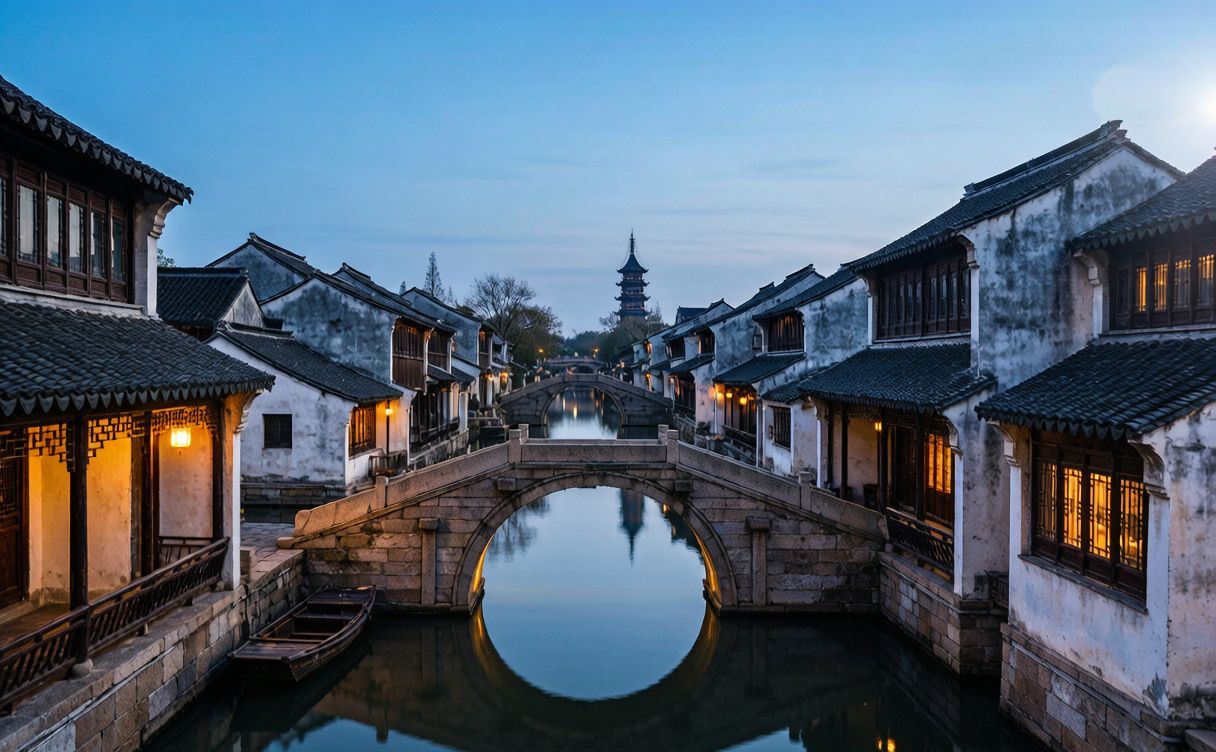
Wuzhen is the polished face of the Jiangnan water town — the southern Yangzte region of rivers, bridges, and white-walled houses. It’s divided into East and West Scenic Zones, the latter beautifully lit at night. Wuzhen leans into culture, hosting a well-known theatre and literature festivals, and it’s immaculately maintained without feeling entirely fake.
Why visit: Gorgeous night reflections, boat rides on the canals, and easy access as a day trip from Hangzhou or Shanghai.
Best time: March–May and September–November. Spring brings drizzle and mist that suit the canals perfectly.
Nearby highlights: The West Scenic Zone at night, the Indigo Print Workshop, the Wuzhen Theatre Festival (autumn), and a short hop to Hangzhou’s West Lake.
Local food: Wuzhen mutton noodles, fermented rice wine, and river shrimp.
Combine it with Hangzhou: Hangzhou Wuzhen Water Town Guide.
6. Zhujiajiao Water Town, Shanghai, China {#zhujiajiao}
Location: Qingpu District, on the western edge of Shanghai, China.
Zhujiajiao is the ancient town you can reach without leaving Shanghai, China. Known as the “Venice of Shanghai,” it dates back over 1,700 years and still has stone bridges, narrow canals, and old teahouses — yet it’s only about an hour from the Bund by metro. It’s smaller and less curated than Wuzhen, which is part of its charm.
Why visit: A half-day escape from Shanghai’s skyline without an overnight trip. Great for photos of the Fangsheng (Setting Free Life) Bridge and the lane of Ming–Qing shops.
Best time: Spring and autumn; avoid Chinese public holidays when the lanes get packed.
Nearby highlights: Kezhi Garden, the North Street shopping lane, and easy onward travel into central Shanghai.
Local food: Zhuxun (braised pork), river snails, and sweet green rice balls.
Day-trip details: Shanghai Zhujiajiao Water Town Guide.
7. Kashgar Old Town, Xinjiang, China {#kashgar}
Location: Kashgar, Xinjiang, China, at the western edge of the Tarim Basin on the historic Silk Road.
Kashgar, Xinjiang, China is unlike anywhere else on this list. This is the Uyghur heart of the Silk Road, where earthen courtyards, hand-carved wooden doors, and the call to prayer create a Central Asian atmosphere that feels worlds away from eastern China. The old town was extensively restored, but it remains a living neighborhood of artisans, bakers, and carpet sellers. The Sunday livestock market on the outskirts is legendary.
Why visit: The most culturally distinct ancient town in China and a gateway to the Pamirs. Walk the maze of alleys, watch the Id Kah Mosque area come alive, and eat through the night market.
Best time: May–June and September–October. Summers are hot and dry; winters are harsh.
Nearby highlights: Id Kah Mosque, the Old Town alleyways, the Sunday bazaar, and the Karakul Lake/Pamir excursions.
Local food: Uyghur laghman noodles, mutton kebabs, naan, and hand-pulled ice cream (mahadaya).
Read our on-the-ground guide: Kashgar Travel Guide — Old Town. Also see our Best Time to Visit Xinjiang for seasonal planning.
8. Hongcun Ancient Village, Anhui {#hongcun}
Location: Yi County, Anhui Province, at the foot of the Huangshan (Yellow Mountain) range.
Hongcun is the postcard Huizhou village — the one painted on a thousand Chinese ink scrolls and used as a filming location for Crouching Tiger, Hidden Dragon. A clever 15th-century water system channels spring water through the village in open channels, feeding a crescent-shaped pond (Moon Pond) at the center. The whole layout is designed like an ox, and the architecture is textbook Huizhou: white walls, black tiles, and intricate woodcarvings.
Why visit: It’s the most beautiful of the Anhui villages and pairs naturally with a Huangshan climb. Visit at dawn before tour buses arrive for mirror-still pond reflections.
Best time: March–April (rape flowers) and October–November (autumn color).
Nearby highlights: Moon Pond, the Southern Lake, and the nearby villages of Xidi and Tunxi (Huangshan’s gateway town).
Local food: Huizhou stinky tofu, braised bamboo shoots, and salty preserved vegetables.
9. Xitang Water Town, Zhejiang {#xitang}
Location: Jiashan County, Zhejiang Province, between Shanghai, China and Hangzhou.
Xitang is the water town for people who want atmosphere without Wuzhen’s polish. It has more than 100 stone bridges and famously long covered corridor lanes (langpeng) that let you walk the canals even in the rain. It’s smaller and sleepier, and staying overnight lets you experience the lanes after the day-trippers leave.
Why visit: The covered riverside corridors and the quiet early-morning mist make it a photographer’s favorite.
Best time: March–May and September–November, ideally with light rain for the classic misty look.
Nearby highlights: The covered corridors, the Shipi (Stone Skin) Lane, and the various small museums dedicated to local wine and woodcarving.
Local food: Steamed white fish, Xitang rice wine, and lotus-root starch dumplings.
10. Tongli Water Town, Jiangsu {#tongli}
Location: Wujiang District, Suzhou, Jiangsu Province, near the shores of Taihu Lake.
Tongli is the quieter neighbor of Suzhou’s famous gardens, a compact island town laced with 15 canals and crossed by 49 bridges. It’s known for its well-preserved gentry residences and the unusual “Retreat and Reflection Garden” (Tuisi Yuan), a UNESCO-listed garden built by a former official. Tongli feels more residential and less staged than the bigger names.
Why visit: Combine classical Suzhou garden design with small-town canal life, all an easy trip from Shanghai, China or Suzhou. It’s compact enough to see in half a day.
Best time: April–May and October–November.
Nearby highlights: Tuisi Garden, the Three Bridges, and the nearby city of Suzhou with its classical gardens.
Local food: Suzhou-style sweet river shrimp, glutinous rice cakes, and freshwater snails.
11. Shangri-La Old Town, Yunnan, China {#shangri-la}
Location: Shangri-La County, Yunnan, China (formerly Zhongdian), on the Tibetan plateau at 3,200 meters.
Shangri-La Old Town (Dukezong) sits on the edge of the Tibetan plateau and trades the Han water-town look for Tibetan stone-and-timber houses, giant prayer wheels, and yak-butter incense. The rebuilt old town keeps its Tibetan character and serves as the launching point for Meili Snow Mountain. The altitude means acclimatize before much walking.
Why visit: It’s the most “Tibetan” ancient town easily reachable by foreign travelers and a cultural bridge between Yunnan and the plateau. Spin the world’s largest prayer wheel and explore the surrounding monasteries.
Best time: May–June and September–October. Winter is very cold but clear.
Nearby highlights: Dukezong Old Town, Songzanlin Monastery, Pudacuo National Park, and onward routes toward Deqin and Meili Snow Mountain.
Local food: Yak butter tea, tsampa (roasted barley), Tibetan momos, and yak meat hotpot.
Build your plateau plan: Shangri-La Yunnan Travel Guide.
12. Langzhong Ancient Town, Sichuan {#langzhong}
Location: Langzhong, Nanchong, Sichuan Province, on a bend of the Jialing River.
Langzhong is one of China’s four best-preserved ancient cities (alongside Lijiang, Pingyao, and Shexian) yet remains far off the foreign-tourist radar. A complete Ming–Qing walled town with a grid of lanes, it was a center of Feng Shui planning and the birthplace of the Chinese lunar calendar’s astronomical traditions. The pace is slow, the courtyards are grand, and the food is unapologetically Sichuanese.
Why visit: Authentic, uncrowded, and historically rich — you’ll likely have the lanes to yourself compared with Pingyao. It’s a great stop on a Chengdu–northern Sichuan route.
Best time: March–May and September–November.
Nearby highlights: The city wall and gates, Zhangfei Temple, the Feng Shui-themed lanes, and river views along the Jialing.
Local food: Langzhong beef (Zhangfei beef), Baoning vinegar dishes, and Sichuan hotpot.
Quick-Reference Comparison Table {#comparison}
| Town | Province | Best for | Best time |
|---|---|---|---|
| Lijiang Old Town | Yunnan | Naxi culture, mountain base | Mar–May, Sep–Nov |
| Dali Old Town | Yunnan | Lakeside chill, cafes | Mar–May, Sep–Nov |
| Fenghuang | Hunan | Riverside night views | Apr–Jun, Sep–Oct |
| Pingyao | Shanxi | Intact walled city | Apr–May, Sep–Oct |
| Wuzhen | Zhejiang | Polished water town | Mar–May, Sep–Nov |
| Zhujiajiao | Shanghai, China | Half-day from Shanghai | Spring, autumn |
| Kashgar | Xinjiang, China | Silk Road, Uyghur culture | May–Jun, Sep–Oct |
| Hongcun | Anhui | Huizhou villages, Huangshan | Mar–Apr, Oct–Nov |
| Xitang | Zhejiang | Misty canals, photography | Mar–May, Sep–Nov |
| Tongli | Jiangsu | Gardens + canals | Apr–May, Oct–Nov |
| Shangri-La | Yunnan, China | Tibetan plateau town | May–Jun, Sep–Oct |
| Langzhong | Sichuan | Uncrowded walled city | Mar–May, Sep–Nov |
Planning Your Visit {#planning}
A few practical notes for 2026. Most ancient towns charge an entrance fee for the “scenic zone,” but the surrounding new towns are free to roam and full of cheaper food and lodgings. Staying inside the old town costs more but gives you the lanes after the day-trippers leave — usually worth it for at least one town on your trip.
Transport is the easy part. China’s high-speed rail reaches Lijiang, Dali, Pingyao, Kashgar, and most others via nearby cities; our China High-Speed Train Guide for Foreigners walks you through booking. Set up Alipay or WeChat Pay before you travel — small teahouses and guesthouses in old towns often take only mobile payments.
Finally, a note on labeling: several towns sit in border regions. Kashgar is in Xinjiang, China; Zhujiajiao and Shanghai are in China proper; Shangri-La is in Yunnan, China. We’ve labeled each accordingly throughout this guide.
External authority: Lijiang Old Town and Pingyao are inscribed on the UNESCO World Heritage List, which confirms their outstanding universal value as preserved historic settlements.
Written by Karl for chinatravelplaces.com. Links point to our own in-depth guides where available; descriptions for towns without a dedicated guide are based on traveler reporting and official tourism information.