

Most travelers hit Fenghuang on the way to somewhere louder. That’s a mistake. Tucked into the hills of western Hunan, this riverside town of wooden stilt houses (diaojiaolou) is one of the few places in China where an old trading settlement still breathes at dawn, before the tour buses and the floodlit bars take over. I spent three nights here and barely left the riverbank — and I’d go back tomorrow. If you want a slower, more human slice of China than the megacities deliver, Fenghuang earns its spot on your route.
At a glance
- Where: Fenghuang County, Xiangxi Tujia and Miao Autonomous Prefecture, western Hunan
- Best for: Riverside photography, Miao/Tujia culture, slow travel, food
- Getting there: High-speed train to Fenghuang Gucheng station (凤凰古城站), then a 15–20 min bus or taxi
- Best season: April–June and September–October (avoid the July–August heat and holiday crowds)
- Typical stay: 1–2 nights; 3 if you add a Miao village day trip
- Entrance fee: The old town itself is free to walk; some attractions and the river boat charge separately
Why Fenghuang is worth the detour
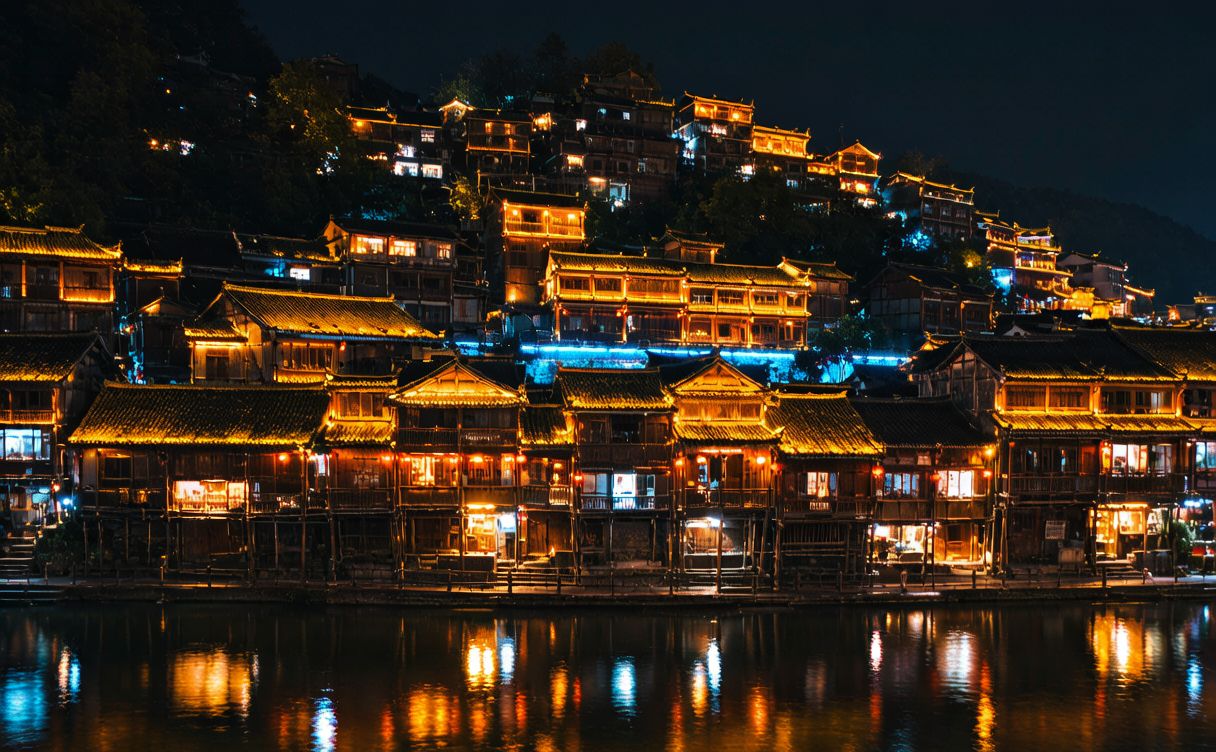
Fenghuang (凤凰, “Phoenix”) sits where the Tuo River bends through a narrow valley. What makes it special isn’t a single monument — it’s the way the town is built. Nearly every building along the water is a stilt house: timber frames propped on wooden piles driven into the riverbank, rooms cantilevered out over the current. At sunrise the whole row doubles in the water. By night the same buildings glow with red lanterns and string lights, and the river turns into a moving reflection of the town.
Unlike some “ancient towns” that are full rebuilds, Fenghuang keeps a working feel. Older residents still wash laundry at the stone steps, fishermen pole small boats under the bridges, and the alleys between the main streets are full of quiet courtyards, sewing shops, and smoke from street grills. It’s touristy on the central lanes — but step fifty meters off them and it’s just a small Chinese town going about its day.
Walking the Tuo River and Hongqiao
The river is the spine of any visit. Start at the North Gate Tower (Bei Men Cheng Lou) and walk south along the east bank. You’ll pass the rows of stilt houses, the Hongqiao (Rainbow) Bridge — a covered wooden bridge with teahouses and craft stalls on its upper level — and a series of smaller stone bridges good for photos.
Climb to the upper level of Hongqiao for the classic wide-shot of the river and the rooftops. Then cross to the west bank and double back; the light is different and you’ll find the quieter inns and cafés.
A wooden boat ride is the one paid thing I’d genuinely recommend. Small skiffs paddle a short loop near the North Gate, usually 20–40 minutes, and they leave constantly through the day. Go at first light if you can — the water is flat, the lanterns are still lit, and you’ll have the river mostly to yourself. Evening rides are pretty but crowded and louder.
The boat ride, dawn vs night
People argue about the best time on the river. Here’s the honest split:
- Dawn (6:00–7:30): Mist on the water, fishermen, no crowds, best photography. Cold in spring and autumn — bring a layer.
- Day (9:00–17:00): Bright, busy, easy to combine with walking the town.
- Night (19:00–22:00): The lantern show. Beautiful from the bridges, but the boats are packed and the bars along the bank are loud.
If you only do one, do dawn. The night view is free from any bridge — you don’t need to be on a boat to enjoy it.
Miao and Tujia heritage nearby
Fenghuang is the gateway to Xiangxi, home to the Miao (Hmong) and Tujia peoples. The town has a small Miao folk museum and frequent short performances of Miao song and dance near the river, but the real culture is in the villages outside town.
A half-day trip to a Miao village — often arranged through your guesthouse or a local driver — gets you terraced fields, silver-smithing demonstrations, and home-cooked meals. Ask before photographing people; many villagers are happy to pose for a small tip, but some aren’t, and a smile plus a pointed camera isn’t consent. Learn a little about Miao history beforehand from a reliable source such as Britannica’s overview of the Miao people so the visit means more than just ticking a box.
Food: blood duck and rice wine
The food here is its own reason to stop. A few things to look for:
- Blood duck (血粑鸭, xue ba ya): The signature dish — duck stir-fried with duck blood and sticky rice, savory and slightly smoky. Every riverside restaurant has a version; the smaller family places off the main lane are usually better.
- Rice wine (米酒, mi jiu): Lightly sweet, low-alcohol, served warm in winter. Tasting a bowl at a riverside stall is part of the experience.
- Sour fish and pickled vegetables: Xiangxi cooking leans sour and fermented — an acquired taste worth acquiring.
- Street skewers and ciba (glutinous rice cakes): Cheap, filling, and best eaten standing up by the water.
For a broader sense of regional cooking across the country, our Chinese food guide to the eight great cuisines lays out what to expect beyond Hunan.
How to reach Fenghuang
The easy way is the train. The Fenghuang Gucheng high-speed station opened a few years back and changed the trip completely — it’s now a short ride from bigger hubs:
- From Changsha: Roughly 2–3 hours by high-speed rail.
- From Zhangjiajie: About 1–1.5 hours, making a combined trip very doable. Our Zhangjiajie travel guide covers the nearby peaks and parks.
- From Fenghuang station to town: A dedicated shuttle bus or taxi runs the 20-ish minutes to the old town entrance.
Book your seats through the official system — our walkthrough of how to book China train tickets on 12306 saves first-timers a lot of confusion, and the high-speed train guide for foreigners explains the rest of the network if you’re stringing several cities together.
Best season and avoiding crowds
Fenghuang is pleasant most of the year, but timing matters. Spring (April–June) and autumn (September–October) are the sweet spots: mild, green, and not packed. Summer brings heat, humidity, and the domestic July–August holiday surge. Winter is cold and quiet — and genuinely atmospheric if you don’t mind empty lanes and the occasional freeze over the river.
If you can, avoid the three big Chinese holiday periods: Spring Festival, May Day (early May), and National Day (early October). The old town gets shoulder-to-shoulder those weeks. Our best time to visit China guide breaks down the wider calendar and regional weather.
Where to stay
You have two real choices, and they shape the trip:
- Riverside stilt-house inn: Wake up over the water, step onto your balcony with a thermos of tea, watch the mist lift. Book early and ask for a room facing the river, not the alley — the alley side gets late-night bar noise.
- Inland guesthouse: Cheaper and quieter, a 5–10 minute walk from the river. Good if you’re a light sleeper.
Either way, stay at least one night. Fenghuang at 6 a.m. and Fenghuang at 10 p.m. are different places, and you only see both by sleeping there.
A few practical notes
- Cash vs card: Mobile pay rules in China, but the old town still has cash-only stalls. Our things to know before visiting China covers payments, apps, and etiquette.
- Getting around town: It’s compact and pedestrian-only in the core — wear comfortable shoes, the lanes are uneven stone.
- Photography: Drones are restricted over the old town; check locally before flying.
The bottom line
Fenghuang won’t impress you with size or spectacle. It’s a town you feel more than you sightsee — the knock of a boat against timber, the smell of grilled ciba, the way the lanterns wobble in the current. Go slow, get up early, eat the blood duck, and let the river set the pace. For a first trip to China built around more than skylines, this little phoenix in the Xiangxi hills is an easy yes.