

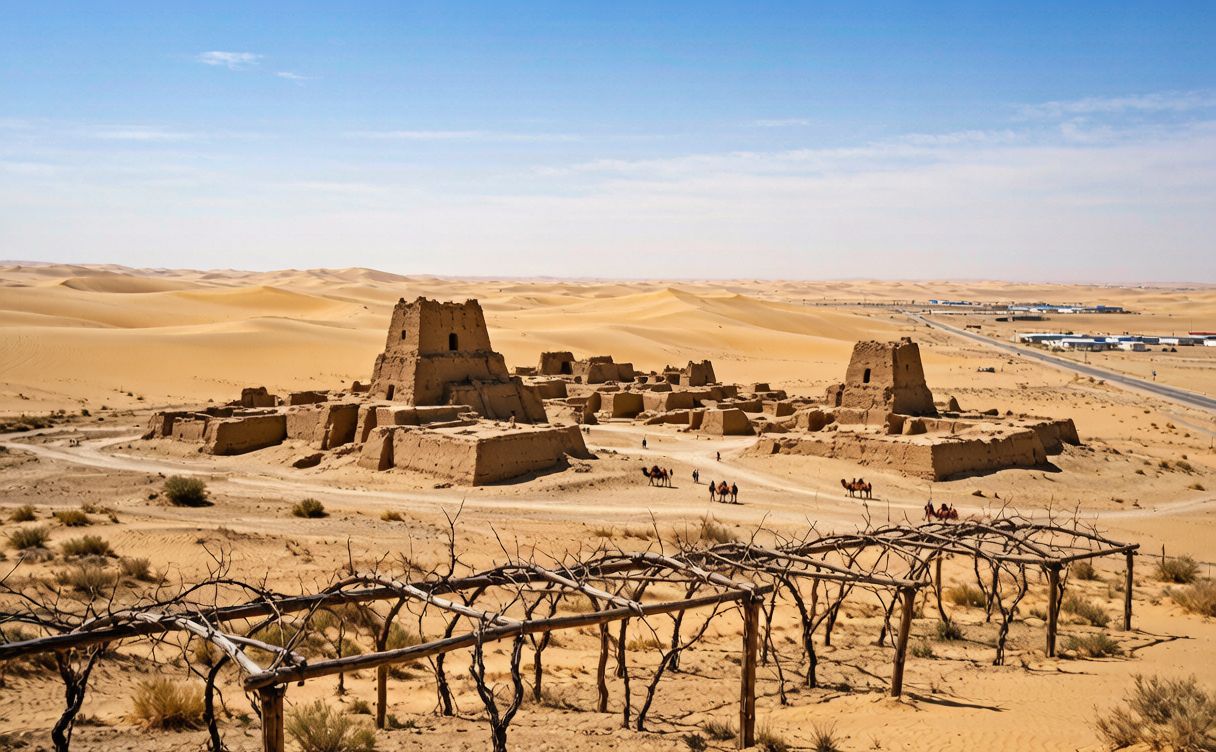
Stand on the cracked earth of the Jiaohe ruins at dawn and you feel it immediately — Turpan, Xinjiang, China is a place where the desert tried to win and the Silk Road refused to lose. This is the second-lowest, hottest, driest basin in the world, yet for two thousand years people have grown fat grapes here and built cities out of mud that still stand. Most foreign travelers blow through on the way to Kashgar or Urumqi. Slow down for two or three days and Turpan repays you with the most atmospheric ruins, the strangest irrigation system, and some of the best kebabs in the country.
Turpan sits in a rain shadow so complete that it gets less than 20 mm of rain a year — roughly what London gets in a wet weekend, stretched across twelve months. The water that keeps the oasis green comes from snowmelt off the Tianshan mountains, delivered by a 2,000-year-old underground tunnel network called the karez. More on that below, because it’s the quiet hero of this whole place.
What pulls travelers in is the layering of history. Turpan was a crossroads where Buddhism arrived from India, where Manichaeism and Nestorian Christianity once had congregations, and where the Uyghur language and identity took shape. You can stand in a 1,400-year-old Buddhist cave, eat a kebab grilled by a family whose ancestors came with the Silk Road caravans, and watch a high-speed train slide past the dunes — all in one afternoon.
At a glance
- Where: Turpan Basin, Xinjiang, China — about 150 km southeast of Urumqi, 154 m below sea level at its lowest point.
- Heat warning: Summer daytime temperatures regularly hit 40–45°C (104–113°F). Heatstroke is a real risk. Plan outdoor sightseeing for early morning or evening.
- Best season: April–June and September–October. Spring brings blooming apricot orchards; autumn is harvest time in Grape Valley.
- How to get there: High-speed train from Urumqi (about 1 hour) is fastest and most comfortable. Long-distance trains also connect from Xi’an and Lanzhou.
- Time needed: 2–3 full days to see the main sites without rushing.
- Language: Mandarin and Uyghur are both spoken; English is rare, so a translation app helps.
Getting to Turpan, Xinjiang, China
The easiest approach is from Urumqi, the regional capital. The high-speed line gets you to Turpan North Station in roughly an hour, and tickets are easy to book once you understand the system. If you’re building a longer western-China route, our Urumqi things to do guide covers the capital’s own sights, and the Xinjiang travel guide lays out the full region from north to south.
Booking trains in China as a foreigner has a few gotchas — real-name ID requirements, the right app, and which stations actually serve high-speed trains. Our walkthrough on how to book China train tickets on 12306 saves most first-timers a headache.
If you’re arriving from the east, the classic Silk Road entry is Xi’an. Pairing the Terracotta Army with Turpan’s ruins makes a clean historical arc, and the Xi’an travel guide explains how to connect the two.
The ruined cities: Jiaohe, Gaochang & Bezeklik
Turpan’s great ruins are the reason many people come, and they reward a slow pace.
Jiaohe
Jiaohe (Yarghul in Uyghur) is the more dramatic of the two. Built on a rectangular plateau between two rivers — the name means “where two rivers meet” — it was carved downward into the earth rather than built up. Walk the main avenue and you’re looking at the collapsed mud-brick walls of Buddhist monasteries, a government district, and residential blocks, all bleached the color of pale terracotta. There are almost no tourists at opening time, and the light is soft enough to photograph every wall. Give yourself two hours.
Gaochang
Gaochang, 45 km southeast, was the bigger, walled metropolis — a capital of the Uyghur kingdom. It’s flatter and more exposed, which means brutally hot midday, but the scale is astonishing: you can still trace the grid of streets inside a fortress wall that ran several kilometers around. Bring water and a hat, or visit late in the day.
Bezeklik Thousand Buddha Caves
Tucked into a gorge in the Flaming Mountains, the Bezeklik caves hold fragments of murals from the 5th to 14th centuries — apsaras, donors, and Buddhas painted in ochre and lapis. Many of the best murals were taken to museums in Berlin and Kyoto in the early 1900s (you’ll see empty niches where they were cut out), but what remains is enough to feel the weight of the place. It’s a short stop, an hour at most, and best combined with the Flaming Mountains on the same half-day.
Both Jiaohe and Gaochang are part of the UNESCO Silk Roads World Heritage corridor, which traces the routes that linked Chang’an (modern Xi’an) to Central Asia. The official listing is worth a read before you go: Silk Roads: the Routes Network of Chang’an-Tianshan Corridor — UNESCO.
Flaming Mountains & Grape Valley
The Flaming Mountains (Huoyan Shan)
You’ve seen them on the Chinese travel posters: a ridge of red sandstone that, at midday, looks like it’s genuinely on fire. The Flaming Mountains are the northern wall of the basin and the backdrop to the classic novel Journey to the West. The heat radiating off the rocks in summer is no exaggeration — surface temperatures here have been recorded above 70°C.
There’s a tourist strip at the base with a giant thermometer monument and a Journey to the West theme park, which is more fun than it sounds if you know the story. But the better experience is simply pulling over at a viewpoint, walking a few meters onto the scree, and realizing how alien and beautiful the place is. Go early or late; midday is unbearable and the photos are washed out anyway.
Grape Valley and the Karez system
Grape Valley (Putao Gou) is the green counterpoint to all that red rock. A shaded gorge where vines are trained overhead into tunnels, it’s cool, damp, and fragrant in late summer when the bunches hang heavy. You can taste a dozen varieties for a few yuan and watch raisins drying on the traditional kengfang racks. If you come in September or October, this is the single best thing to do in Turpan.
The Karez system is the engineering story behind the green. Wells are sunk at intervals down the mountain slope and connected by gently sloping underground channels, so snowmelt travels dozens of kilometers to the fields without evaporating in the desert air. Turpan has over 1,100 karez, some still in use. The Karez Museum on the edge of town lets you walk down into a real channel. It sounds niche; it’s genuinely one of the more impressive things you’ll see here.
Food: what to eat in Turpan
Turpan’s Uyghur cooking is the highlight of any visit, and it’s cheap.
- Kebabs (kawap): Lamb rubbed with cumin and chili, grilled over charcoal. The standard is a skewer of cubed tail-fat and meat alternating — trust it.
- Naan: The flatbread baked in a tonur oven, sold from roadside stalls still warm. Buy one to snack on at the ruins.
- Grapes and raisins: Obvious, but the scale and variety are the point. Seedless white grapes in summer, green raisins year-round.
- Hand-pulled noodles (laghman) and polo (pilaf with carrot and lamb) fill you up for under $3.
- Samsa: Spiced-meat pastries baked in the tonur, eaten hot.
A night market in the new town and the stalls around the old bazaar are the easy wins. Stick to busy stalls where meat is grilling fresh in front of you, and you’ll eat well and safely.
Planning your visit
When to go — and when not to
The basin’s climate is extreme but predictable. Summer (July–August) is ferociously hot; if you must come then, do everything before 10 a.m. and after 7 p.m., and treat midday as indoor or pool time. Winter is cold but clear, with few tourists and cheap rooms. The best time to visit Xinjiang guide breaks the region down month by month and by sub-region, since the north and the south differ sharply.
Spring (April–May) and autumn (Sept–Oct) are the sweet spots: warm but not lethal, with the orchards and vineyards at their best.
A sample 2-day plan
Day 1 — Arrive by morning train. Drop bags, then Jiaohe ruins (cool, early). Lunch in town. Afternoon: Karez Museum and Grape Valley. Dinner at the night market.
Day 2 — Early start for Gaochang ruins, then Bezeklik caves and the Flaming Mountains viewpoint on the way back. Evening train or overnight to Kashgar — our Kashgar old town guide picks up the Silk Road thread from there.
Practical tips
- Sun and water: The dryness fools you — you sweat and it evaporates instantly, so you dehydrate without feeling it. Carry 2 liters a day in summer.
- Dress: Light, long sleeves protect better from sun than short sleeves. A scarf helps with dust and mosque visits.
- Cash vs. cards: Alipay and WeChat Pay dominate, but a little cash covers small stalls where a QR code isn’t on display.
- Getting around: Sites are spread out. Hire a driver for a day (cheap, negotiable at the station) or join a local tour. Public buses exist but are slow and sparse.
- Altitude: Turpan is below sea level, so no altitude issues — a relief after the Tianshan passes.
Final word
Turpan, Xinjiang, China won’t flatter you with comfort — it’s hot, dry, and far — but it’s the closest you’ll get to touching the Silk Road as a living thing rather than a museum label. Spend two nights, ride the karez water from mountain to vine, and watch the Flaming Mountains turn black at dusk. Then keep going west.
Written by Karl.