

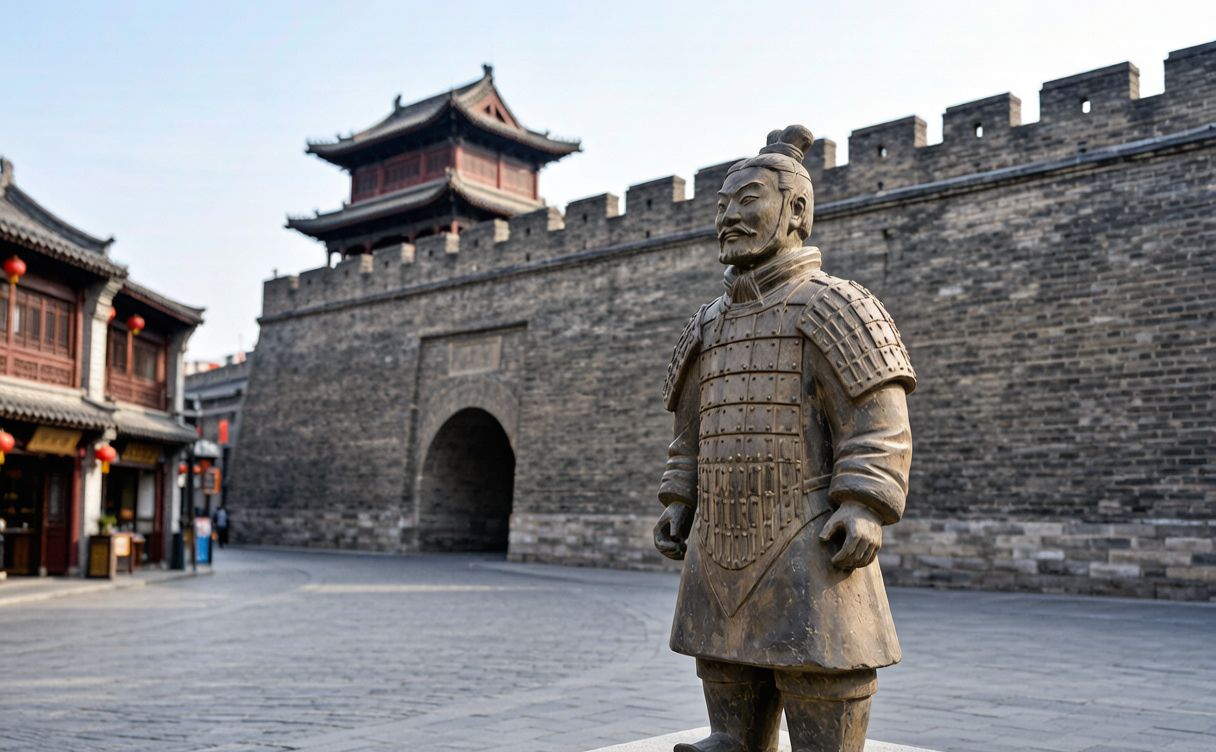
Most first-time visitors to China fly into Beijing or Shanghai and never make it west. That’s a real mistake. This Xi’an travel guide is for the traveler who wants the China that feels ancient and alive at once — a city that was the capital of thirteen dynasties and still wraps itself in a wall you can ride a bike around. Xi’an is where the Silk Road began, where an army of 8,000 clay soldiers has been standing guard underground for 2,200 years, and where you can eat lamb skewers handed to you by a Hui family whose ancestors settled here eight centuries ago. If you have three or four days anywhere in central China, spend them here.
At a glance
- Best for: History buffs, food lovers, photographers, first-timers wanting a softer entry to China than megacities
- Minimum time: 2 full days (3–4 is better)
- Top sights: Terracotta Army, City Wall, Muslim Quarter, Bell & Drum Towers, Great Mosque
- Getting in: High-speed train from Beijing (4–5.5 hrs) or direct flight
- Walkability: Excellent inside the wall; the wall-enclosed old city is flat and compact
- Vibe: Ancient capital that hasn’t been turned into a museum — people actually live here
The Terracotta Warriors: timing beats everything
The Terracotta Army is the reason most people come, and it rewards planning. The site sits about 40 km east of the city in Lintong, so budget a half day including transit. Pit 1 is the showstopper — a vast hangar-like hall where rows of life-sized soldiers stand in battle formation, most still awaiting full excavation. Pit 2 holds cavalry and archers; Pit 3 is the command post. Don’t skip the on-site museum with two bronze chariots; they’re small but stunning.
Tickets. The standard admission is ¥120 in peak season (March–November) and ¥90 in winter, covering all three pits plus the museum and a shuttle. Buy at the official window or, better, through the same systems you’d use for trains — our guide on booking China train tickets via 12306 walks through the app that handles a lot of attraction bookings too. Either way, bring your passport: it’s checked against the ticket.
Timing. Arrive when the gates open (typically 8:30 a.m.) or after 3 p.m. The mid-morning crush from tour buses is real, and the light in Pit 1 is flat and gray at noon. Go early, walk the pits clockwise, and you’ll have the front-row railing at Pit 1 almost to yourself. Avoid Chinese public holidays entirely if you can — the lines then are measured in hours, not minutes.
Ride the City Wall before you do anything else
Xi’an has the most complete ancient city wall left in China, and you can walk or cycle the full 13.7 km loop on top of it. The wall is about 12 meters wide up top — wide enough for a proper bike path — and 14 meters tall. Rent a bike at the South Gate (Nanmen), the most impressive entry, and circle it in roughly 1.5–2 hours if you keep moving. Go near sunset: the bricks warm to gold, the moat below goes still, and the modern city glows beyond the ramparts.
A few practical notes. Bike rental runs about ¥45 for a single, and you must return the bike to the same gate before it closes (around 10 p.m. in summer, earlier in winter). Walking the wall is free with your entry ticket but slow; cycling is the move. If your legs protest, the South Gate also has an evening fountain-and-light show that’s cheesy in the best way.
Muslim Quarter: eat your way through the old city
North of the Drum Tower is the Muslim Quarter (Huimin Jie), the loud, smoky, delicious heart of Xi’an’s Hui Muslim community. This is the best street food in the city and some of the best in the country. Come hungry and come in the evening when the stalls fire up.
What to eat:
– Roujiamo — the “Chinese hamburger,” chopped stewed pork (or beef) in a round baked bun. Get it from a stall with a line; ¥10–15.
– Biang biang noodles — wide, belt-like ribbons in chili oil. The character for biang has 58 strokes; just point.
– Yangrou chuanr — cumin lamb skewers, ¥3–5 each, handed over hot off the coals.
– Persimmon cakes (guanneng) and mirror-cake (jinggao) for something sweet.
– Suanmeitang — cold sour plum drink that cuts the heat.
It gets crowded and the lanes are narrow. If you travel with dietary worries, our piece on street food safety in China covers what’s safe to eat from a cart and what to skip. Spoiler: the grilled meat and fresh noodles here are about as safe as street food gets.
Bell Tower, Drum Tower, and the Great Mosque
The Bell and Drum Towers sit at the geographic center of the old city, facing each other across a traffic roundabout. The Bell Tower is the larger and photogenic one, especially lit at night; you can climb both for views over the tiled rooftops. A combined ticket is cheaper than two singles. They’re touristy, but they anchor the city visually and make a natural landmark when you’re weaving back from the Muslim Quarter.
Two streets west of the food chaos, down a quiet lane, is the Great Mosque of Xi’an — one of the oldest and largest in China, built in the Tang dynasty and expanded under the Ming. What’s remarkable is that it’s laid out like a Chinese temple: courtyards, pavilions, and a screen wall, with Arabic calligraphy tucked inside. Non-Muslim visitors can enter the outer courtyards (dress modestly, ¥25, and be quiet during prayer times). It’s a calm, beautiful counterpoint to the noise two minutes away.
How many days do you need?
Two days covers the essentials: Terracotta Army one morning, wall + Muslim Quarter + towers the other. Three days lets you add the Great Mosque, the Small Wild Goose Pagoda, and a relaxed evening. Four days opens a day trip to Hua Mountain (Huashan) for the cliffside cable cars and plank walk that terrify half of YouTube.
If you’re building a longer China route, Xi’an slots naturally between Beijing and Chengdu, or as the eastern anchor before heading south to the river gorges.
Getting to Xi’an from Beijing by train
The high-speed line makes Xi’an an easy add-on to a Beijing trip. Trains run from Beijing West to Xi’an North roughly every 20–30 minutes through the day, and the G-series bullets cover it in 4 to 5.5 hours depending on stops. Second class is comfortable and costs around ¥515; first class is roomier for not much more. Book a few days ahead in peak season.
Our high-speed train guide for foreign visitors explains seat classes, how to read a Chinese ticket, and the ID rules — you must book with your passport number, and the gate checks it. Miss the train and the ticket is void; arrive 30 minutes early your first time.
Where to stay and when to go
Stay inside the city wall if it’s your first visit. The South Gate and Bell Tower areas are the obvious choices: walkable, lit up at night, and steps from the food. Our Beijing where-to-stay guide has the same logic applied to the capital if you’re pairing the two cities.
Timing-wise, spring (April–May) and autumn (September–October) are ideal — mild, clear, and good for wall-cycling. Summer is hot and packed; winter is cold but cheap and empty, and the Terracotta Army with no crowds is a different experience. Check the best time to visit Beijing if you’re sequencing both cities, since their weather tracks closely.
One more thing worth knowing before you go: Xi’an is friendly to foreign cards at hotels and big attractions, but small food stalls are cash or mobile-pay only. Set up Alipay or WeChat Pay before arrival and keep a little cash for skewers so you’re not stuck at a stall with a dead payment app.
Practical tips that save the trip
- Get a local SIM or eSIM so maps and translation work outside Wi-Fi. Our SIM card guide for tourists compares what’s easiest to pick up at the airport.
- Carry your passport. Hotels, the Terracotta site, and train gates all check it.
- Watch the holiday calendar. Golden Week (early October) and Spring Festival turn every attraction into a shoulder-to-shoulder swarm.
- Taxis vs. metro. The metro is clean and cheap and reaches both the wall and the train station; use DiDi (the local Uber) for door-to-door when you’re laden with noodles.
Xi’an rewards the traveler who slows down. See the warriors early, cycle the wall at golden hour, then lose yourself in the Muslim Quarter until the skewers run out. It’s the closest you’ll get to tasting why this city mattered for a thousand years — and why it still does.
This article was written by Karl, based on repeated trips through central China. For official opening hours and ticket prices, confirm with the Xi’an Tourism official site before you go, since schedules shift season to season.