

The best time to visit Beijing is spring (April–May) or autumn (September–October), when daytime highs sit in the comfortable 19–26°C range and the skies turn that famous postcard blue. I’ve now spent five separate trips in this city across every season, and the gap between an October blue-sky week and a July thunderstorm afternoon is the gap between a trip you’ll rave about and one you’ll just survive. This guide breaks the year down month by month — real temperatures, crowd levels around China’s holidays, air-quality trends, and exactly what to pack — so you can pick your window instead of fighting it.
Key Takeaways
– The best time to visit Beijing is April–May and September–October, with mild 15–26°C days, low humidity, and reliably clear skies.
– Avoid the two 2026 Golden Weeks — Spring Festival (Feb 15–23) and National Day (Oct 1–7) — when trains sell out and every sight packs wall-to-wall.
– Summer (Jun–Aug) is hot, humid, and rainy (July alone averages ~176 mm), but crowds thin as locals escape the heat.
– Winter (Dec–Feb) is bone-dry cold with occasional snow, the fewest tourists, and the year’s worst air during heating season.
– Air quality is now excellent March–October — Beijing recorded 348 “good” PM2.5 days in 2025 — so the old “smoggy city” reputation no longer holds in shoulder season.
Beijing’s Climate at a Glance
Beijing sits in a continental monsoon zone, so it gets four sharply different seasons. Winters are cold and dry; summers are hot, sticky, and stormy; spring and autumn are short, goldilocks windows that locals and visitors both race to enjoy. Long-term normals from the World Weather Information Service (WMO) put the annual average high at roughly 14°C, but that single number hides a 30-degree swing between January and July.
Here’s the month-by-month picture I keep bookmarked before every trip:
| Month | Avg High | Avg Low | Rain (mm) | What it feels like |
|---|---|---|---|---|
| January | 2°C | −9°C | 3 | Coldest; dry; occasional snow |
| February | 4°C | −7°C | 6 | Still freezing; pre-Festival calm |
| March | 11°C | −1°C | 9 | Warming; windy, dust risk |
| April | 20°C | 7°C | 26 | Pleasant; parks in bloom |
| May | 26°C | 13°C | 29 | Warm, dry, lovely |
| June | 30°C | 18°C | 71 | Heat and humidity climb |
| July | 31°C | 22°C | 176 | Hottest, rainiest, muggy |
| August | 30°C | 20°C | 182 | Still rainy and humid |
| September | 26°C | 14°C | 49 | “Golden September,” cooling |
| October | 19°C | 7°C | 19 | “Golden Autumn,” crisp |
| November | 10°C | 0°C | 6 | Rapid cool-down |
| December | 3°C | −7°C | 2 | Cold, dry, clear |
The headline: aim for the rows where the high lands between 19°C and 26°C and the rain stays under 50 mm. That neatly describes April, May, September, and October.
Planning your first visit? Our Beijing travel guide for first-timers walks through visas, transport, and the best neighborhoods to stay.
Spring (March–May): Blooms, But Watch the Wind
Spring is when Beijing shakes off winter. By April the parks explode with peach and crabapple blossoms, and a 20°C afternoon is close to perfect for walking the hutongs. May is even better — warm, dry, and green.
The catch is the wind. March and early April are Beijing’s windiest weeks, and that’s also sandstorm season, when grit blows in from the Gobi Desert. Most years it’s just a breezy, dusty day; some years it’s a genuine orange-sky event. I learned this the hard way in April 2023, cycling past Gulou when the light went strange — by 3 p.m. the sky had turned the color of weak tea and the air stung my eyes. That was a spring dust storm, and the air-quality index that afternoon climbed past 150. Locals just pulled on masks and kept walking.
Crowds: Spring is moderate, with two bumps. Qingming (Tomb-Sweeping Day, around April 4–6) sends families to parks, and Labour Day (May 1–5, 2026) is a five-day holiday that fills trains and the Great Wall. Travel the weeks between and you’ll have room to breathe.
What to pack: a light jacket for cool mornings, a windbreaker for dusty afternoons, and a scarf. Bring a basic mask if you’re sensitive to dust — it’s the one season I’d actually pack one.
Summer (June–August): Hot, Humid, and Quiet-ish
Summer is Beijing at its most extreme. Highs hit 30–31°C, humidity rides up with them, and the rain arrives in earnest — July and August each pull in 176–182 mm, often as evening thunderstorms that turn the hutongs slick and the air briefly fresh.
Here’s the paradox: June–August is China’s school-holiday season, so you’d expect crowds. But Beijing residents flee the heat on weekends, and many foreign visitors assume summer is unbearable and stay away. The result is a city that’s busy at marquee sights but rarely as crushed as October. Time outdoor plans for early morning or after a storm, and summer is genuinely workable — the rain even scrubs the air clean.
Crowds: moderate-to-high at the Forbidden City and Badaling, but manageable elsewhere. Start at 8 a.m. and you’ll beat both the heat and the tour buses.
What to pack: breathable cotton shirts, a compact umbrella, sunscreen, and a refillable water bottle. An afternoon thunderstorm can soak you in minutes, so keep electronics in a dry bag.
Autumn (September–November): The Golden Window
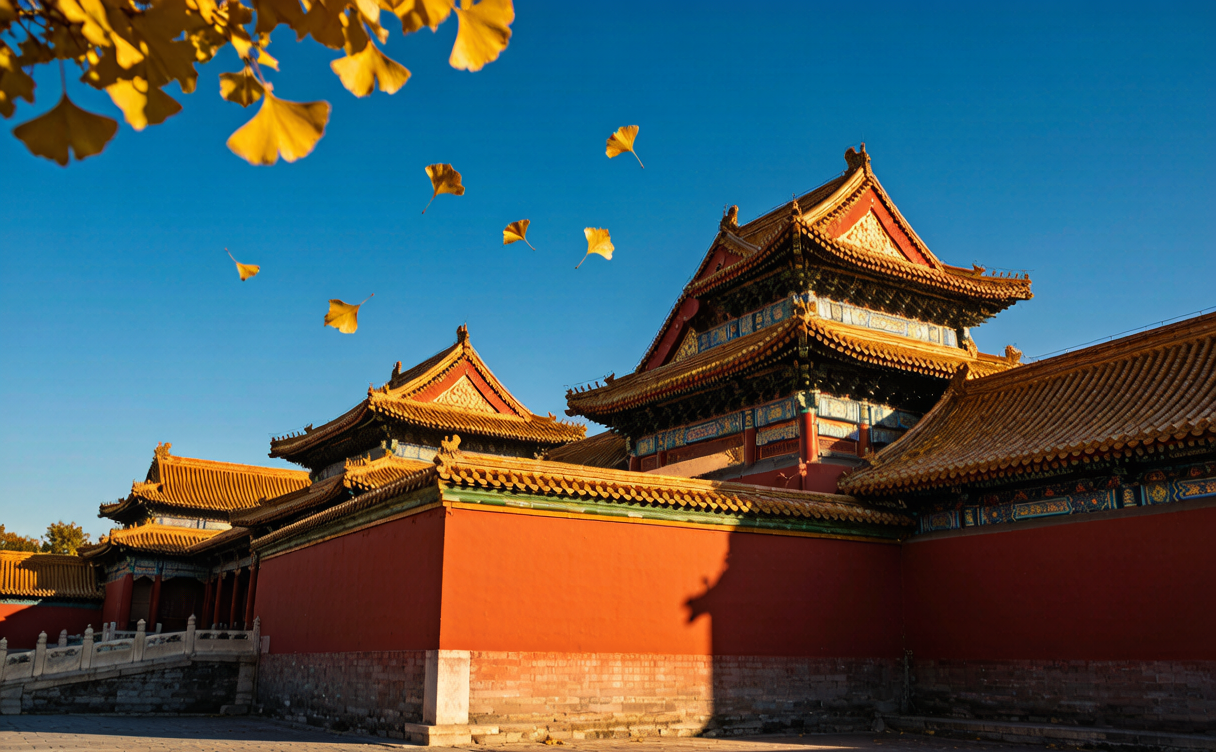
If you ask me the single best time to visit Beijing, I’ll say the last two weeks of September and the stretch from mid-October to early November. September cools from a warm 26°C into a mellow 20s, the humidity drops, and the sky turns a deep, reliable blue. October is the city’s postcard month — crisp 19°C days, almost no rain, and trees along the hutongs going gold.
I deliberately shifted a 2019 trip to land in late September instead of October, and it paid off. One Wednesday at the Summer Palace I had the Long Corridor nearly to myself, the lakeside trees were turning, and the air was so clear I could read the rooftops of the Forbidden City from Jingshan Hill. That’s the Beijing everyone pictures, and almost nobody was fighting me for it.
Crowds — the one trap: National Day Golden Week runs October 1–7, 2026, and it is the worst week of the year. Trains sell out the minute they’re released, hotels triple, and the Forbidden City hits its daily cap by 9 a.m. The fix is simple: travel the two weeks before October 1 or the two weeks after October 7, and you get identical weather with a fraction of the people. For the national picture, our best time to visit China guide maps the same logic across every region.
What to pack: a light sweater for mornings, a medium jacket by November, and comfortable walking shoes. Autumn is the easiest season to dress for — layers solve everything.
Want the full Wall breakdown? Our Great Wall day trip from Beijing guide compares Mutianyu, Badaling, and Jinshanling with exact train times.
Winter (December–February): Cold, Clear, and Crowd-Free
Winter divides travelers. Temperatures sit below freezing from December through February, the wind off the Mongolian plateau bites, and heating season (mid-November to mid-March) can trap smog under a cold inversion — so air quality is at its yearly worst. But the trade-offs are real: almost no tourists, the lowest hotel rates of the year, and a city that looks spectacular under snow.
On a January morning the temperature sat at −6°C but the sky was a shock of blue. I walked out onto the frozen Houhai lake where old men were skating, then took the early train to Mutianyu — and had a snow-dusted watchtower almost to myself by 9 a.m. Cold, yes, but not crowded. A snow-dusted Great Wall is one of the most photogenic sights in China, and you’ll have it largely alone.
Crowds: low, except around Spring Festival (Chinese New Year), Feb 15–23, 2026 — a nine-day break and the world’s largest annual migration. Transport jams and some family-run shops close, but major sights stay open and domestic tourism concentrates on hometowns, not Beijing. If your dates are flexible, arrive after the Festival week for empty attractions.
What to pack: a proper winter coat, thermal base layers, gloves, a hat, and solid insulated boots. Indoor heating is fierce, so wear layers you can shed indoors.
Air Quality: The “Beijing Blue” Bonus
Worried about smog? The data should ease your mind for most of the year. According to a January 2026 release from the Beijing Municipal Ecology and Environment Bureau, the city’s average PM2.5 in 2025 fell to 27.0 µg/m³ — the first year it dropped below 30 — and Beijing logged 348 days of “good” air quality, with PM2.5 staying at good levels for 227 consecutive days from March through October.
In plain terms: from spring through autumn, “Beijing Blue” is now the default, not the exception. The weak spots are winter (heating inversion) and the occasional spring dust storm. If clean air matters most to you, target June–October, when rain and wind keep the sky clear. Check the real-time AQI and save outdoor Wall days for a blue-sky forecast.
Crowds & Holidays: The Golden Week Trap
Everything above about weather is undone if you land during a Golden Week. China’s two week-long holidays in 2026 are:
- Spring Festival (Chinese New Year): Feb 15–23, 2026 — nine days, and the planet’s biggest travel surge.
- National Day Golden Week: Oct 1–7, 2026 — seven days, with Oct 1 the single busiest day at every famous site.
- Labour Day: May 1–5, 2026 — a shorter but still busy five-day break.
The move that saves more trips than any other: shift your dates by 10–14 days. Mid-September and mid-October feel identical to early October weather-wise but lack the crowds entirely. And book transport early — our high-speed train guide for foreigners explains exactly when tickets release and how to grab them before they vanish.
What to Pack, by Season
A quick cheat sheet so you’re never caught out:
- Spring: light jacket, windbreaker, scarf, dust mask (just in case).
- Summer: breathable shirts, umbrella, sunscreen, water bottle, dry bag for electronics.
- Autumn: layers, light sweater, medium jacket by November, good walking shoes.
- Winter: heavy coat, thermals, gloves, hat, insulated boots.
Final Verdict: When Should You Go?
The best time to visit Beijing is April–May or September–October, with a slight edge to late September and mid-to-late October for blue skies and thinner crowds. Build your trip around those windows, steer clear of Feb 15–23 and Oct 1–7 in 2026, and pack for the season you chose. Summer works if you beat the heat; winter rewards you with solitude and snow.
Whichever month you pick, the city delivers — you just need to time it. For the full sightseeing list once you’re here, see our things to do in Beijing guide, and for a day-by-day plan that strings it all together:
Ready to map your days? String the sights together with our Beijing 3-day itinerary.
Pick your window, book the Forbidden City tickets early, and let the hutong bicycle bells wake you.
Written by Karl · Updated July 2026