

The Temple of Heaven isn’t a temple and it isn’t one building — it’s a 273-hectare walled park in southeast Beijing where Ming and Qing emperors came to pray for good harvests. Most first-timers rush in, snap the blue-roofed Hall of Prayer, and leave within an hour. That’s a mistake. On my first visit I did exactly that, then returned at 8 a.m. on a later trip and found a completely different place: a living park where hundreds of Beijingers were practicing tai chi, singing opera, and walking their birds. This guide covers what to see, 2026 ticket prices in RMB, opening hours, the Echo Wall trick, and how to catch the local life that makes the Temple of Heaven special.
Key Takeaways
– Buy the combined ticket (¥34 peak / ¥28 off-season) to enter the three inner sights — the single park ticket (¥15) only gets you the grounds.
– The park opens at 6:00 a.m. (Apr–Oct) but the Hall of Prayer, Echo Wall and Circular Mound open at 8:00 a.m. and close Mondays.
– Go before 9 a.m. to watch locals do tai chi and to actually hear the Echo Wall work.
– The Hall of Prayer for Good Harvests is a 38-meter wooden masterpiece built without a single nail — the symbol of Beijing.
– Best months are April–May and September–October; skip National Day (Oct 1–7) when crowds swamp the grounds.
What Is the Temple of Heaven?
Built in 1420 under the Ming emperor Yongle — the same ruler who began the Forbidden City — the Temple of Heaven was where the Son of Heaven performed the most important ritual of the year: praying to Heaven for a good harvest. It’s enormous, about three times the size of the Forbidden City, and laid out on a north–south axis. The northern wall is rounded and the southern wall is square, echoing the old Chinese belief that “heaven is round and earth is square.”
In 1998 UNESCO listed it as a World Heritage Site, calling it “a masterpiece of architecture and landscape design.” You can read the official background on the Beijing municipal tourism page at english.beijing.gov.cn, which also carries the current opening hours. The whole complex is a quiet park first and a museum second — a balance that confuses visitors who expect a single monument.
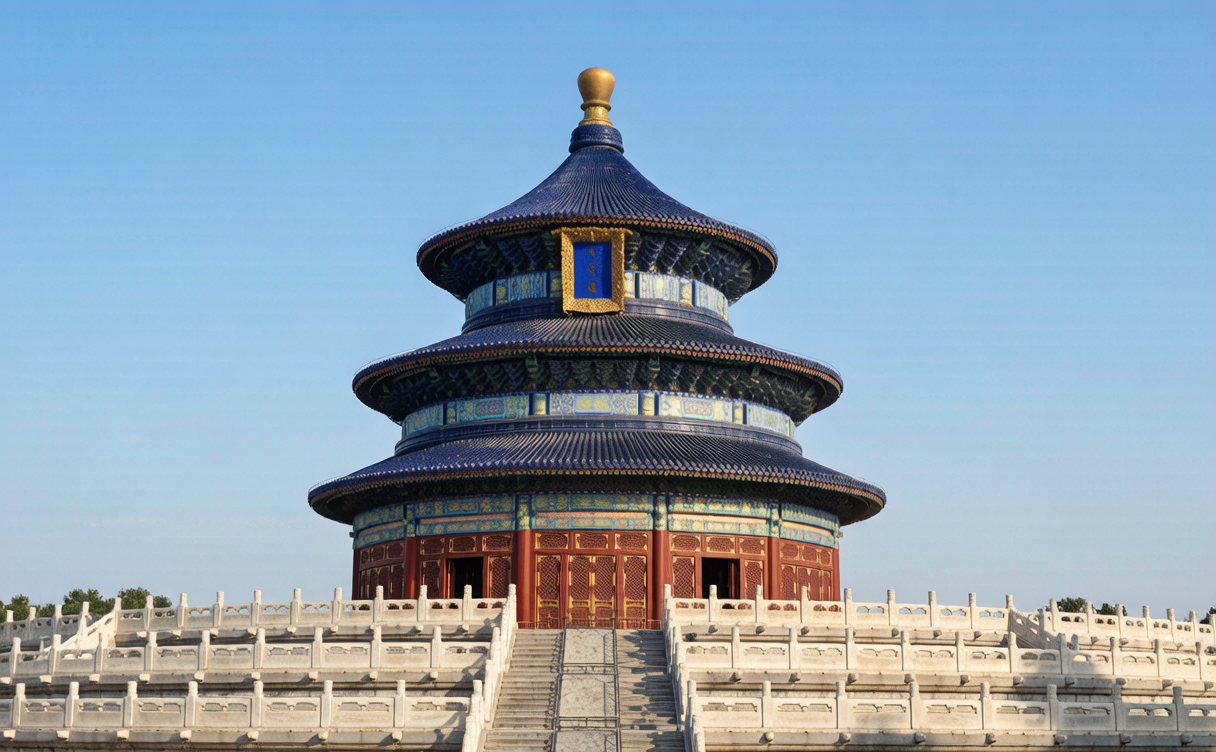
The Hall of Prayer for Good Harvests
This is the building on every Beijing postcard. A triple-eaved circular hall wrapped in deep-blue glazed tiles, it stands 38.2 meters tall and 24.2 meters across, raised on a three-tiered white-marble terrace. What stopped me the first time wasn’t the height — it was learning the hall has no nails and no crossbeams. The entire structure is held up by 28 wooden pillars in a feat of interlocking joinery.
The pillars carry meaning. The four central “Dragon Well” columns, each 19.2 meters tall, stand for the four seasons. The inner ring of 12 represents the months; the outer ring of 12 stands for the traditional twelve two-hour periods of the day. Stand back on the central axis and you’ll see why it became the symbol of the city. The original burned down in a lightning strike in 1889 and was faithfully rebuilt — so what you photograph is Victorian-era craftsmanship on a 15th-century plan.
The Echo Wall and Imperial Vault of Heaven
A short walk south brings you to the Imperial Vault of Heaven, a smaller single-roofed blue hall that once stored the sacred tablets used in the ceremonies. It’s ringed by the Echo Wall — a smooth circular wall about 65 meters across, built so precisely that a whisper against one side carries to a listener on the opposite side.
I had to try it. On a Tuesday morning at 8:20, my friend whispered “ni hao” against the brick, and I heard it clearly from 60 meters away — the park was nearly empty and the sound had nothing to compete with. By 11 a.m., when tour groups arrive, you’ll hear only chatter, and the trick fails. Timing is everything here. Also look for the Triple-Sound Stones on the approach path: clap once and you get one, two, then three distinct echoes bouncing off the vault behind you.
The Circular Mound Altar
The southernmost and most sacred structure is the Circular Mound Altar — an open, three-tiered marble platform where the emperor actually faced Heaven on the winter solstice. There’s no roof, deliberately, so the emperor stood directly beneath the sky. At its center sits the Heart of Heaven Stone: stand on it, speak, and your own voice rings back amplified by the surrounding balustrades.
The altar is built around multiples of nine, the most “yang” and imperial of numbers — nine rings of stone slabs, the innermost of nine, expanding outward to 81 in the outer ring. It’s the kind of detail you’d walk straight past without a guide or a paragraph like this one.
Tickets & Opening Hours (2026)
The Temple of Heaven uses a two-tier ticket system, and getting the wrong one is the most common tourist error. The park ticket only admits you to the grounds and gardens. To step inside the Hall of Prayer, Echo Wall, and Circular Mound you need the combined (through) ticket.
| Ticket | Peak (Apr 1–Oct 31) | Off-season (Nov 1–Mar 31) |
|---|---|---|
| Park only (grounds) | ¥15 | ¥10 |
| Combined (3 inner sights) | ¥34 | ¥28 |
| Hall of Prayer / Echo Wall / Circular Mound (separate) | ¥20 | ¥20 |
Opening hours:
– Park gates: 6:00–22:00 (last entry 21:00) in peak season; 6:30–22:00 off-season.
– Inner sights (Hall of Prayer, Echo Wall, Circular Mound): 8:00–18:00 (last entry 17:30) peak; 8:00–17:00 (last entry 16:30) off-season.
– Closed Mondays (except statutory holidays) — plan around it.
– Children under 1.2 m free; students and kids 6–18 half price; seniors over 60 free with ID.
Foreign visitors book through the WeChat account “Temple of Heaven Official Ticketing Platform” using a passport. Buy a day ahead in peak season — the combined ticket caps daily, and Monday closures mean Tuesday mornings get busy with everyone who couldn’t go the day before.
Local Life: Tai Chi, Opera, and Birds
Here’s what the postcards don’t show. The Temple of Heaven is one of the best places in Beijing to watch ordinary city life unfold, and it’s free to simply wander the outer park. Arrive between 6:30 and 9:00 a.m. and you’ll find:
- Tai chi groups moving in slow unison under the cypress trees.
- Retirees singing Beijing opera (or erhu ballads) with portable speakers.
- Bird-keepers strolling with caged songbirds — a fading old-Beijing hobby.
- Kite-flyers and calligraphy enthusiasts writing with water on the paving stones.
I once sat on a bench near the east gate for twenty minutes and watched a man practice sword forms while a woman beside him painted characters on the ground with a giant wet brush, the characters evaporating as the sun rose. Nobody was performing for tourists. That quiet, ordinary morning is the real Temple of Heaven — and it costs nothing beyond your park ticket.
[CTA] Planning the rest of your Beijing stay? Our Beijing first-time travel guide breaks down where to stay, how to get around, and which hotels sit near a subway line.
Best Time to Go
Time of day: Arrive at opening (6:00–6:30 a.m. for the park, 8:00 a.m. for the sights). The first two hours belong to locals and photographers; by late morning the tour buses arrive and the calm is gone. If you only have an afternoon, go for the light on the Hall of Prayer around 4 p.m.
Time of year: Spring (April–May) and autumn (September–October) are ideal — clear skies and 15–25°C days. Summer is hot and crowded; winter is cold but stunningly empty and great for photos. Avoid National Day Golden Week (Oct 1–7) and the Spring Festival holiday, when the grounds turn into a scrum. For the regional weather picture, see our best time to visit China guide.
[CTA] Want a day-by-day plan that pairs the Temple of Heaven with the Forbidden City and the Great Wall? Our Beijing 3-day itinerary strings the big sights together without backtracking.
Insider Tips
A few things I wish I’d known on trip one:
- Enter from the east or north gate and walk the central axis north to south — it mirrors the emperor’s own processional route and saves steps.
- Rent the audio guide (¥40, plus ¥100 deposit) at any gate. The symbolism of the pillars and numbers is easy to miss without it.
- Bring your passport even if you book online — it’s matched to your ticket at the gate.
- Go on a weekday and skip Mondays entirely (closure). Tuesday morning is the sweet spot.
- Pair it with the Summer Palace in the same trip if you love imperial gardens — they’re two different moods of the same era. Our Summer Palace guide has the ticket prices and boat-rental details.
Getting There
The park has four gates; the East Gate (Tiantan Dongmen) is the most convenient and sits right on Subway Line 5 (Tiantan Dongmen station). The North Gate is near Line 8 (Tianqiao). A DiDi from the Forbidden City runs about 20–30 minutes and ¥25–40 depending on traffic. If you’re doing the Forbidden City the same day, our Forbidden City tickets guide explains the Monday closure and the advance booking you’ll need there too.
Make the Temple of Heaven Your Morning
The Temple of Heaven rewards a slow start. Buy the combined ticket, arrive when the gates open, walk the axis from the Hall of Prayer down to the Circular Mound, and leave an hour just to watch the park wake up. Most visitors see the building; the travelers who go early see the city. With ticket prices under ¥35 and a morning that costs nothing extra, it’s one of the best-value half-days in Beijing.
[CTA] Build your full route around it — our things to do in Beijing guide covers the Wall, hutongs, and Peking duck, and our China travel guide for first-timers handles visas and payments before you fly.
Written by Karl, a travel writer who has lost count of his Temple of Heaven visits — and still thinks a 7 a.m. tai chi morning beats the postcard shot every time.