

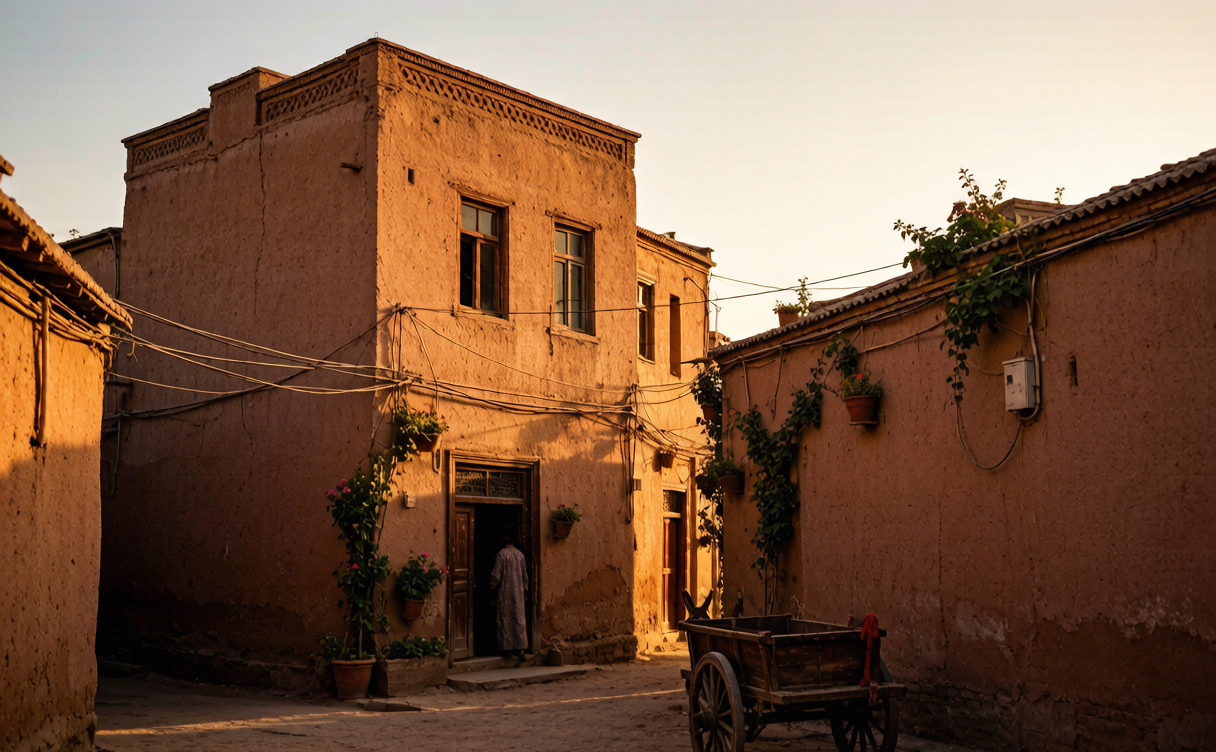
The first time I got lost in Kashgar old town, I was grateful for it. I had turned off Seman Road to chase the smell of roasting lamb, took three random lefts into the mud-brick labyrinth, and suddenly there was no map that matched the alleys around me — just wooden doors painted a tired blue, a grandmother thumping naan dough on a courtyard wall, and a boy wheeling a bicycle far too big for him. That disorientation is the point. The old town is one of the last living Silk Road neighborhoods on earth, and the best way to see it is to surrender to its lanes. This guide is the one I wish I had before that first trip: how to reach Kashgar, where to walk, what the Sunday market actually looks like, and the respectful, practical habits that make a conservative Muslim city easy to enjoy.
Why Kashgar Old Town Matters
Kashgar sits at the western edge of China, where the Tarim Basin meets the Pamir Mountains, and it has been a trading crossroads for more than two thousand years. Caravans from Samarkand, Bukhara, and Kashmir converged here to swap silk, jade, wool, and spices before pushing on toward Xi’an and the heart of China. The old town — called Kashgar’s historic core — is the physical memory of that trade: a dense warren of earthen houses, covered bazaars, and tea houses built by generations of Uyghur families. UNESCO recognizes the wider Silk Roads corridor as World Heritage, and you can read about the trans-Asian route network on the UNESCO World Heritage Centre. Standing in the old town, you are literally standing on a road that moved civilizations.
What makes it different from the glass-and-concrete new city around it is that people still live here. This is not a museum district with staged performances. It is a working neighborhood where bread is baked in street-side tonurs, where tailors stitch doppa caps by hand, and where the call to prayer from the Id Kah Mosque still marks the rhythm of the day.
Getting to Kashgar
Kashgar (Kashi) is far from China’s eastern hubs, but it is easier to reach than most foreigners expect.
- Flight: The fastest route. Kashgar Laining International Airport (KHG) has daily flights from Urumqi (about 2 hours) and direct links from a handful of big cities including Xi’an, Chengdu, and Guangzhou. Most visitors fly straight through to Kashgar rather than stopping in the capital, which keeps the southern desert as the trip’s grand finale.
- Train: The southern Xinjiang railway now connects Urumqi to Kashgar by sleeper or daytime bullet service in roughly 12–15 hours, depending on the train. It is slower than flying but you see the desert change color at dawn.
- Overland from the west: The Irkeshtam and Torugart passes link Kashgar to Kyrgyzstan and Pakistan, but these require the right visas and a guide — not a casual day trip.
My rule: fly in, give yourself two full days minimum, and treat Kashgar as the climax of a wider Xinjiang loop rather than a one-night stop. The Xinjiang 7-day itinerary shows how to stitch Kashgar together with the Tian Shan and the desert highways.
Walking the Narrow Lanes
The old town is roughly divided by the Id Kah Mosque. To the northeast is the older, denser maze; to the south and west are the reconstructed lanes that still follow the original street lines. Start at the Id Kah Mosque (China’s largest), walk east into the lane network, and let yourself get lost on purpose.
The streets are narrow — often two or three meters wide — with high mud-brick walls that keep the summer heat out and the winter cold in. Look up: many houses have carved wooden lintels and the distinctive Uyghur rooftop vents shaped like chimneys. The best walks are aimless ones. I once followed the sound of a dutar (a long-necked lute) down a dead-end alley and found three old men sharing a flask of tea on a raised platform, who waved me over without a word and poured me a glass. That is the old town at its best — hospitable, unhurried, and unbothered by cameras if you ask first.
The Id Kah Mosque
The Id Kah Mosque is the spiritual and geographic anchor of the old town. Its yellow-tiled facade and arched gateway face the main square, and on Friday it fills with thousands of worshippers. Non-Muslim visitors can enter outside prayer times for a small ticket; dress conservatively (cover shoulders and knees) and keep quiet. I made the mistake on my first visit of arriving at midday Friday — the square was closed for prayers and I waited an hour under a vendor’s umbrella drinking apricot juice. Arrive mid-morning on a weekday and you’ll have the courtyard almost to yourself.
The Reconstruction Story
A note that surprises many visitors: much of the old town you walk today was rebuilt between roughly 2009 and 2015. The original earthen houses were earthquake-prone and lacked modern utilities, and a large-scale renovation relocated some residents, reinforced structures with steel and concrete cores, and relaid the lanes. Critics and supporters debate the balance between safety and authenticity, but the practical result for you is a neighborhood that is safe to explore, has working plumbing, and still looks and feels like a Uyghur mud-brick town. When locals tell you “this is the new old town,” they mean exactly that — and the craftsmanship in the woodwork and plaster is genuinely traditional even where the foundations are not.
The Sunday Livestock & Market Day
If you can time one thing in Kashgar, make it Sunday. Two completely different markets operate that day, and both are unforgettable.
The livestock market (the “animal bazaar”) sits a few kilometers out of the center. Go early — 8 to 10 a.m. — and you’ll see thousands of sheep, goats, cattle, camels, and the occasional horse herded into pens, inspected, haggled over, and sold with a slap on the flank. The body language of the traders, the dust, the bleating — it is one of the most purely Central Asian scenes left in China. I bought nothing but a handful of walnuts there; I stayed two hours.
Back in town, the Sunday bazaar sprawls through the streets south of the old town: piles of spices, bolts of patterned cloth, copper teapots, knives from the nearby town of Yanghang, and stacks of the round flat bread that defines every Uyghur meal. Haggle good-naturedly, smile, and remember that the “market” you read about in old travel books is very much alive on Sundays.
What to Eat in the Old Town
Kashgar’s food is the tastiest argument for coming west. The staples:
- Naan and sangza — the round flatbread baked in domed tonur ovens, and the crispy fried wheat twists sold by weight.
- Laghman and polo — hand-pulled noodle stir-fries and the oily, sweet carrot-and-raisin rice known as pilaf elsewhere.
- Kawap (kebabs) — mutton skewers dusted with cumin and chili, grilled over charcoal and eaten standing up on the street.
- Samsa — meat or pumpkin pastries baked inside the tonur, pulled out hot with long hooks.
- Tea — black or milk tea served in small bowls; the tea houses near Id Kah are perfect for a slow hour.
On my second trip I ate dinner at a hole-in-the-wall near the west gate three nights running: lamb polo, a bowl of yogurt with honey, and endless green tea for about ¥35 total. Point at what looks good, learn the words “rahmat” (thank you) and “birkök” (one), and you’ll eat like a local.
When to Visit
Kashgar is extreme-continental: blazing, dry summers (often 35°C-plus in July) and icy winters that can hit -15°C. The sweet spots are spring (April–May) and autumn (September–October), when days are warm, the light is golden, and the Sunday market is at its liveliest. If you can, aim for autumn — the fruit is in season and the Pamir passes are still open. For the month-by-month breakdown across the region, our best time to visit Xinjiang guide does the math on temperature, crowds, and road access.
Respect & Safety Notes for a Conservative Muslim Area
Kashgar is safe for foreign visitors and the locals are famously welcoming, but it is also a devout, conservative Muslim community, and a little awareness goes a long way.
- Dress modestly. Shoulders and knees covered, especially near the mosque. Loose, light clothing also beats the heat.
- Ask before photographing people. A smile and a raised phone get you a yes far more often than pointing and shooting.
- Friday and prayer times mean quieter streets and closed squares — plan around them, don’t push into them.
- Alcohol and public affection are best kept private; this is not a party town.
- Carry your passport and keep digital copies — hotels and occasional checks will want it. General habits are covered in our China travel safety tips.
I’ve walked the old town alone at dusk more times than I can count and never once felt unsafe. The bigger “risk” is simply being underprepared for the altitude, the dryness, and the long distances — all manageable with water, sunscreen, and a realistic daily plan.
Practical Packing & Logistics
A few things I now never travel to Kashgar without:
- A refillable bottle and lip balm. The air is bone-dry; you’ll drink more than you expect.
- A light scarf or shawl. Doubles as sun cover and mosque modesty.
- Cash in small notes. Many old-town vendors prefer it, and foreign cards are unreliable off the main squares.
- A power bank. Mapping the maze drains your phone fast. Our China packing list for first-timers lists the rest of the essentials for the whole trip.
Get online before you land — Google Maps and Western apps don’t work cleanly in China, so sort a SIM or eSIM and a VPN-friendly setup in advance, or you’ll be navigating the lanes truly blind.
The Bottom Line
Kashgar old town rewards the traveler who slows down. Fly or train in, base yourself within walking distance of Id Kah, spend one day lost in the lanes and another at the Sunday markets, and eat standing up at a charcoal grill at least once. Respect the mosque, ask before you photograph, and let the mud-brick maze undo your schedule. Do that, and Kashgar will hand you the most Central Asian morning you can have without leaving China.
Written by Karl — last updated July 2026. Karl has spent three years helping foreign visitors plan low-stress trips across China, including trips along the Xinjiang section of the old Silk Road around Kashgar.