

The best time to visit Xinjiang depends on what you came to see, because it isn’t one climate — it’s several. The first time I drove south from Urumqi, I left a cool, drizzly mountain morning and reached a desert town eight hours later at 34°C and bone dry. That day taught me more than any chart: Xinjiang is one-sixth of China’s landmass and its seasons move out of sync. This guide is the calendar I wish I’d had first — a month-by-month breakdown of weather, what’s in bloom or under snow, the crowd peaks that wreck plans if ignored, and exactly what to pack.
Understanding Xinjiang’s Climate Before You Pick a Month
Before the calendar, you need the map in your head. Xinjiang splits roughly into two basins: the northern Dzungarian Basin (cold winters, the grasslands of Yili and the alpine lakes of Kanas) and the southern Tarim Basin (hot, dry, the Taklamakan desert and the Silk Road cities of Kashgar and Turpan). The Tianshan mountains run east–west right through the middle and act as a weather wall.
A few rules of thumb I’ve confirmed on the ground:
- North is cooler and greener; south is hotter and drier. Urumqi and Yili swing hard between seasons; Turpan is one of the hottest places in China and Kashgar is desert-cold at night year-round.
- Altitude changes everything. At 1,300 m in Kanas or 2,000 m on a grassland pass, nights are 10–15°C colder than the valley floor below you.
- It’s continental, so days are dramatic. Clear skies, intense sun, and a huge swing between afternoon heat and midnight chill are normal everywhere.
The UNESCO-listed Xinjiang Tianshan range (see the UNESCO World Heritage Centre) is the spine that defines most of this, and it’s also where the most photogenic seasonal change happens.
Spring (March–May): Apricot Blossoms and Thawing Grasslands
Spring is the sleeper season most foreign visitors miss, and it’s my quiet favorite. The headline event is the wild apricot (xing hua) blossom in the Yili valley, usually peaking in early-to-mid April. Picture hillsides of gnarled old trees turned shocking pink-white against the still-snowy Tianshan behind them — it’s brief, about a ten-day window, and it pulls domestic photographers but almost no international crowds.
The first time I chased the blossoms, I mis-timed it by a week and caught only scattered petals. The lesson stuck: in spring, dates are everything. Aim for the first two weeks of April for Yili, and accept that March is still winter in the north (snow, closed mountain passes) while the southern deserts like Turpan are already warm and pleasant.
What you’ll get in spring:
- April: Yili apricot blossoms, melting snow on the grasslands, empty roads.
- May: Alpine meadows green up, wildflowers start, and the north finally shakes off winter. Good for Kashgar’s old town without summer heat.
Downsides: some high passes and the Kanas area can still be cold or partly closed in early spring, and dust storms (sand-flagged “yangsha”) blow through the south in April–May.
Summer (June–August): Alpine Grasslands at Their Peak
If green mountains and nomad culture are your goal, summer is the best time to visit Xinjiang’s north. The Yili grasslands — Nalati, Kalajun, Bayinbuluke — turn into rolling emerald carpets dotted with yurts and grazing herds, and the weather is mild (20–28°C by day in the mountains) compared to the baking south.
I spent a July on the Nalati plateau and remember the light at 9 p.m. — Xinjiang’s far-west longitude means sunset doesn’t come until nearly 10 p.m. in summer, so your usable day is enormous. You can hike at 7 a.m. and still have golden evening light at 9. That long daylight is the single biggest summer advantage.
But summer has a catch: it’s peak domestic travel season. July and August are when Chinese families take school-holiday trips, so the famous spots (Kanas, Nalati) get busy and prices rise. The south — Turpan, Kashgar — is brutally hot (often 38–45°C), so save desert cities for early morning and evening.
Autumn (September–October): The Golden Poplars Everyone Talks About
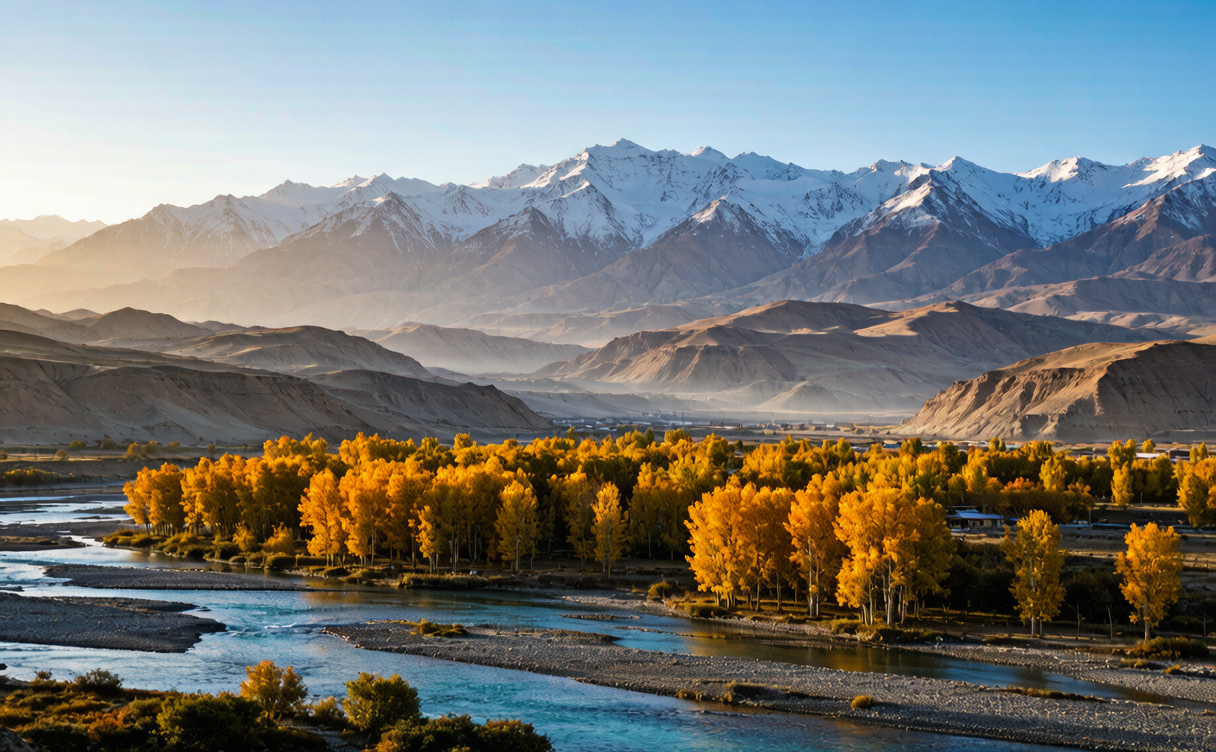
For most photographers and serious travelers, autumn is the undisputed best time to visit Xinjiang. From mid-September the birch and poplar forests of the north ignite: Kanas Lake and the nearby village of Hemu turn into a postcard of golden larch, cobalt water, and wooden cabins with morning mist. The south’s desert poplars (huyang) around Luntai and Yarkand also glow yellow against blue sky.
Late September is the sweet spot. I arrived in Hemu on September 28 one year and woke to a low river of fog sliding between golden roofs — the iconic shot — with crisp 12°C days and no crowds yet. Three days later, the National Day wave hit and the same boardwalk was a packed corridor.
The National Day Trap (October 1–7)
This is the one calendar warning I give every traveler. Golden Week (Oct 1–7) is the busiest travel period in all of China, and Xinjiang’s headline sights absorb it badly because there are only a few access roads. On one October 2nd I sat in a 40-km traffic jam outside Kanas for four hours, and every hotel within 100 km was booked months ahead at triple price.
If your trip lands near Oct 1–7, either go in late September (the same colors, a tenth of the people) or push to mid-October (still golden in the south, quiet everywhere). Never arrive at Kanas, Hemu, or Nalati during the first week of October without a booking and a plan.
Winter (November–February): Harsh, Empty, and Magical If You’re Prepared
Winter is the contrarian choice, and I love recommending it to confident travelers. The north drops to -20°C or colder, but the trade is solitude: Kanas under snow is a frozen fairy tale with almost no visitors, and flight and hotel prices collapse. The Ice and Snow Festival energy in the north, plus Kashgar’s misty, wood-smoke old town, make for atmospheric, crowd-free travel.
The costs are real: some mountain roads and the Kanas scenic shuttle close or run limited schedules, and you need serious cold-weather gear. But if your dates are fixed in winter, you’ll have Xinjiang largely to yourself — something almost impossible in any other season.
The Month-by-Month Quick Calendar
A fast reference for planning:
- January–February: Deep winter. Coldest, cheapest, emptiest. North snow-bound; south mild days, freezing nights.
- March: Still winter up north; Turpan/Kashgar pleasant. Blossoms not yet.
- April: Yili apricot blossoms (first two weeks). Dust-wind risk in the south.
- May: Grasslands green; comfortable everywhere; low crowds.
- June: Peak summer green in the north; hot but manageable south.
- July–August: Best alpine weather, longest daylight — but peak domestic crowds and prices.
- September (mid-late): Golden larch in Kanas/Hemu; ideal, still pre-holiday calm.
- October 1–7: Avoid the headline sights — National Day crush.
- October (mid-late): Quiet, golden south; cold nights moving in.
- November–December: Winter sets in; crowds vanish.
Crowd & Holiday Calendar: When to Brace Yourself
Beyond National Day, two periods spike crowds and prices across Xinjiang: the Chinese New Year / Spring Festival (January–February, dates shift) and the week-long May Day holiday (May 1–5). The summer school break (mid-July to August) is a rolling peak rather than a spike.
My rule: if you want empty roads and low prices, travel in the shoulder weeks — late April, late May, late September, or mid-October. If you must travel during a holiday week, book transport and lodging two months out and treat the big scenic areas as packed. For a full regional overview and how seasons fit into a route, our Xinjiang travel guide lays out the whole picture.
What to Pack per Season
Xinjiang’s swing between day and night, and between north and south, means layering beats everything. A season-by-season shortlist:
- Spring: A warm mid-layer (fleece), a windproof shell for dust storms, sunglasses, and a scarf for sandy wind. Snow is still possible up north.
- Summer (north): Light breathable clothes for day, a fleece for cool evenings at altitude, strong sun protection (hat, SPF, lip balm), and good hiking shoes. Summer (south): Loose sun-blocking clothing, a refillable water bottle, and electrolytes — heat is the real hazard.
- Autumn: The trickiest packing. Days are mild but mornings and nights at Kanas/Hemu drop near freezing. Bring thermal base layers, a down jacket, and a beanie for those misty sunrise shots.
- Winter: Serious insulated parka, thermal everything, waterproof boots, and hand warmers. The cold is dry but piercing; cover every extremity.
Sun is ferocious at altitude and latitude year-round, so SPF and a brimmed hat belong in every season’s bag. If you want a master checklist that works beyond Xinjiang, our China packing list for first-timers covers plugs, documents, and cold-weather specifics.
Regional Differences You Should Plan Around
Two practical splits I always budget for:
- North vs south timing. The north’s best window (grasslands June–Sept, golden larch late Sept) is short. The south (Kashgar, Turpan, Hotan) is best in spring and autumn and best avoided at summer noon. Many travelers do a loop — north in September, south in October — to catch both at their peak.
- Distances are enormous. Xinjiang is huge; a “day trip” can mean six hours of driving. Build rest days, and remember that weather closures hit mountain roads first. Our Urumqi things to do guide is the usual launch pad, and the Kashgar old town guide covers the far south.
Safety, Comfort & Practical Notes
Xinjiang is safe and well-policed for travelers, but its scale and climate demand respect. Carry your passport at all times (it’s checked at hotels, some scenic gates, and fuel stations), download offline maps because signal drops in remote passes, and keep water and snacks in the car for long desert drives. The altitude in Kanas and on grassland passes can leave you light-headed on day one — go easy, hydrate, and let your body adjust. For the broader safety picture across the region, our China travel safety tips are worth a read before you fly.
The Bottom Line
The best time to visit Xinjiang is late September for golden autumn in the north, June–August for the alpine grasslands (if you can handle domestic summer crowds), April for the Yili apricot blossoms, and winter if you want it empty and don’t fear the cold. The one date to circle in red and avoid at the famous sights is October 1–7, National Day. Pick your season by the image you want — pink orchards, green meadows, golden poplars, or silent snow — pack for a 15°C day-to-night swing, and Xinjiang will hand you the most dramatic landscapes in all of China.
Written by Karl — last updated July 2026. Karl has spent three years helping foreign visitors plan low-stress trips across China, including multiple seasonal trips across Xinjiang.