

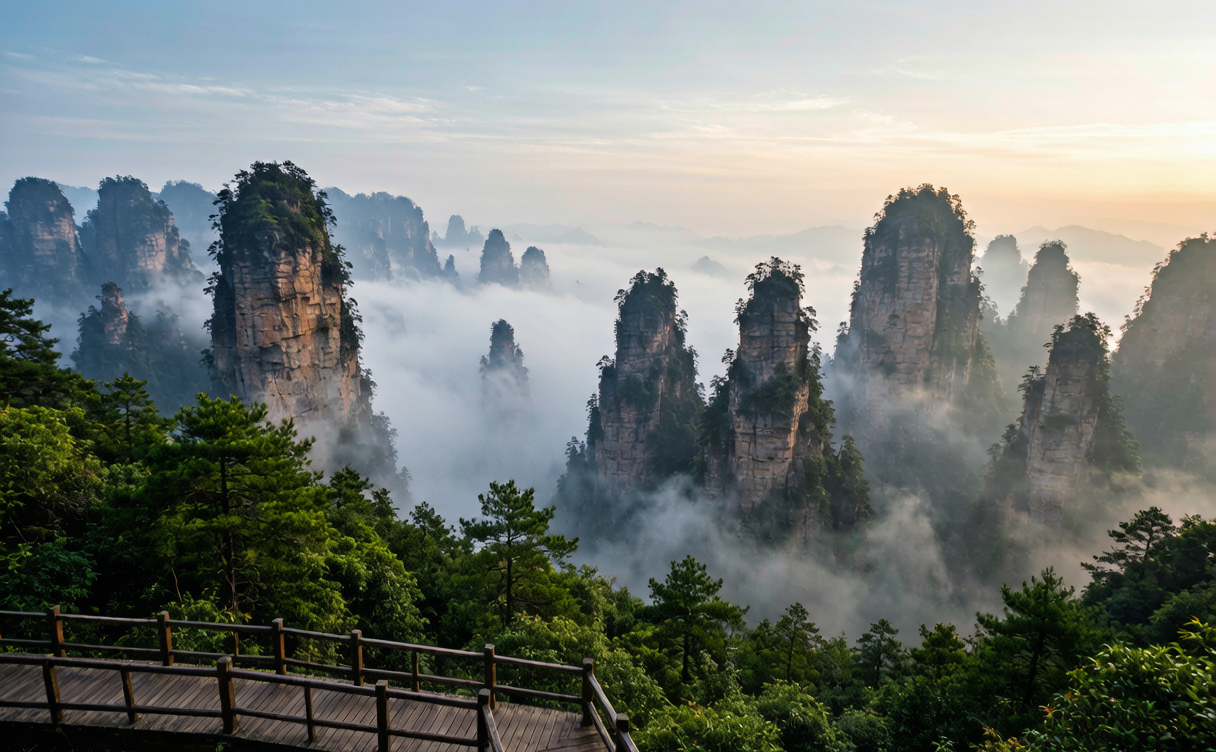
If you have ever wondered where the floating Hallelujah Mountains in the movie Avatar came from, the answer is real, and it is in central China. This Zhangjiajie travel guide walks you through everything a foreign visitor needs to plan a smooth trip to one of the most surreal landscapes on earth: the misty quartz-sandstone peaks of Zhangjiajie. Rising hundreds of meters straight out of the ground, these narrow stone pillars are often draped in cloud — exactly what made them look otherworldly on screen. Below you will find when to go, how to arrive, the top sights, ticket tricks, where to sleep, a realistic 3-day plan, and practical details that keep stress low.
Key Takeaways
– Zhangjiajie’s peaks are real quartz-sandstone pillars in Hunan Province and the visual inspiration for Avatar’s Hallelujah Mountains.
– Visit in April–May or September–October for comfortable weather and the best balance of clear and misty days.
– Fly directly into Zhangjiajie Hehua Airport, or take a high-speed train from Changsha, Wuhan, or Guangzhou.
– Base yourself in Wulingyuan (inside the scenic area) to save up to 90 minutes of daily commute versus staying in Zhangjiajie city.
– A 3-day itinerary covering the National Forest Park, Avatar/Glass Bridge, and Tianmen Mountain is the sweet spot for most travelers.
What Is Zhangjiajie and Why Visit?
Zhangjiajie is a city in northwestern Hunan Province, but travelers usually mean the Wulingyuan Scenic Area, a cluster of protected parks built around more than 3,000 sandstone pillars. The core attraction, Zhangjiajie National Forest Park, became China’s first national forest park in 1982 and was later inscribed as a UNESCO World Heritage Site in 1992. You can read the official listing on the UNESCO World Heritage Centre.
Why go? Because nowhere else on the planet looks like this. The pillars were formed over millions of years as water and ice eroded the plateau, leaving thin towers that catch the light differently every hour. On a foggy morning you feel like you are floating above a sea of clouds; on a clear afternoon you can trace the ridgelines for kilometers. If this is your first big trip to the country, pair it with our broader China travel guide for first-timers so the logistics outside the park make equal sense.
Best Time to Visit Zhangjiajie
The Seasons
Zhangjiajie has a humid subtropical climate, which means four distinct seasons and a lot of moisture. Spring (April–May) and autumn (September–October) are the consensus best windows: temperatures sit around 15–25°C, rainfall is moderate, and the vegetation is either fresh green or tinted gold. Summer (June–August) is hot, humid, and busy with domestic tourists, though the mountains stay a few degrees cooler than the cities. Winter (December–February) is cold and occasionally snowy, but it brings thin crowds and a rare frosted-pillar look that photographers love.
If you are mapping a larger China trip, our best time to visit China guide breaks the trade-offs down region by region.
Fog vs. Clear Days
Here is the part most guides get wrong. Tourists panic when they see fog in the forecast, but in Zhangjiajie, mist is often the main event. I learned this on April 14, 2024, waking to a whiteout at my Wulingyuan hotel and almost skipping the Bailong Elevator. I went anyway. At the top, the clouds broke and a single pillar materialized about 40 meters away — then dissolved again. That fleeting moment is the signature Zhangjiajie experience, and you only get it on foggy days. Clear days reveal the range’s full scale; foggy days give you the mystery. Build buffer days so you catch both.
How to Get to Zhangjiajie
Flying to Zhangjiajie Hehua Airport
Zhangjiajie Hehua International Airport (DYG) has direct flights from major Chinese hubs including Beijing, Shanghai, Guangzhou, Xi’an, and Chengdu, plus a handful of regional international routes. From the airport it is roughly a 30–40 minute drive to Wulingyuan and about 20 minutes to Zhangjiajie city center. Book domestic legs early during Chinese holidays, when seats sell out weeks ahead.
Taking the Train
The high-speed rail station, Zhangjiajie West, opened to fast connections and is now the easiest overland option. You can ride a bullet train from Changsha (about 2.5–3 hours), Wuhan (around 4–5 hours), or Guangzhou (roughly 5–6 hours). Trains are comfortable, punctual, and cheaper than flying once you add airport transfers. If rail logistics feel intimidating, our China high-speed train guide for foreigners explains booking, seat classes, and station navigation step by step.
Top Things to Do in Zhangjiajie
Zhangjiajie National Forest Park
This is the heart of the visit and deserves a full day, ideally two. The park is enormous, so most visitors focus on a few hubs: Yuanjiajie (the Avatar filming area), Tianzi Mountain, and the Yangjiajie loop. The Bailong Elevator, a glass outdoor lift bolted to a cliff face, shoots you 326 meters up in under two minutes. Inside, shuttle buses connect the zones, and the scale is genuinely disorienting in the best way.
Avatar Mountains and the Glass Bridge
Yuanjiajie’s “Hallelujah Mountain” (officially Avatar Hallelujah Mountain since 2010) is the pillar that directly inspired the film. Nearby, the Zhangjiajie Glass Bridge spans a canyon in the Grand Canyon of Zhangjiajie spot, stretching 430 meters with a glass floor 300 meters above the stream. Walking it is equal parts thrill and vertigo. Go early — both the bridge and Yuanjiajie hit capacity by mid-morning in peak season.
Tianmen Mountain
Tianmen Mountain sits on the opposite side of the city from the forest park and is famous for the Tianmen Cave, a natural arch punched through the cliff, and the glass-paneled cliff walkways. You reach the summit on the world’s longest passenger cable car (about 7.5 km from the city center). The 99-Bend Road snaking up the mountain is a spectacle in itself. Budget a half to full day here.
Golden Whip Stream
For a low-effort, high-reward walk, the Golden Whip Stream (Jinbian Xi) trail is unbeatable. It is a flat, shaded 7.5 km path along a clear mountain stream, flanked by pillars and frequented by macaques. I walked it on the afternoon of May 9, 2023, after two exhausting peak days, and it was the perfect comedown — no elevators, no queues, just water and stone. Families and older travelers especially appreciate how gentle it is compared with the vertical thrills elsewhere.
Tickets and Pass Tips
The standard ticket is a multi-day pass for the Wulingyuan core area (the National Forest Park and its zones), typically valid for three days on one QR-code entry. Buy at the official visitor centers or through authorized platforms; avoid resellers outside the gates. Keep these pointers in mind:
- Pass validity matters. A 3-day pass costs far less per day than single entries and lets you spread the big sights without rushing.
- Bring your passport. Foreign visitors must show the passport used at purchase for every scan-in.
- Arrive at opening. Gates usually open around 7:00–7:30 a.m. Beat the tour buses by 90 minutes and you will have empty lookouts.
- Bundle smartly. The Glass Bridge and Tianmen Mountain are separate paid areas, not covered by the forest park pass, so budget for them individually.
For a realistic sense of total spend, our China travel budget per day guide helps you set a daily ceiling including tickets, food, and local transport.
Where to Stay: Wulingyuan vs. Zhangjiajie City
Stay in Wulingyuan
Wulingyuan is the town wrapped around the east gate of the scenic area. Staying here puts you steps from the entrance, so you can be on the first shuttle bus at dawn. Hotels range from budget guesthouses to upscale resorts. The trade-off is a quieter nightlife and fewer international restaurants, but for sightseeing efficiency it wins.
Stay in Zhangjiajie City
Zhangjiajie city (Yongding District) is where the airport and Tianmen Mountain cable car sit. It has more dining and shopping, but it is 30–40 minutes from the forest park gate. Choose it if Tianmen Mountain is your priority or if you arrive late and fly out early. Most visitors split the difference by sleeping in Wulingyuan for park days and the city for the Tianmen day.
A 3-Day Zhangjiajie Itinerary Sketch
This plan assumes you base in Wulingyuan and arrive the evening before Day 1.
- Day 1 — National Forest Park (Yuanjiajie + Tianzi Mountain): Take the Bailong Elevator up, walk the Avatar Mountain viewpoints, ride shuttles to Tianzi Mountain for ridgeline views, and descend by cable car. A full, vertical day.
- Day 2 — Golden Whip Stream + Glass Bridge: A relaxed morning stroll along Golden Whip Stream, then a short transfer to the Grand Canyon Glass Bridge for the afternoon adrenaline hit.
- Day 3 — Tianmen Mountain: Transfer to the city, ride the long cable car up, walk the glass walkways, see the Tianmen Cave, and catch your train or flight out.
A fourth day lets you loop into Yangjiajie or rest at Wulingyuan’s hot springs.
What to Eat in Zhangjiajie
Hunan cuisine is famously spicy, and Zhangjiajie’s Tujia and Miao influences add smoke and sour notes. Try Tujia braised pork, smoked bacon with dried chili, and noodle soups from roadside stalls. In Wulingyuan’s walking street you will find hotpot, barbecue, and the occasional Western café. Vegetarians do fine with stir-fried mountain greens and tofu; tell staff “bu yao la” (no chili) if you are sensitive, since the default here is fiery.
Practical Tips for Foreign Visitors
A few field-tested pointers will save you headaches:
- Internet access. Google, WhatsApp, and many foreign apps need a workaround. Sort connectivity before you fly with our China eSIM and SIM card guide for tourists so maps and translation work on arrival.
- Cash and payments. Carry some cash and set up a payment app in advance; smaller park vendors may not take foreign cards.
- Comfortable shoes. You will walk 15,000+ steps on peak days across steep paths.
- Weather layers. Mountain weather flips fast; pack a light rain jacket even in dry season.
- Passport always. You need it for every ticket scan and often for hotel check-in.
Frequently Asked Questions
How many days do I need for Zhangjiajie?
Three full days is the sweet spot: one for the National Forest Park core, one for Golden Whip Stream and the Glass Bridge, and one for Tianmen Mountain. Add a fourth day if you want a slower pace or to explore the Yangjiajie loop.
Is Zhangjiajie worth it if it is foggy the whole time?
Yes. Fog is part of the magic, not a spoiler. The pillars emerging from cloud are the iconic shot, and clear days are common enough that building a buffer day usually gives you both moods.
Can I visit Zhangjiajie without a tour group?
Absolutely. Signage, shuttles, and elevators are designed for independent travelers, and English maps are available at visitor centers. A tour helps if you want zero planning, but it is not required.
What is the difference between the forest park pass and Tianmen Mountain?
The multi-day forest park pass covers the Wulingyuan core (Yuanjiajie, Tianzi, Golden Whip Stream). Tianmen Mountain is a separate mountain on the city side with its own ticket, cable car, and cave — plan and budget for it independently.
Written by Karl. Karl has spent the last three years helping foreign visitors plan practical, low-stress trips across China.