

Most Chinese towns wear their history in fragments — a repaired gate here, a rebuilt temple there. Pingyao is different. Step through its south gate and you walk into a Ming-Qing walled town that has stayed almost completely intact for six hundred years: 6.4 km of grey-brick ramparts, a grid of lanes still paved with the original stone, and courtyard residences whose timber beams were cut before Columbus sailed. UNESCO calls it the best-preserved ancient county town in China, and you’ll believe it the second the modern city drops away behind the wall. It’s small, it’s walkable, and it hands you a version of China that the bullet-train era usually erases.
At a Glance
- Best for: Intact Ming-Qing architecture, the city wall walk, China’s first bank, slow nights on car-free lanes
- Nearest hubs: Taiyuan (≈1.5 hrs by train), Xi’an (≈3 hrs by high-speed rail)
- Ideal stay: 1–2 full days
- Top sights: City Wall, Rishengchang (first draft bank), Ming-Qing Street, County Government Office, Chenghuang Temple
- Signature foods: Pingyao beef (pingyao niurou), wantuo (碗托, buckwheat jelly), shanxi vinegar
- Best season: Spring (Apr–May) and autumn (Sept–Oct); avoid the cold, smoggy winter and the packed National Day week
- Don’t miss: Walking the full wall at sunset, and the town after 9 pm when the day-trippers have gone
Why Pingyao Stands Out
Pingyao’s luck was decline. After the railways bypassed it in the early 1900s, the town simply stopped changing — no industrial sprawl, no concrete towers inside the walls. What stayed was a complete financial district from when this was the banking capital of Qing-dynasty China. In the 19th century, more than half the country’s draft-bank (piaohao) headquarters sat on these lanes, moving silver across an empire that had no modern banking system. That history is the reason the whole town, not just a monument, made the World Heritage list — you can read the details on the UNESCO listing for Pingyao Ancient City.
The flip side is tourism. Pingyao is popular, and the main streets can be crowded midday. The trick is timing and geography: stay overnight, drift to the quieter western and northern lanes, and the place turns peaceful and a little eerie in the best way.
Walk the City Wall
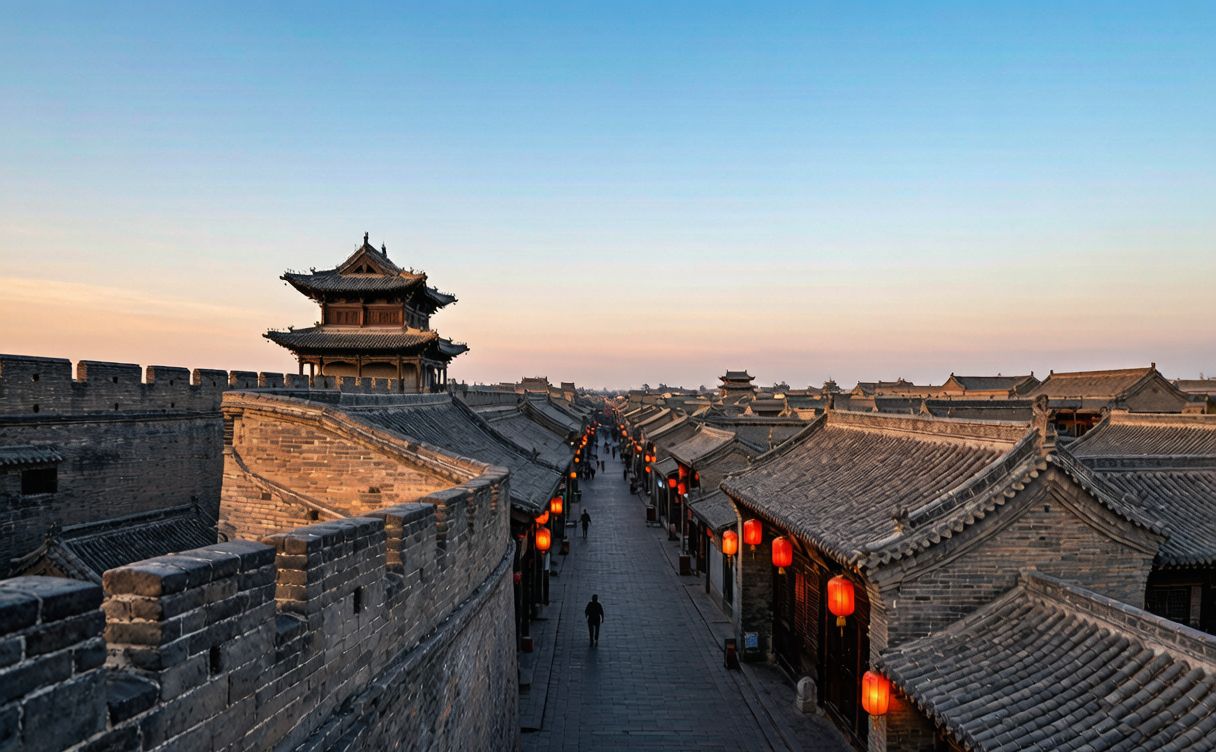
The wall is the single thing you shouldn’t skip. Built in 1370 and reshaped under the Ming, it’s a rectangle about 3 km around, with six barbican gates and a muddy moat long since gone dry. The top is a paved walkway wide enough for two, and you can circle the whole town in roughly two hours at a stroll. Do it late afternoon. The light goes long and gold, the grey tiles warm up, and you get the full layout — the chessboard of roofs, the single-story courtyard houses, the occasional watchtower — laid out below you.
A few practical notes: the wall has ramps but also stretches of steep, uneven steps; wear real shoes. There’s no shade up top, so a noon summer walk is miserable. And the corners are the best photo spots, where the wall jogs and you can see two faces at once.
Inside the Town: Streets, Banks, and Yamen
Rishengchang — China’s First Draft Bank
This is the marquee sight for a reason. Rishengchang opened in 1823 and is credited as the first draft bank in China, letting merchants transfer money by paper note instead of hauling silver on muleback. The museum occupies the original courtyard compound: counting rooms with carved screens, a vault with a heavy iron door, and ledger displays showing remittances sent as far as Japan and Russia. Stand in the front courtyard and it’s easy to picture clerks in queue, because the bones of the operation are all still there. Budget an hour.
Ming-Qing Street (Nan Dajie)
The central spine, also called South Street, is the busiest lane and the obvious place to start. It’s lined with restored shopfronts selling paper-cut, lacquerware, and the usual souvenirs — but look up. The building fronts are the real thing, with deep overhanging eaves and stone thresholds worn into shallow valleys by centuries of foot traffic. Side lanes off the street (try the east-west cross streets) are calmer and hold the better teahouses.
County Government Office (Yamen)
At the north end, the restored county yamen shows how imperial justice actually worked: a courtroom with the magistrate’s bench, holding cells, and a small torture-instrument exhibit that’s more sobering than titillating. It’s a 30–45 minute stop and gives the town a civic anchor beyond commerce. The Chenghuang Temple complex just east is quieter and good for a low-key wander.
Food: What to Eat in Pingyao
Shanxi calls itself the vinegar capital of China, and Pingyao cooks accordingly — sharp, savory, a little sweet. The two things to hunt down:
- Pingyao beef (平遥牛肉). Slow-braised, sliced cold, dark and tender. Sold by the slab in the markets and by the plate in restaurants; buy a vacuum pack at the shops near the walls if you want to carry some home.
- Wantuo (碗托). Buckwheat jelly steamed in a bowl, scraped out into ribbons, dressed with vinegar, garlic, and chili oil. Cheap, filling, and distinctly local — you won’t find it outside Shanxi much.
Round it out with shanxi knife-cut noodles (daoxiao mian) and a bowl of the region’s aged-vinegar broth. For a wider frame on regional cooking, our Chinese food guide to the eight cuisines explains where Shanxi fits among its neighbors.
Getting to Pingyao by Train
Pingyao has its own station, Pingyao Gucheng, on the high-speed line, which is what makes it an easy add-on.
- From Taiyuan: Roughly 1 to 1.5 hours by high-speed train; Taiyuan is the usual gateway because it has an airport with domestic connections.
- From Xi’an: About 3 hours by high-speed rail, which makes Pingyao a natural stop on a Xi’an–north-Shanxi route. Our Xi’an travel guide covers the hub and the Terracotta Warriors if you’re building that leg.
- From Beijing or further: Connect through Taiyuan or Xi’an rather than booking a direct, which may not exist or may be slow.
Book through the official 12306 system or a reputable reseller; our how to book China train tickets on 12306 walks through the foreign-passport process, and the broader China high-speed train guide for foreigners covers what to expect on board. The station is a short taxi or bus ride from the walled town.
Where to Stay: Inside vs. Outside the Walls
This is the one decision that shapes your trip.
Inside the walls: Courtyard hotels (many converted from old residences) put you on the lanes after the day-trippers leave. You can step out at 10 pm for a quiet walk and a nightcap. Downsides: rooms are smaller and quirkier than a chain hotel, sound carries between paper-thin courtyards, and vehicles can’t reach your door — you’ll wheel your bag a hundred meters.
Outside the walls: Newer, larger hotels with elevators and reliable heating, often a better value, and a five-minute walk to a gate. You trade the atmosphere for comfort, which matters in a January cold snap.
My take: if it’s your first visit and the weather’s mild, stay inside for one night to get the after-dark town. If you’re traveling in winter or with kids, the walled courtyard charm cools fast when the pipes do.
Best Season and Crowd Timing
Pingyao sits on the Shanxi loess plateau, which means real seasons. Spring (April–May) and autumn (September–October) are the sweet spots — mild, clear, good for the wall walk. Summer is hot and occasionally rainy but green and lively. Winter is cold, dry, and sometimes smoggy, though the town dressed in snow is genuinely beautiful and nearly empty.
Avoid the first week of October (National Day holiday), when domestic tourism peaks and the lanes are shoulder-to-shoulder. Our best time to visit China guide gives the national picture, including the holiday weeks to dodge.
A Note on the Night Town
Day-trippers from Taiyuan and Xi’an flood in around 10 am and are gone by 6 pm. If you only have daylight hours you’ll miss the best version of Pingyao: the lanterns on, the lanes empty, a few restaurants and bars still open, and the wall silhouetted against a dark blue sky. That’s the moment the six-hundred-year quiet finally lands. Stay the night, and let the town slow down around you.