

Some cities wear their history like a badge. Macau, China wears it like a layered coat — Portuguese church bells over a Cantonese street market, neon casino towers rising behind 400-year-old stone fortresses. I landed expecting a miniature Las Vegas with a few old buildings tagged on. I left convinced it’s one of the most quietly fascinating corners of the country. This former Portuguese colony returned to China in 1999 and now runs as a Special Administrative Region, blending two cultures that have been bumping into each other since the 1500s.
If you’re planning a trip to mainland China and want one easy, high-reward side destination, Macau, China should be near the top of your list. It’s compact, walkable, and you can see the best of it in two or three days.
At a glance
- Region: Macau, China (Special Administrative Region of the People’s Republic of China)
- Best for: Portuguese colonial architecture, casino resorts, Macanese food, easy day trips
- Ideal trip length: 2–3 days
- Language: Cantonese and Portuguese are official; English widely understood in tourist areas
- Currency: Macau Pataca (MOP); Hong Kong dollars accepted almost everywhere
- Getting in: Ferry from Hong Kong, China; the Hong Kong–Zhuhai–Macau Bridge; or fly into Macau International Airport
- Visa: Visa-free entry for 30 days for passport holders of many countries (check before you travel)
The Historic Centre: a UNESCO world in walking distance
The heart of Macau, China is the Historic Centre of Macau, a UNESCO World Heritage Site that strings together more than 20 landmarks across the old city. You don’t need a ticket or a tour bus — just comfortable shoes and a loose plan.
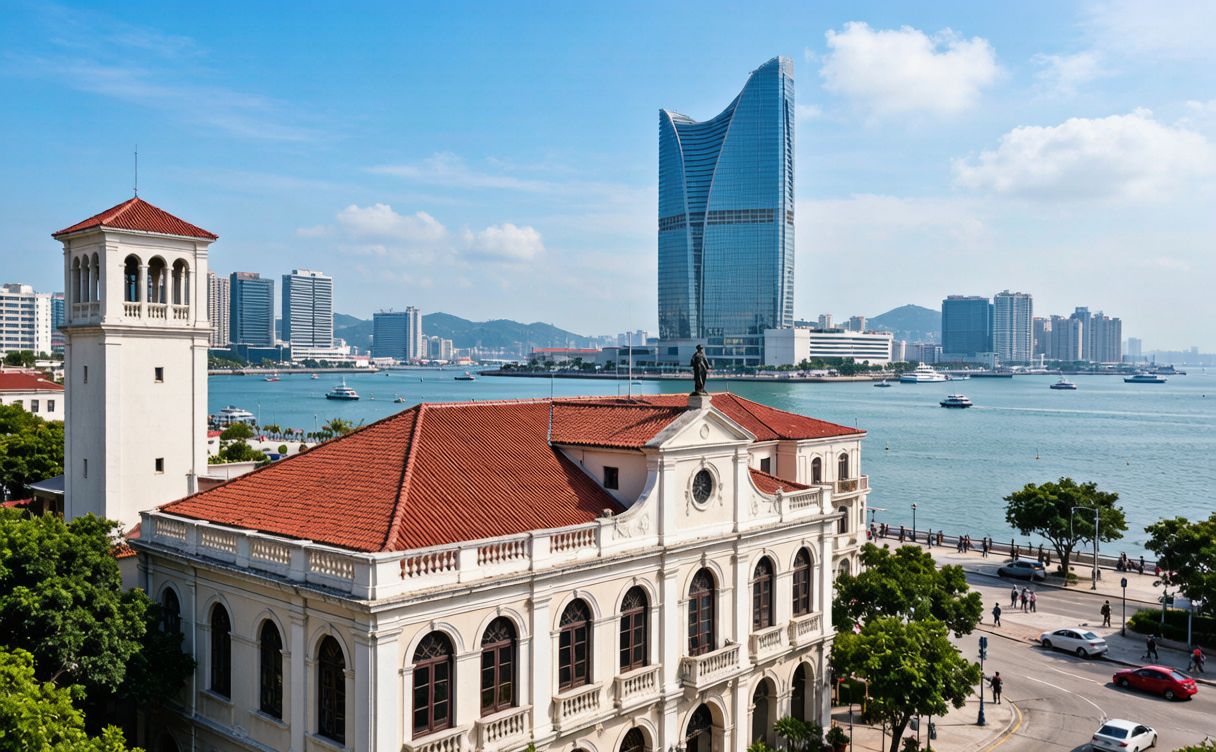
Start at Senado Square (Largo do Senado). The wavy mosaic pavement, the pale neo-classical facades, and the tiled wave patterns underfoot all carry the unmistakable stamp of Lisbon. It’s busy, yes, but early morning is calm and photogenic. From there, walk uphill along the stepped streets toward the Ruins of St. Paul’s.
The Ruins are the postcard of Macau, China for good reason: a towering stone facade of what was the Church of St. Paul, burned down in the 1800s and never rebuilt. Climb the stairs, then slip behind to the small museum in the crypt. Right beside it, Mount Fortress offers shade, cannons, and one of the best free viewpoints over the city and the Pearl River estuary.
Nearby, don’t skip St. Dominic’s Church, the Holy House of Mercy, and the Leal Senado building. The whole quarter is compact enough that you can wander for an afternoon and never feel lost — the streets loop back on themselves. For background on the designation and the full list of protected monuments, see the official UNESCO entry: https://whc.unesco.org/en/list/1110/
The Cotai Strip: casinos, but make it theatrical
Cross to the reclaimed land of Cotai and the mood flips entirely. This is the Las Vegas side of Macau, China — a row of integrated resorts where the hotels themselves are the attraction.
The Venetian replicates Venice with indoor canals and gondoliers. The Parisian plants a half-scale Eiffel Tower in the lobby plaza. City of Dreams, Galaxy, and Wynn Palace lean into fountains, floral displays, and choreographed light shows. You don’t have to gamble to enjoy any of it; the shopping malls, free performances, and food courts are open to everyone, and they’re air-conditioned refuges in the humid summer.
A note on gambling: the casinos here are enormous and operate legally under Macau, China law. If you choose to play, set a hard spending limit before you walk in and treat any losses as the price of entertainment. The resorts post responsible-gaming information, and there’s real help available if gambling stops being fun. For a broader set of practical cautions that apply across the region, our China travel safety tips cover staying sharp on the road.
Egg tarts and Macanese food you shouldn’t miss
Macanese cuisine is its own thing — a creole born from Portuguese, Chinese, African, and Southeast Asian influences. It exists almost nowhere else on earth, which is reason enough to eat seriously here.
The famous Portuguese egg tart (pastel de nata) is the headline act. Two names dominate: Lord Stow’s Bakery in Coloane and Margaret’s Café e Nata near the city centre. Both serve them warm, with a blistered caramelized top and a custard that barely holds its shape. Get a half-dozen and walk.
Beyond tarts, look for African chicken (galinha à Africana), pork chop buns (a Macau, China street staple), minchi (a minced meat and potato hash), and serradura (a whipped “sawdust” pudding of cream and crushed biscuit). The Cantonese dim sum guide is a useful companion if you want to understand the wider Guangdong-style eating culture that surrounds Macau.
Coloane village, down in the south, is the calmest corner of Macau, China — sleepy streets, a beach, and the original Lord Stow’s. Worth the bus ride for a slower half-day.
Getting to Macau, China
Most foreign visitors arrive via Hong Kong, China. The TurboJET and Cotai Water Jet ferries run frequently between Hong Kong’s airport or downtown and Macau’s Outer Harbour or Taipa terminals — about an hour on the water. It’s the classic route and easy to combine into a Hong Kong, China trip; our Victoria Harbour guide helps you plan that side.
The Hong Kong–Zhuhai–Macau Bridge opened a new option: a shuttle bus across the world’s longest sea crossing, roughly 40 minutes. It’s efficient but less scenic than the ferry.
Flying directly into Macau International Airport works well from several Asian cities, and there are also land border crossings from Zhuhai on the mainland if you’re already touring Guangdong.
Visas and money
Good news for many travelers: Macau, China grants visa-free entry for up to 30 days to passport holders of numerous countries, including most of Europe, the US, Canada, Australia, and New Zealand. Rules change, so confirm your nationality against the current list before booking — our China visa-free countries list is a starting point, though Macau has its own entry regime separate from mainland China.
On the ground, the Macau Pataca (MOP) is the official currency, but Hong Kong dollars are accepted almost everywhere at a roughly 1:1 rate (you’ll get change in MOP). ATMs are plentiful. For a wider look at handling money and cards across the country, see do you need cash in China.
Best time to visit
Macau, China has a humid subtropical climate. Autumn (October to December) is the sweet spot: cooler, drier, and clear for photos. Spring is pleasant too. Summer (June–August) is hot, sticky, and peak typhoon season — fine if you stick to the air-conditioned resorts, but less fun for the outdoor heritage walks. Winter is mild and rarely cold.
If you want the full picture of seasonal weather across the country when planning a longer trip, our best time to visit China guide breaks it down region by region. Major holidays like Chinese New Year pack the resorts and push up hotel prices, so book ahead or travel in the quieter weeks.
A practical three-day sketch
- Day 1: Senado Square → Ruins of St. Paul → Mount Fortress → dinner in the old city.
- Day 2: Cotai Strip resorts, Eiffel Tower photo, gondola ride, evening fountain show.
- Day 3: Coloane village, Lord Stow’s tarts, Taipa Village for quieter streets and local eats.
Macau, China rewards the curious. Spend a morning on cobblestones laid by Portuguese engineers, an evening under a fake Eiffel Tower, and every few hours eat something you can’t get anywhere else. Few places let you time-travel and people-watch in the same afternoon.