

I almost skipped Zhujiajiao. After five days of Shanghai’s glass towers, the Bund’s neon, and line 2 sardine-can commutes, the last thing I wanted was another “ancient town” sold to tourists. Then a friend from Qingpu texted one word: “Fangbang.” I went on a whim, took the metro to the end of line 17, and stepped off into a 1,700-year-old village where the only sounds were a paddle slapping water and a grandmother calling her cat. Zhujiajiao is the real thing — a living canal town of stone bridges, Ming-era lanes, and tea houses that haven’t changed their view in four centuries. If you’re staying in Shanghai, this is the easiest, cheapest, most genuine day trip you can make, and I’m going to walk you through exactly how I did it.
What Zhujiajiao Actually Is
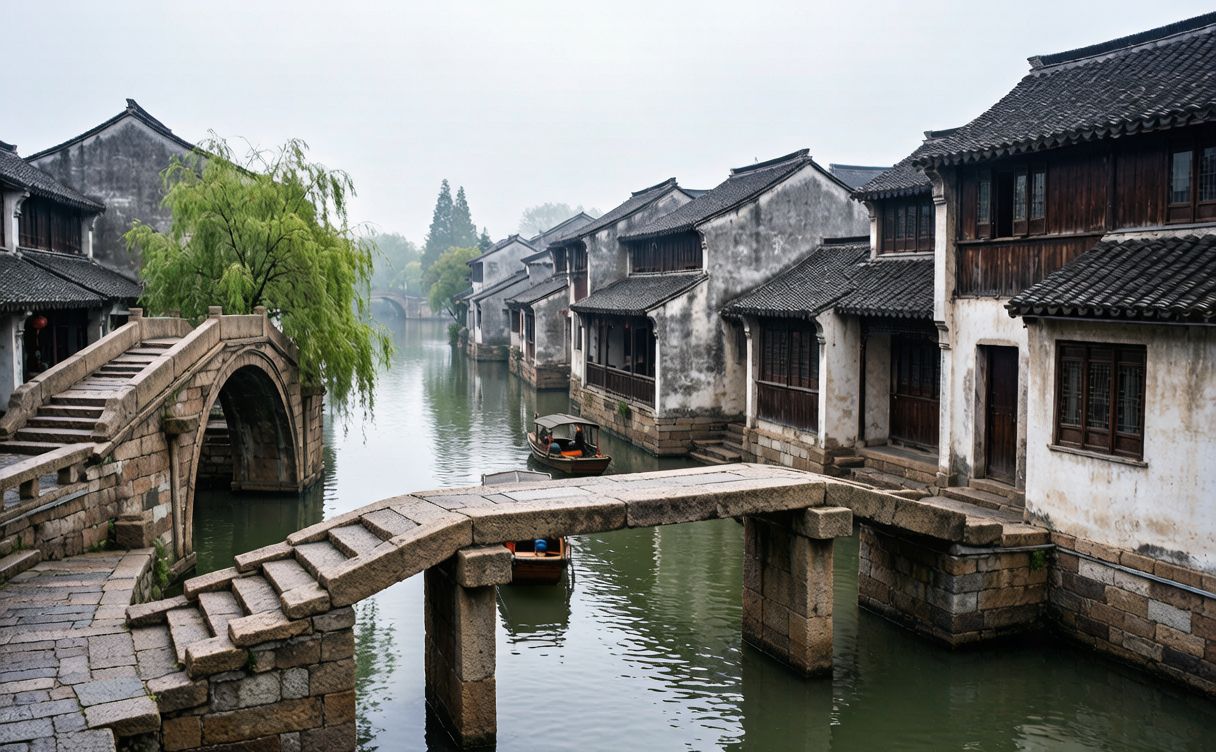
Zhujiajiao (朱家角) sits about 48 kilometers southwest of central Shanghai, in the Qingpu district. Unlike the full-scale reconstructions you’ll find on the city’s outskirts, this one has been continuously inhabited since the Yuan and Ming dynasties. The town wraps around a network of canals fed by the Dianshan Lake water system, and its layout still follows the old logic: water first, then the lanes, then the houses built right up to the water’s edge.
What struck me on my first wander was how ordinary it felt. Yes, there are souvenir stalls and the occasional selfie stick, but there are also residents hanging laundry over the canal, neighborhood noodle shops where nobody speaks English, and a 400-year-old post office still standing on its original foundations. It’s this blend — heritage and daily life tangled together — that separates Zhujiajiao from the theme-park version of “old China” you might fear.
If you’re building a Shanghai plan, I’d pair this read with our broader things to do in Shanghai list, because Zhujiajiao slots in perfectly as a half-day escape from the urban core.
How to Get There from Downtown Shanghai
This is the part that intimidates first-timers, and it shouldn’t. There is no tour bus required and no expensive private driver needed.
The method I used: Shanghai Metro Line 17 to Zhujiajiao Station, then a 10–15 minute walk (or a short taxi / e-bike ride) into the old town. From People’s Square, the trip took me about 70–80 minutes door to water, cost under ¥10, and the line 17 trains are spacious and quiet compared to the packed downtown lines. Get off at Zhujiajiao Station, exit toward the canal signs, and follow the crowd — you literally cannot get lost.
A few practical notes from my trip:
– Buy a metro card or use Alipay/WeChat transport code. If you haven’t set that up yet, our Shanghai first-time travel guide covers the payment apps that make metro rides frictionless.
– Go early. I caught the 8:40 train and was on the main bridge by 10. The light was soft, the tour groups hadn’t arrived, and I had the lanes mostly to myself.
– Don’t book a guided “water town” bus tour by default. They’re fine, but they eat your schedule and lock you to a lunch stop. The metro gives you freedom.
One honest caveat: line 17 ends at a station still a little outside the core, so the final stretch is a walk or a ¥10 taxi. Totally manageable, just don’t expect the train platform to open directly onto the canal.
Walking the Canals: What to See
Once you’re inside, the town is walkable end to end in under an hour — but you should take three. Here’s the loop I loved.
The Famous Bridges
Zhujiajiao has 36 stone bridges, and they’re the town’s spine. The standout is Fangsheng Bridge (放生桥), the largest stone arch bridge in the Shanghai region, built in the Ming dynasty. Standing on it at sunrise, watching a wooden boat drift underneath, I finally understood why people rave about water towns. The curve of the arch reflected perfectly in still water, and an old man on the far bank was feeding koi with practiced, patient tosses.
Kezhi Garden
Tucked off the main canal, Kezhi Garden (课植园) is the one paid attraction I’d actually recommend. It’s a scholar’s garden — rockeries, a small pond, lattice windows framing deliberate little views. Quiet, well-kept, and a nice counterpoint to the open canals. Entrance was around ¥20 when I visited, and it’s included in some combined tickets sold near the entrance.
The Old Post Office and North Street
The Qing Dynasty post office on Caohe Street is the oldest still-standing post office in East China, and you can send a postcard with a special Zhujiajiao postmark — a small, satisfying souvenir. From there, North Street (Bei Dajie) is the busiest lane, packed with sticky-rice snacks, handmade fans, and the kind of fried dumplings that smell like everywhere and taste like here.
The Canal Boat Ride
For ¥20–30, a wooden gondola-style boat will paddle you along the main canal for about 15 minutes. Is it touristy? Yes. Is it worth it? Also yes — you see the town from the water the way it was meant to be seen, and the boatman pointed out roofs and doorways I’d have missed on foot. I’d do it once, late morning, before the lines build.
Food: What to Eat and Where
Zhujiajiao’s signature is zongzi — sticky rice wrapped in leaves, steamed with pork or sweet red bean. You’ll see giant pyramids of them stacked outside family shops; the pork version, salty and fragrant, became my breakfast. Beyond that:
- Congyou bing (scallion pancake) fresh off the griddle.
- Steamed river shrimp at the waterside restaurants — small, sweet, and clearly local.
- Sesame candy and pressed sweets if you’ve got a sweet tooth and a train to walk off.
I ate at a no-name spot where the only English was a hand-drawn fish on the menu, paid ¥45 for three dishes and tea, and it was among my better meals in China. Don’t overthink the menu — point, smile, and trust the wok.
When to Go (and When to Skip)
Timing made a huge difference for me. I went in late spring on a weekday; the weather was mild, the lanes were breatheable, and the photos didn’t need crowd-removal. Our best time to visit Shanghai breakdown lines up with my experience: spring (March–May) and autumn (September–November) are the sweet spots, with comfortable temperatures and manageable humidity.
Avoid, if you can, Chinese public holidays — the National Day week in early October and the Spring Festival travel period turn every water town within reach of Shanghai into a human river. If your dates are fixed on a holiday, go at opening (8:30am) and leave by noon. Weekends are busier than weekdays but still fine if you arrive early.
Make It a Twin-Town Day: Zhujiajiao + Suzhou
Here’s a tip I wish I’d known sooner. If you’ve got a free day and want more canal magic, Suzhou — the “Venice of the East” — is only about 25 minutes from Shanghai by high-speed train, and it pairs naturally with a water-town appetite. I did Zhujiajiao as a half-day, then took the train to Suzhou two days later for the classical gardens. Our Suzhou travel guide maps the gardens and canals there in detail, and the city makes a brilliant follow-up once Zhujiajiao has hooked you on canal towns.
For the train between Shanghai and Suzhou, our China high-speed train guide for foreigners walks through booking and boarding without the app headaches.
Where to Stay for Easy Day Trips
If Zhujiajiao is a priority, you don’t need to sleep in the village (though a handful of boutique courtyard inns do exist for the full immersion). Staying anywhere on Metro Line 17’s path or near Hongqiao makes the trip shortest. For the bigger picture on neighborhoods and hotels, our where to stay in Shanghai guide breaks down which districts suit day-trippers versus nightlife seekers.
I based myself near People’s Square and found the commute totally reasonable — the key is just starting before the city wakes up.
Practical Tips I’d Hand a Friend
- Cash vs card: small stalls are cash-friendly but Alipay/WeChat dominate; bring some small notes.
- Footwear: the lanes are real stone, uneven and occasionally slick near the water — skip the fancy shoes.
- Toilets: public restrooms exist near the main entrances; carry tissues, as always in China.
- Boat vs walk: do both — walk to feel the town, boat to see it.
- Photography: the north-side canals (away from North Street) are quieter and prettier for shots, especially in the first hour after opening.
One more thing worth knowing: Zhujiajiao is managed as part of Shanghai’s Qingpu district tourism, and the town’s conservation status is documented by the district’s official heritage office. For authoritative background on the town’s history and protected architecture, the Shanghai Municipal Tourism administration publishes visitor information and heritage notes in English.
Final Thought
I went to Zhujiajiao expecting a manufactured stop on a tourist conveyor belt. I left having eaten pork zongzi on a 400-year-old bridge, watched a boatman nap in the bow of his skiff, and felt, for the first time that week, like I’d touched the older rhythm of this country. It’s close, it’s cheap, it’s genuinely old, and it asks almost nothing of you except a morning and a metro card. If you’re in Shanghai for more than two days, carve out the half-day. You’ll thank yourself on the ride home.