

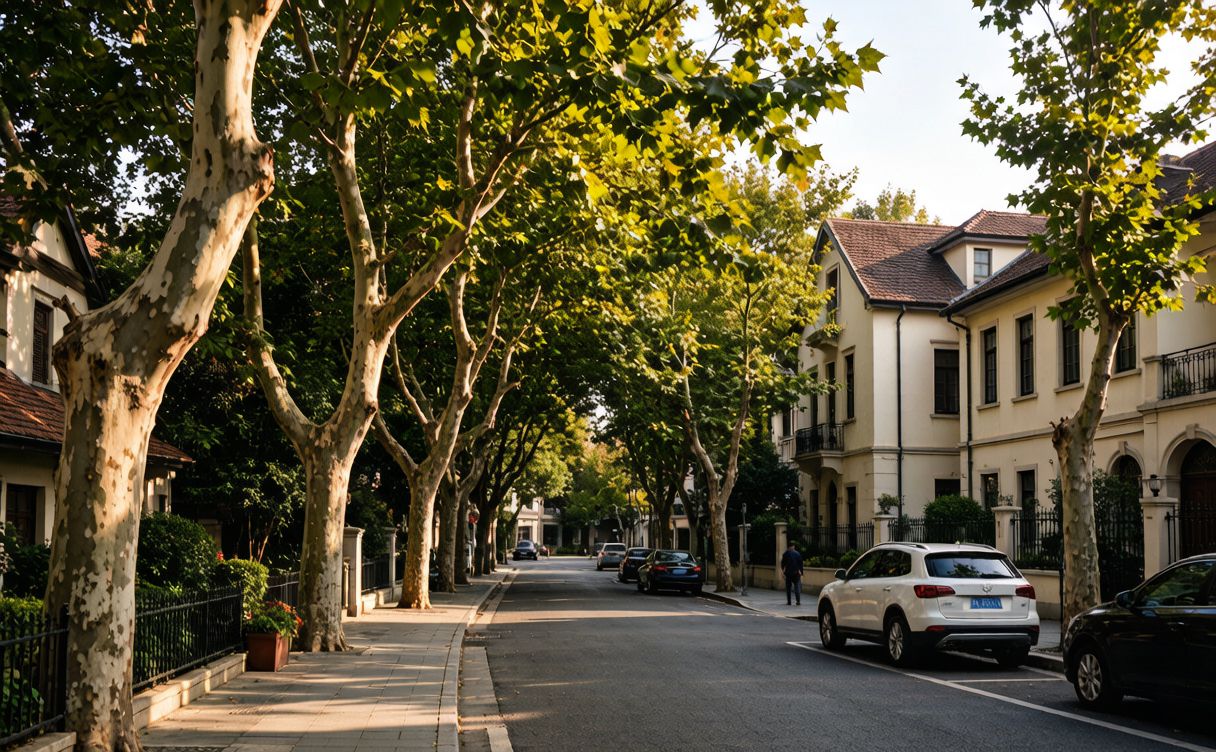
The first time I really understood the Shanghai French Concession, I wasn’t looking at a map or a museum — I was lost. It was a damp April evening, I’d turned off Wukang Road onto a lane I couldn’t pronounce, and suddenly the noise of the city dropped away. Plane trees arched overhead and locked into a green tunnel. A bicycle bell rang once, softly. Behind a low brick wall, a villa glowed yellow from an upstairs window, and the smell of coffee and rain came off the pavement at the same time. That’s the Shanghai French Concession in one frame: not a monument you tick off, but a mood you wander into. If you only have two days in the city, this is where I’d send you for both of them.
I lived within walking distance of these streets for three years, and I still find new corners. This guide is the walk I’d actually give a friend — where the plane trees are tallest, which villas you can see up close, which café streets are worth your afternoon, and a loop you can do on foot without a guide or a plan.
What the French Concession Actually Is
Quick history, because it changes how you look at the place. From 1849 until 1943, this wedge of western Shanghai was administered by the French consulate — one of several foreign concessions carved out after the Opium Wars. The French ran their zone differently from the British and Americans: less grid, more garden-city. They planted Platanus — the “plane trees” (French platanes) that Shanghai now calls wutong — in long avenues, and let foreigners and wealthy Chinese build low-rise villas with gardens instead of tenements.
You won’t find a wall or a gate marking the old border. The “Concession” today is really a feeling bounded by Yan’an Road to the north and Zhaojiabang Road to the south, stretching west toward Xujiahui and east to the Bund-side streets of Huangpu. Locals just call it the “French Concession” (法租界) or, more poetically, the wutong qu — the plane-tree district. The official Shanghai tourism portal has a curated overview of the area’s heritage architecture and the opening hours of the few houses you can enter.
One thing I tell every visitor: don’t over-research it. The magic is in the unplanned turn. But a little structure helps, so here’s mine.
The Walk I’d Actually Give You
Start at Wukang Road (武康路). This is the spine of the whole experience, and it’s the one stretch where the plane trees form a genuine canopy rather than a polite line. Wukang Road is short — about 1.2 km — but it holds more than 30 protected historic buildings, including the former residence of statesman Zhou Enlai and the famous wedge-shaped Wukang Mansion (武康大楼), a 1924 apartment block that looks like the bow of a ship stuck on dry land. Go early, before 10 a.m., when the light comes through the leaves in slices and the tour groups haven’t arrived.
From Wukang Road, drift south onto Hengshan Road, then cut into Yongjia Road. Yongjia is my secret favorite — quieter than Wukang, lined with ivy-covered walls and small design shops, and it has the best “I can’t believe this is a megacity” moments. I once sat on a Yongjia stoop for twenty minutes just watching cats. No landmark, no ticket, just Shanghai exhaling.
Then loop back via Fuxing Road and Sinan Road (思南路). Sinan is where the villas open up: gated garden houses from the 1920s, some now boutique hotels, some still residences. The Sinan Mansions (思南公馆) complex is the polished, Instagram version — restored shikumen and villa architecture with restaurants and a small museum. It’s a little staged, but it’s the easiest place to walk inside the old world without trespassing.
If you want the fuller neighborhood picture before you set out, our things to do in Shanghai roundup pairs this walk with the Bund and the water towns, and our Shanghai first-time travel guide explains how to slot it into a 2-day plan.
The Villas and Buildings Worth Slowing Down For
You can’t go inside most of the old houses — they’re still homes — but a handful are open, and they’re worth timing your walk around.
Wukang Mansion. You can’t miss it; you also can’t go in (it’s residential). But stand across the intersection at sunrise and you’ll see why everyone photographs it. The brickwork, the rounded balconies, the way the whole building pivots to meet two roads at once — it’s the Concession in a single frame.
Sun Yat-sen’s Former Residence (香山路). A calm villa-museum on Rue Molière (now Sinan-adjacent), with period furniture and a small garden. Quiet, cheap, and genuinely moving if you know the name.
Zhou Enlai’s Former Residence (思南路). Two connected garden villas where the premier lived in the 1940s. Modest compared to the mansions, which is exactly the point.
The Former French Concession Police Station / today’s upscale blocks on Fuxing West Road. Less famous, more atmospheric — look up at the wrought-iron balconies and the tiled roofs.
My advice: pick one villa-museum, not three. The rest of the joy is external — the walls, the gates, the way a palm tree leans out of a courtyard you’ll never enter.
The Café Streets (Yes, They’re a Real Thing)
The Concession didn’t invent coffee, but it perfected the café street — a whole block where sitting outside with a flat white is the default activity. Three streets stand out:
Anfu Road (安福路). The current queen: short, stylish, packed with indie roasters and bakeries. Weekends are a squeeze, but the people-watching is world-class. Some of my best conversations in Shanghai happened leaning against an Anfu Road railing.
Tianzifang (田子坊). A different animal — a maze of longtang alleys turned into craft shops and cafés. Touristy, yes, but duck past the first two rows of shops and you’ll find quieter, authentically old lanes. Go on a weekday morning.
Wulumuqi Road (乌鲁木齐路) and around it. My local pick — less performative than Anfu, more neighborhood. Good coffee, good dumplings, old men playing cards on stools. This is where the Concession meets real life.
Coffee here isn’t a luxury splurge, by the way — a good flat white runs ¥30–45 ($4–6). Bring a book, or just your phone, and let an hour dissolve. It’s the cheapest therapy in town.
When to Go (and When to Walk)
Timing makes or breaks the mood. The plane trees are bare and a little sad from December to February; by late March they’ve leafed out, and April–May and October–November are the sweet spots — mild, green, and photogenic. Our best time to visit Shanghai guide breaks the months down if you’re building a trip around weather.
For the hour of day: mornings for photos and solitude, early evening (5–7 p.m.) for the golden light through the leaves, and night for the villa windows glowing behind the trees. I’d rank them golden-hour, morning, night, midday — and midday is just hot and flat.
Rain is not a reason to skip it. A wet Concession — empty lanes, reflective pavement, trees dripping — is the most romantic version there is. Pack a small umbrella; the streets are narrow enough that you can duck into a café the second it pours.
Where to Stay in the Concession
If you want to live the walk instead of visit it, stay inside the wedge. Boutique hotels in restored villas run ¥600–1,200 ($85–170) a night; hostels and guesthouses from ¥130 ($18). The trade-off is size — rooms are smaller than the skyscraper hotels across the river — but you step onto a plane-tree street the moment you leave the lobby. Our where to stay in Shanghai guide compares the Concession with Jing’an and the Bund if you’re deciding between charm and skyline.
I stayed on a lane off Hunan Road and never regretted it.
A Half-Day Loop You Can Follow Blind
Here’s the exact route I give friends, about 4 km, 3–4 hours with stops:
- Wukang Mansion (sunrise or 9 a.m.) — photograph, then walk south down Wukang Road.
- Wukang Road → Yongjia Road — slow down, peek through gates.
- Sinan Road & Sinan Mansions — go inside one villa-museum.
- Anfu Road — coffee and people-watching.
- Wulumuqi Road — late lunch or a dumpling stop.
- Loop back via Fuxing Road as the light goes gold.
No metro needed until you leave; the whole thing is walkable and flat. If your legs give out, the metro’s Changshu Road or South Shaanxi Road stations drop you right back in.
Beyond the Concession: A Day Trip
The Concession is the city at its most European, but Shanghai’s real genius is how fast it flips to Chinese. If you’ve done the walk and want contrast, Suzhou is 25 minutes away on the high-speed train — a classical-garden city of canals and scholar’s rocks that feels like the Concession’s ancient opposite. Our Suzhou travel guide covers the gardens worth the trip.
And don’t skip the river. After a day among villas, cross to the Bund for the night view — the Concession’s trees from one bank, the future from the other. That pairing is the whole story of Shanghai.
Practical Notes
- Getting there: Metro Line 10/11 to Jiaotong University, or Line 1/7/10 to South Shaanxi Road. Both drop you at the edge of the wedge. From the Bund, it’s a 20-minute walk or a short ride west.
- Cost: The streets are free. Villa-museums are ¥5–20 ($1–3). Coffee ¥30–45. A full day costs almost nothing if you skip shopping.
- Etiquette: These are residential streets. Keep voices down near the villas, and don’t push into private courtyards for a photo — the gates are there for a reason.
- Language: Street signs are bilingual; Google Maps is unreliable in China, so save an offline map or use Apple Maps, which works well here. Check our guide to using the internet in China for the VPN situation before you fly.
The Shanghai French Concession isn’t a sight you “do.” It’s a place you return to — the same trees, a different hour, a lane you swear you haven’t walked before. Three years in, I’m still finding them. That’s the only review that matters.