

Most first-timers to China picture the trip as temples, the Great Wall, and pandas, then an early night at the hotel. I made that mistake on my second visit, and I have regretted it ever since. The country wakes up differently after dark. The cities I know best — Shanghai, Beijing, and Chengdu — each run on a completely separate clock once the sun goes down, and some of my favorite evenings in China have happened in a tiny basement bar at 1 a.m. or at a street stall watching skewers smoke over charcoal.
This is a practical, first-hand guide to where to drink, dance, and wander at night in China as a foreign visitor. I have been to every place I mention, and I have paid my own tab at all of them. I will tell you what to expect, what it costs, how to get in, and how to get home safely.
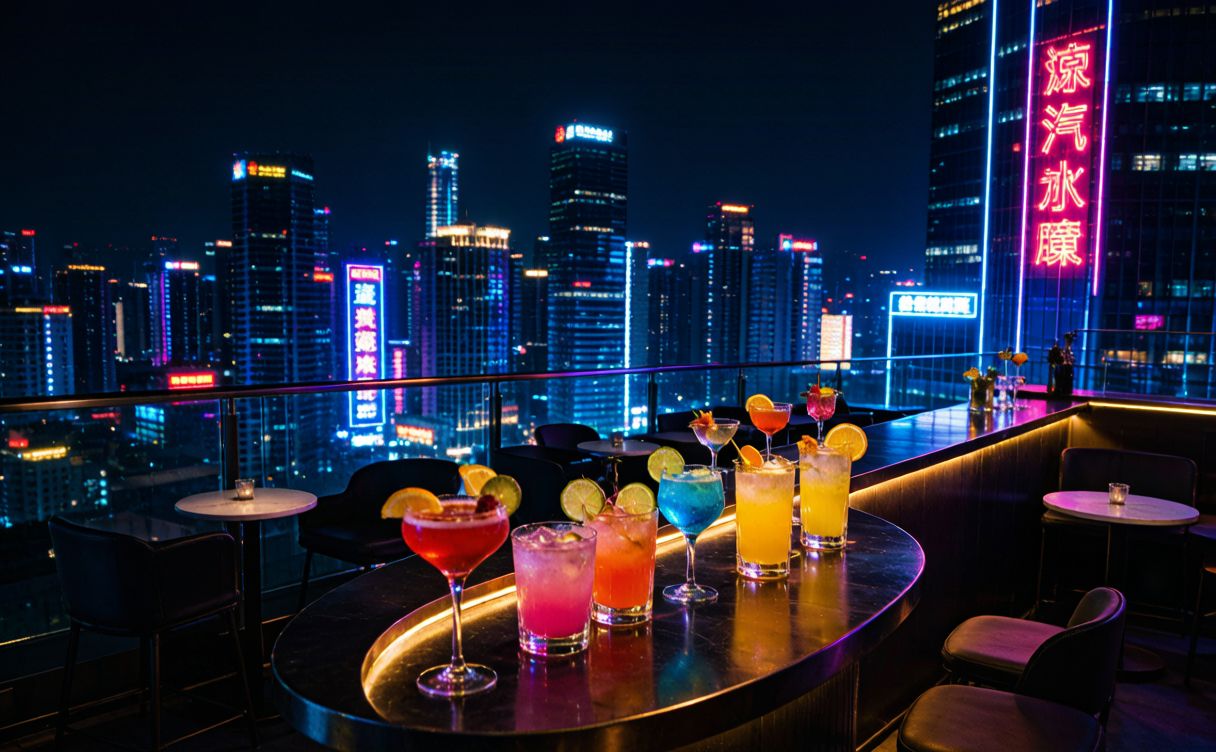
Shanghai: The Bund, Found 158, and the French Concession
Shanghai does nightlife better than anywhere else in mainland China, and the two neighborhoods you need to know are the Bund waterfront and Found 158, a compact bar alley tucked just off Nanjing Road.
The Bund itself is the postcard. Stand on the west bank around 8 p.m. and the Pudong towers across the river put on a light show that runs on a loop. For the actual drinking, I skip the touristy riverside terraces and head to one of the rooftop bars in the historic buildings — places like a bar on the top floor of a 1930s building where you can see both the skyline and the colonial architecture below. Expect to pay 80–120 RMB for a cocktail. Dress is smart-casual; they will turn away flip-flops and shorts at the better spots.
Found 158 is where I take friends who want to bar-hop without a plan. It is a single lantern-lit courtyard of maybe fifteen bars packed together — whisky dens, a tiki bar, a place that only does natural wine. The vibe is loud, young, and unpretentious. A local beer here is 30–45 RMB. The whole thing is outdoors, so go spring through autumn; in deep winter it is miserable.
A short taxi ride south, the former French Concession has my favorite quiet drinking. Tree-lined streets, low villas, and bars where you can actually talk. I have spent entire evenings on Fenyang Road and Yongkang Road doing one cocktail per stop. If you want the wider picture of the area, my things-to-do-in-shanghai piece covers the daytime side of these same streets.
For the view that anchors the whole night, read my shanghai-bund-guide-night-view guide — it tells you exactly where to stand for the best photos before you climb up to a rooftop.
Beijing: Sanlitun, Houhai, and the Hutongs
Beijing’s nightlife splits into two personalities. Sanlitun is the glossy, expat-and-clubbing side. The hutongs and Houhai lake are the traditional, low-key side.
Sanlitun, in the Chaoyang district, is the default Foreign visitor nightlife zone, and for good reason. The Taikoo Li complex is open-air and walkable, ringed by bars and international chains. Behind it, in the alleys of Sanlitun South, are the basements that matter: small craft-cocktail bars where the bartenders have competed internationally. Cover charges at clubs here run 50–150 RMB, often including one drink. The big clubs — the warehouse-style ones playing house and hip-hop — get going after midnight and run to 4 or 5 a.m. Bring ID; some venues scan passports at the door.
I actually prefer the older Beijing after dark. Houhai, the lake behind the Forbidden City, is ringed with bars where someone is usually singing a ballad badly and enthusiastically. It is touristy but genuinely fun in a group. Better still, wander the hutongs — the narrow lane neighborhoods — where a converted courtyard house (a siheyuan) might hide a serious speakeasy. I once followed a red lantern down a dead-end lane near Nanluoguxiang and found a bar serving Chinese whisky I have never seen exported. That is the magic of Beijing at night: you have to get a little lost.
Plan your days around the nights with my beijing-3-day-itinerary, which leaves room for an evening in Sanlitun or the hutongs.
Chengdu: Beer, Baijiu, and the Jinjiang River
Chengdu is the most down-to-earth drinking city in China, and my personal favorite. The pace is slow, the snacks are endless, and nobody is performing for anyone.
Start at the river. The Jinjiang, which runs through the city, has a riverside bar street where plastic stools, cold beer, and the sound of mahjong drift together. Locals call it “he an” — riverbank drinking. You buy a case of beer (Tsingtao or the local Snow) for 40–60 RMB and sit on the stones by the water until late. It is the opposite of Shanghai rooftop polish, and I love it.
For craft beer, Chengdu has quietly become a hub. There are well-known local breweries with taprooms serving Sichuan-peppercorn pale ales and fig-infused stouts — flavors you will not find anywhere else. A pint runs 40–60 RMB. The brewpubs cluster around the Kuanzhai (Wide and Narrow) alleys and the newer Taikoo Li Chengdu development.
Then there is baijiu, the fiery sorghum liquor that is China’s national drink. Do not leave Chengdu without trying it properly. A handful of modern bars now serve baijiu cocktails that soften the 50%-plus alcohol into something approachable. My rule: sip, never shoot, unless a local insists — and even then, pace yourself.
Pair your evenings with the pandas and daytime sights in my chengdu-pandas-and-city-guide, and if you want a comfortable base within walking distance of the bars, the best-hotels-in-chengdu roundup has options near the Kuanzhai area.
Craft Beer and the “Jingjiang” Riverside Scene
Craft beer in China has exploded in the last decade, and you no longer need a big city to find a decent pint. The “jingjiang” riverside drinking culture — sitting on the banks of a city’s river with friends and beers — shows up everywhere from Chengdu’s Jinjiang to smaller towns.
In Shanghai, look for the established craft taprooms in the former warehouse districts. In Beijing, a famous Slow Boat brewery location near Sanlitun was a pioneer, though the scene has since spread to neighborhood spots across the city. Chengdu, as above, is the sleeper hit. Even in Xi’an, you can drink a locally brewed wheat beer within the shadow of the city wall — worth combining with the history in my xian-travel-guide.
A practical note: most craft places take Alipay or WeChat Pay, and many now accept foreign cards through those apps. Carry some cash as backup. My alipay-wechat-pay-foreigners-china guide explains how to set this up before you travel — it will save you at the bar more than anywhere else.
Tea Bars, Night Markets, and Non-Alcoholic Nights
Not everyone wants to drink, and China is brilliant for that. The tea bar (cha ba) trend started in Chengdu and spread fast: you sit for two hours while a tea master brews you a flight of Chinese teas — green, oolong, pu’er — at a table with a burner. It feels like a cocktail bar without the alcohol, and the bill is often similar, 80–150 RMB a head. I take my non-drinking friends here every time.
Night markets are the other great evening out. The Muslim Quarter in Xi’an (see the xian-muslim-quarter-food-guide) is a chaotic, glorious string of stalls selling lamb skewers, persimmon cakes, and pomegranate juice until midnight. Shanghai’s night markets are tamer but the temple-fair-style ones near Yu Garden come alive after dark. Street food safety worries many visitors; my street-food-in-china-safety article covers what is safe to eat from a stall.
Clubs, Covers, and Getting In
A few hard-won tips from nights I would rather forget:
- ID: Carry your passport. Many clubs photocopy or scan it. A photo on your phone is not always accepted.
- Cover: 50–200 RMB is normal at big clubs; that usually includes one drink. Smaller bars are free.
- Timing: Chinese clubs start late. Arrive before 11 p.m. and you may be alone; things peak at 1–2 a.m.
- Bottle service: Common at larger clubs. A bottle of whisky or vodka for a group runs 800–2,000 RMB and gets you a booth. Pointless for one or two people.
- Etiquette: Being friendly and buying a round goes a long way. Being loudly drunk and demanding does not — bouncers here are calm but firm.
Staying Safe After Midnight
China is one of the safer countries I have drunk in, but a few rules keep it that way:
- Transport: DiDi (the local Uber) works in all three cities and now supports foreign cards in-app. Use it to get home rather than hailing a random cab. Save your hotel’s name and address in Chinese characters in your phone.
- Scams: The classic “bar scam” — a friendly local invites you for a drink and a huge bill appears — is rare but real near tourist hubs. If a stranger you just met steers you to a quiet bar, suggest a busy one instead.
- Safety net: For the broader picture, my china-travel-safety-tips covers everything from pickpockets to emergencies.
One more thing: public transport stops late. The metro in Shanghai and Beijing closes around 10:30–11 p.m., Beijing’s a touch earlier. After that, DiDi is your friend. Plan your last drink within reach of a ride.
My Suggested First Night in Each City
- Shanghai: Sundown at the Bund, then cocktails at a rooftop, then wander Found 158.
- Beijing: Dinner in a hutong, then one proper cocktail bar, then Sanlitun if you still have energy.
- Chengdu: Riverside beers by the Jinjiang, then a craft brewery, then a tea bar to sober up.
China at night is nothing like the China of the guidebooks, and that is exactly why it is worth your time. Go a little past your bedtime. The best stories start after the metro stops running.
For official, up-to-date guidance on visiting China as a foreign national — including visa rules that affect how long you can stay and explore — check the China National Tourism Administration resources via Travel China Guide, a long-running authority I use to cross-check entry rules.
[CTA]
Planning your China trip? Start with our China Travel Guide for First-Timers to get the basics right before you hit the bars.
[/CTA]
[CTA]
Want a city base near the nightlife? Compare stays in our Best Hotels in Chengdu and Where to Stay in Shanghai guides.
[/CTA]
[CTA]
Set up payments before you fly — read Alipay & WeChat Pay for Foreigners so you are never stuck for a tab at 2 a.m.
[/CTA]