

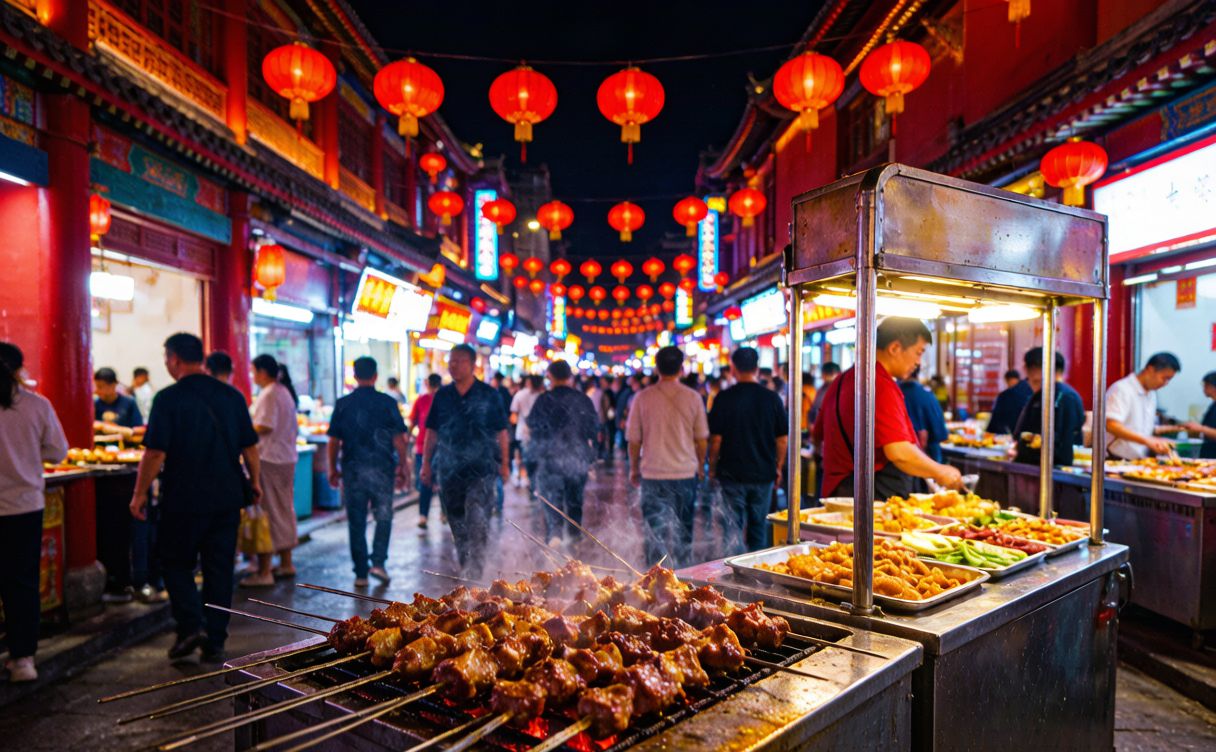
The first time I walked into the Xi’an Muslim Quarter, it was around 9 p.m. and the alley was already thick with smoke, sizzling oil, and the kind of noise that only happens when a few thousand hungry people crowd into a space meant for a few hundred. A vendor flicked a handful of cumin onto a row of lamb skewers, and the smell hit me before I could even see the grill. I came for the famous food photos I’d saved on my phone. I stayed for three hours, ate things I couldn’t pronounce, and left with chili oil on my shirt and zero regrets.
If you’re planning a trip to Xi’an, the Muslim Quarter (回民街, Huí mín jiē) is not a single street — it’s a sprawling maze of lanes northwest of the Drum Tower where the city’s Hui Muslim community has cooked, traded, and fed travelers for more than a thousand years. It sits at the eastern end of the old Silk Road, and you can taste that history in nearly every bite. This guide is built from my own nights spent there, with practical notes on what to eat, where to point your camera, and how to avoid the few traps that can sour an otherwise perfect evening.
Why the Muslim Quarter Matters (Beyond the Snacks)
Before you go thinking it’s just a tourist food court, understand what you’re standing in. The Hui people are ethnically Chinese and Muslim, and their neighborhood around the Great Mosque of Xi’an is one of the oldest continuously lived-in Muslim quarters in China. The food here follows halal (清真, qīng zhēn) law, which means no pork and specific slaughter practices — a welcome detail if you keep a halal diet and have struggled to find safe options elsewhere in the country.
What makes the cooking distinct isn’t just the religion, though. It’s the geography. Xi’an was the eastern terminus of the Silk Road, so its kitchens absorbed noodles from Central Asia, spices from the west, and wheat from the Loess Plateau. The result is a cuisine that tastes nothing like the rice-and-soy flavors of southern China. If you want the full context on how regional cooking differs across the country, our guide to China’s eight great cuisines is a good primer before you board the train.
The Dishes You Absolutely Should Not Miss
Lamb Skewers (羊肉串, yáng ròu chuàn) — The Heart of the Quarter
This is the smell that pulls you in. Small cubes of lamb, threaded on flat metal skewers, dusted with cumin, chili, and salt, then seared over charcoal until the fat crisps. A stick costs roughly 3–5 yuan, and the right move is to buy a stack of ten and walk. The best ones I had came from a tiny stall near the north end of Beiyuanmen where the man had been flipping skewers for what looked like his entire life. Don’t expect tenderness like a Western chop — these are meant to be chewy, smoky, and eaten standing up.
Biángbiáng Noodles (biángbiáng miàn) — The One With the Impossible Character
You’ll see the character 褢 (or its even more complex traditional form) painted on restaurant signs; it’s famously one of the most complicated characters in the Chinese language, with around 50 strokes. The noodle itself is a wide, belt-like belt of hand-pulled wheat dough, drowned in chili oil, smashed garlic, and sometimes a sprinkle of cilantro. It’s slippery, messy, and deeply satisfying. Order it “spicy” only if you actually like pain — the default already carries a real kick.
Roujiamo (肉夹馍) — The “Chinese Hamburger”
A crisp, flatbread pocket stuffed with braised meat. In the Muslim Quarter the filling is always halal lamb or beef, slow-cooked with spices until it falls apart. The bread (mo) is baked in a clay oven until blistered, then split and stuffed. It’s cheap (8–15 yuan), portable, and the perfect thing to eat while you keep wandering. I treated it as my between-skewers snack.
Yangrou Paomo (羊肉泡馍) — The One You Build Yourself
This is the dish that separates tourists from everyone else. You’re given a couple of dense round flatbreads and told to break them into pea-sized pieces with your fingers — the smaller, the better, though locals will quietly judge your technique. Then the bowl goes to the kitchen, where it’s submerged in a rich lamb broth with vermicelli, sliced lamb, and scallions. The broth is earthy and warming, and the broken bread soaks it up like a sponge. It’s a whole ritual, not a fast meal, and it’s worth slowing down for.
Persimmon Cakes (柿子饼, shì zi bǐng) — Save Room for Dessert
Made from local Fuji-area persimmons (the surrounding Shaanxi countryside grows some of the best in China), these are mashed, formed into small cakes, and fried until the outside cracks into a caramelized shell. Inside is sweet, jammy, and barely holding together. They’re sold by the piece from pushcarts and are best eaten hot, standing in the lane, with napkins at the ready. After a night of chili and lamb, this is the gentle landing you’ll want.
A Loose Map of Where to Wander
The main drag everyone photographs is Beiyuanmen (北院门), the pedestrian lane running north from the Drum Tower. It’s the most crowded and the most commercial — go once for the spectacle, then peel off.
The better food is often one lane over. Xiyangshi (西羊市) and Dapiyuan (大皮院) run parallel and feel more local, with family-run shops that have signs in Chinese only. Sajinqiao (洒金桥), a little further northwest, is where I ate my best breakfast — early-morning huímin congee and fried dough that the office crowd was lining up for. If you only have one evening, walk the main lane north, hook left at Xiyangshi, and let your nose decide.
Practical Tips I Wish I’d Known
Go late, but not too late. The quarter wakes up around 5–6 p.m. and peaks between 8 and 10 p.m. Arriving at 7 gives you full stalls without the absolute worst crush. Most vendors pack up around midnight.
Carry small cash and a payment app. Many tiny stalls still prefer cash or scan-to-pay, and while Alipay and WeChat work, setting them up can be fiddly for newcomers — worth doing before you’re standing at a grill with empty hands.
Share, don’t hoard. Portions are small and prices are low on purpose — the point is to graze across a dozen stalls. Buy two skewers here, a cake there, a bowl to split with a friend. You’ll taste more and spend less.
Mind the “free samples” tours. A few operators near the lane entrances offer “free tasting tours” that end at a souvenir shop with marked-up dried fruit and tea. Polite decline works fine. The real food is on the open street, not behind a curtain.
For broader safety habits around street eating in China — including how to judge a stall’s cleanliness and what to do if your stomach rebels — see our street food safety guide for China. I followed its “busy stall = fresh turnover” rule and never got sick.
Halal, Explained (So You Can Eat With Confidence)
If keeping halal matters to you, the Muslim Quarter is the easiest place in China to relax about it. Look for the green 清真 (qīng zhēn) character on a shop’s sign or window — that’s your signal the kitchen follows Islamic dietary law. Pork is absent everywhere in the quarter, and alcohol is limited. Vegetarians will find fewer options than they’d like (most dishes center on lamb or beef), but the noodle shops can usually do a plain chili-oil version if you ask.
One language tip that saved me: learn the phrase “wǒ chī qīng zhēn” (我吃清真) — “I eat halal.” Say it when you step up to a stall and you’ll get a nod of recognition and usually a point to the safest item on the grill.
Pairing the Quarter With the Rest of Xi’an
The Muslim Quarter is walkable from the city’s biggest hits. The Drum and Bell Towers sit at its southern mouth, and the Xi’an City Wall is a 15-minute stroll east. Most travelers base their Xi’an days around the Terracotta Warriors, which are an hour east of the center — a logical plan is warriors by day, Muslim Quarter by night. Our full Xi’an travel guide lays out that rhythm in detail, including how to time the crowds.
And if you’d rather not guess at menus, our guide to ordering food with Chinese apps covers translation tools that turn a confusing character menu into plain English — handy even here, where many stalls post only Chinese signs.
My Honest Take
Is the Muslim Quarter touristy? Yes, the main lane absolutely is, and you’ll hear more English and Korean than Shaanxi dialect there after dark. But “touristy” and “worth it” are not the same thing. The food is real, the halal tradition is genuine, and the chaos is part of the charm. Go in with reasonable expectations, step off the postcard street, and eat where the locals queue. Do that, and an evening in the Xi’an Muslim Quarter might be the meal you remember longest from your whole China trip.
For the deeper historical thread — how this neighborhood grew out of Xi’an’s role as the start of the Silk Roads — the UNESCO listing for the Silk Roads: the Routes Network of Chang’an-Tianshan Corridor is a solid, authoritative read before you go.
Quick Reference
- Where: Beiyuanmen lane, north of the Drum Tower, inside Xi’an’s city wall
- When: Stalls open ~5 p.m., peak 8–10 p.m., close near midnight
- Must-eat: lamb skewers, biángbiáng noodles, roujiamo, yangrou paomo, persimmon cakes
- Budget: 60–100 yuan buys a full, stuffed evening of grazing
- Watch for: “free tasting” tours that end at souvenir shops