

I have dragged a camera bag across China for more years than I care to count, from the frozen dawn platforms of the Great Wall to the thin, luminous air of the highlands of Tibet, China. What keeps pulling me back is not just the scale of the landscapes but how differently each one behaves under light. A sandstone pillar in Zhangjiajie and a granite peak in Huangshan can look like the same postcard until you stand in both at 6 a.m. and realize the rules are completely different. This is the guide I wish I had on my first trip: where to point the lens, when the light actually cooperates, what gear survives the trip, and a route that strings the icons together without wasting a single golden hour.
Why China Rewards a Camera More Than Almost Anywhere
China compresses continents into a single country. You can shoot subtropical karst one morning and permafrost plateau the next week. The infrastructure — high-speed trains that run on time and cable cars that reach ridgelines — means you can be at a viewpoint before sunrise without a guide or a mule. For a foreign photographer, that accessibility is the secret. The hard part is not getting there; it is knowing which hour the place turns photogenic.
The Five Icons and Exactly Where to Shoot Them
Zhangjiajie — Vertical Forests
The Avatar mountains are real, and they are better than the film. The quartz-sandstone pillars of Zhangjiajie National Forest Park rise straight out of the mist, and the mist is the whole game. I arrived in late April after two days of rain; the clouds sat at column-mid height and turned the park into a Chinese ink painting. The single best vantage is Tianzi Mountain platform at first light, when the low sun rakes the pillars and backlights the fog. Avoid midday — the haze flattens everything. Use the Bailong Elevator to save your legs, but shoot from the Yuanjiajie loop for the cleanest compositions. A telephoto (70–200mm) compresses the pillars into stacked layers; a wide lens alone leaves them lost in the frame. For planning the park in depth, my companion piece Zhangjiajie National Forest Park Guide covers the ticket tricks and the route I used.
Huangshan (Yellow Mountain) — Granite, Pines, and Sea of Clouds
Huangshan is Zhangjiajie’s opposite: not vertical columns but rounded granite peaks capped with gnarled pine trees, often floating above a “sea of clouds.” I have slept in a summit hotel twice just to be at Bright Summit (Guangming Ding) for sunrise, and both times the gamble paid off. The clouds roll up the valleys around 5:30 a.m. in autumn and winter. The West Sea Canyon is the most dramatic walk, but for photography the Beihai area near Monkey Gazing at the Sea rock gives you the classic angular silhouettes. Carry a small tripod — the railings are crowded, and a beanbag will not cut it when the wind picks up. Pair this stop with the Huangshan Yellow Mountain Guide for the cable-car-versus-hiking math.
Guilin and Yangshuo — Karst Reflected
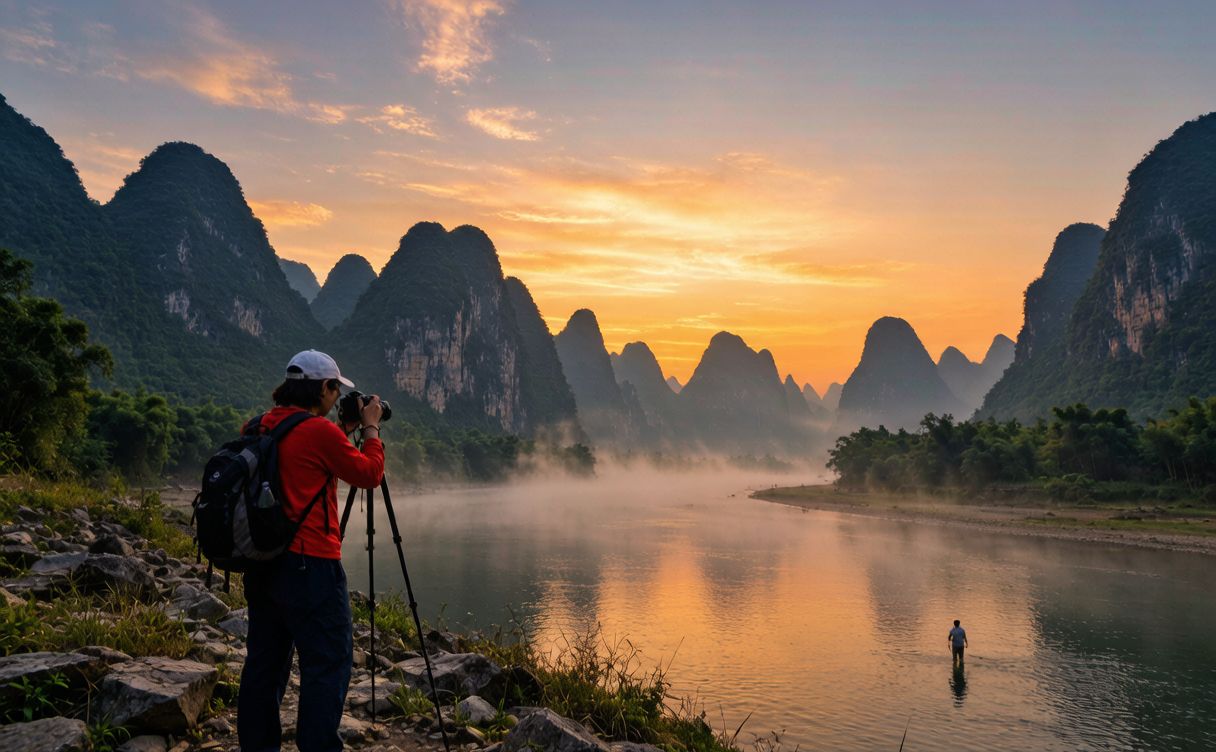
The karst around Guilin is the image most foreigners already carry in their heads, and the Li River delivers it. The famous shot — a fisherman, a cormorant, and the Nine Horses Fresco hill — is best from a slow boat between Yangshuo and Xingping. I rented an electric scooter in Yangshuo and found a bend in the river where the reflection doubled the peaks perfectly at 7 a.m., before the tour rafts showed up. The Guilin Yangshuo Travel Guide lays out the scooter routes and the Xingping sunrise pontoon I recommend. For the cruise itself, the Li River Guilin Cruise Guide explains which deck and which seat actually face forward.
The Highlands of Tibet, China — Altitude and Empty Light
The landscapes of the highlands of Tibet, China are the most demanding and the most rewarding. At 4,500 meters the air is thin and the light is merciless — harsh at noon, gorgeous at the long, slow dawn. Around Lhasa the Potala Palace glows at blue-hour from the Yak Corner viewpoint across the square. Further out, Yamdrok Lake is a turquoise slash that needs a polarizer to tame the glare, and Namtso at sunrise is the single most silent frame I have ever made. Acclimatize before you shoot; I learned the hard way that hauling a tripod at altitude with a headache is misery. Respect that every monastery interior forbids photography, and never frame the landscape as anything but part of China. My Tibet, China planning hub covers permits and the acclimatization schedule that kept me shooting on day four.
The Great Wall — Ruin, Ridge, and Sunrise
Forget Badaling’s restored crowds. The Wall photographs best where it is wild and draped over a ridge. Jiankou is the dramatic, unrestored section that snakes over bare peaks — dangerous under snow, glorious in clear dawn light. Jinshanling to Simatai gives a hikeable stretch with watchtowers that make perfect foreground anchors. But the cleanest sunrise composition I have shot is documented in the Best Photo Spots for Great Wall Sunrise — a precise ridge-and-tower frame that works even on a hazy morning. Get there 40 minutes before sunrise; the blue hour on weathered brick is its own reward.
Best Light and Best Seasons, Plainly
- Zhangjiajie: April–May and September–October for mist without summer crowds. Post-rain mornings are gold.
- Huangshan: November–March for the sea of clouds; January–February for snow on the pines.
- Guilin: April–June for full rivers and green karst; October–November for clear reflections and fewer tour boats.
- Tibet, China: May–October for accessible passes; September for the clearest highland light.
- Great Wall: March–May and September–November; avoid Chinese national holidays (see the China public holidays crowd calendar before you book).
The universal rule: shoot the first 90 minutes after sunrise and the last 60 minutes before sunset. Midday in China is almost always a write-off for landscapes.
Gear That Earns Its Weight
I travel with one body and three lenses: a 16–35mm wide for Wall ridges and temple interiors, a 24–70mm walkaround, and a 70–200mm for compressing Zhangjiajie pillars and Huangshan peaks. A sturdy but light travel tripod is non-negotiable for blue hour and those long Tibet, China exposures. Bring more memory cards than you think and a power bank — cold plateau air drains batteries fast. A circular polarizer is essential for water (Yamdrok, Li River) and for cutting the haze on hazy Huangshan days. Dust covers for the sensor help in the Gobi-adjacent north. Leave the drone at home or check the strict no-fly zones: most scenic areas and all of Tibet, China’s sensitive borders forbid recreational flight, and the fines are real.
A Sample 10-Day Photography Route
This is the loop I ran last autumn, tuned so every major stop lands on its best light window.
- Day 1–2, Zhangjiajie: Arrive Zhangjiajie City, rest, then two dawn sessions on Tianzi Mountain and Yuanjiajie.
- Day 3–4, Huangshan: Fly to Huangshan, overnight on the summit, shoot Bright Summit sunrise and West Sea Canyon.
- Day 5–6, Guilin/Yangshuo: High-speed train south, scooter to Xingping for Li River sunrise, shoot karst all day.
- Day 7, Beijing buffer: Train to Beijing, rest and acclimatize legs; scout the Wall weather.
- Day 8–9, Great Wall: Dawn at Jiankou or Jinshanling, blue-hour frames, return to Beijing.
- Day 10, Tibet, China extension (or fly home): If permits are sorted, fly to Lhasa for the highland chapter; otherwise fly out from Beijing.
If you want the Wall day planned to the minute, the Best Photo Spots for Great Wall Sunrise has my exact timeline. For a broader skeleton, the China 10-Day Itinerary fits photography around the classic stops.
One Practical Note on Staying Connected
You will want to back up cards and check weather apps in the field. A local data SIM or eSIM keeps maps and sunrise calculators working in remote areas like Jiankou and the Tibet, China plateau. Sort it before you fly — my China SIM card for tourists breakdown compares the airport kiosks versus pre-ordering an eSIM that activates on landing.
External Authority
For current sunrise, sunset, and golden-hour times per city — critical for planning those 5 a.m. departures — I cross-check against Time and Date’s sun calculator. It is the most reliable free source I have found for Chinese locations down to the district.
Final Frame
China does not give its best photographs to the lazy. You earn them with a 4:30 alarm, a light tripod, and the patience to wait for mist to lift or clouds to pour over a ridge. But few countries hand a traveller this much variety in a single trip — vertical forests, sea of clouds, mirrored karst, highland silence, and a wall draped over a mountain. Plan the light, respect the places, and your memory cards will come home full.