

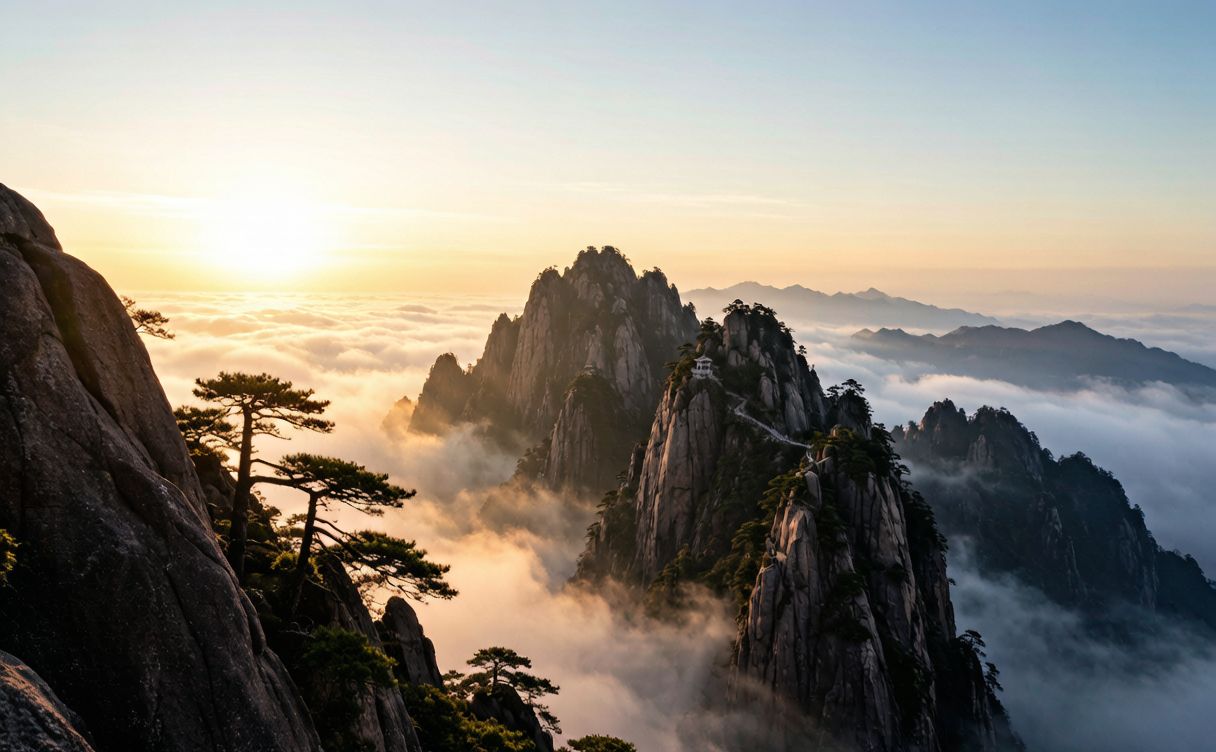
I still remember the first time I stood on a Huangshan Yellow Mountain ridge at 5:40 in the morning, half-asleep and shivering, watching the granite peaks turn from grey to gold. People talk about this place like it’s a painting, and standing there I finally understood why. This guide pulls together what I wish I’d known before that trip — where to catch the best sunrise, how the cable cars actually work, which trails will wreck your knees, and how to sleep at the top without emptying your wallet. If you’re planning a first visit to Huangshan Yellow Mountain, read this before you book a single hotel.
What Makes Huangshan Special
Huangshan sits in southern Anhui province, a few hours west of Shanghai by high-speed train. “Yellow Mountain” is the literal English translation of 黄山, and the name carries weight: it’s been a source of Chinese landscape painting and poetry for over a thousand years. UNESCO lists it as a World Heritage site for both its natural scenery and its cultural footprint — you can read the official description on the UNESCO Huangshan listing.
Three things define the mountain. First, the granite peaks — more than 70 of them rise above 1,000 meters, with names like Lotus Peak (1,864 m, the highest) and Celestial Capital Peak. Second, the gnarled Huangshan pines that grow sideways out of bare rock, twisted by the wind into shapes you’d swear were sculpted. Third, the hot springs at the base, where tired legs go to recover after a long descent. Add the famous sea of clouds, and you get the postcard view that draws close to three million visitors a year.
Sunrise Spots Worth the Early Alarm
Sunrise is the reason most people climb. The catch: you’ll be walking in the dark with a headlamp, often in a crowd. Pick your viewpoint the night before and set an alarm for roughly 4:30–5:00 depending on season.
Bright Summit (Guangming Ding)
At 1,860 meters, Bright Summit is the most popular sunrise spot and the easiest to reach from the top hotels. It’s a broad, flat area, so it handles crowds better than the narrower pavilions. Arrive at least 40 minutes early in peak season or you’ll be staring at the backs of phones.
Dawn Pavilion (Shiguang Ting)
On the east side near the Yuping (Jade Screen) cable car, Dawn Pavilion faces the morning light directly. It’s less crowded than Bright Summit but involves a steeper walk. Good choice if you’re staying near the Yuping area or coming up the Eastern Steps.
Cloud-Dispelling Pavilion (Paiyun Ting)
This one faces west, so it’s actually better for sunsets and the sea of clouds than for sunrise. I’m including it because the late-afternoon light here, with mist pouring through the valleys, is the single best photo opportunity on the mountain. Save it for day one if you arrive early.
Cable Cars & Hiking Routes
Most visitors don’t hike the whole mountain on foot anymore — they mix cable cars with walking. There are three main cableways: Yuping (east/south), Taiping (north), and Yungu (east). A one-way ride costs around ¥80 (about $11).
Western Steps vs Eastern Steps
The Western Steps (from the Hot Spring area) are the classic, scenic route up — more stone steps, more shade, more old-growth forest, and a longer, gentler grade. Count on 4–5 hours of climbing if you go all the way to the top on foot. The Eastern Steps via Yungu cable car are faster: ride up, then it’s about 2 hours of walking to Bright Summit. First-timers who want to save their legs usually take a cable car up and walk down, or ride both ways and connect the peaks on foot.
Lotus Peak and Tiandu Peak
Lotus Peak is the highest point and the headline hike, but it’s closed on a rotating basis (usually alternating years with Tiandu Peak) for trail recovery, so check before you go. Tiandu Peak is the steeper, more exposed climb — there are sections with chains bolted into the rock where you’re essentially pulling yourself up. Both are serious. If you only have one day, pick one and skip the other; trying both in a single push is how people end up missing the last cable car down.
Where to Stay
You’ve got two real options, and they shape completely different trips.
Staying on the mountain puts you at the sunrise spots in minutes and lets you watch the sea of clouds at golden hour without a midnight hike. The catch is price and availability: a basic room at a summit hotel like Beihai or Xihai runs ¥800–1,500 ($110–210) in shoulder season and can double on holidays. Book two to three months ahead if you want a room with a window for the sunrise — these sell out fast, and walk-up availability is basically luck. The rooms are simple, the walls are thin, and the hot water is sometimes unreliable, but stepping onto Bright Summit in your jacket at 5 a.m. is worth it.
The alternative is basing in Tunxi, the historic district of Huangshan City (also called Tunxi Old Street), and riding up each day. This is far cheaper and gives you better food and a real bed. The downside is a 1-hour transfer from the train station to the scenic gate plus the cable car time, so you lose the easy sunrise. For most first-timers on a tighter budget, I’d stay in Tunxi and accept a slightly later start — and our Chinese food guide to the eight regional cuisines will tell you what Anhui dishes to hunt for down on the old street.
How to Get There
The easy way is the high-speed rail. Huangshan North Station connects directly to Shanghai (about 2.5–3 hours, ¥200–300 / $28–42), Hangzhou (roughly 1.5–2 hours), and Beijing via transfer. From the station, a tourist bus or taxi takes you to the scenic area entrance at Tangkou, about an hour away, for ¥20–50.
If you’re building a longer China trip around this, land in Shanghai first — our Shanghai first-time travel guide covers where to stay and how to catch the train out west. From Huangshan North you can also loop south toward Hangzhou or west toward the rice-terrace country, which fits neatly into a broader itinerary.
Best Time to Go
Spring (April–May) and autumn (September–November) are the sweet spots: clear air, comfortable temperatures, and the best odds of a real sea of clouds after rain. Autumn also paints the lower forests in red and gold. Summer is green and dramatic but crowded and prone to afternoon thunderstorms — and it’s peak holiday season, so hotels spike. Winter (December–February) is my quiet secret: snow on the pines, almost no crowds, and stunning shots, but some cable cars and peaks close in icy conditions, so pack for cold and check the weather hourly.
Nearby Hongcun Village
If you have a spare day, Hongcun is 30–40 minutes from the mountain’s south gate and is worth the trip on its own. This 800-year-old village of white-walled, black-tiled Hui-style houses reflected in still ponds is also a UNESCO World Heritage site, and it’s a favorite subject for art students with easels. Go early or late to dodge tour buses. Pairing Huangshan with Hongcun is the classic Anhui combo, and it gives your legs a flat, walkable recovery day between climbs.
Safety, Steps & Altitude
Huangshan isn’t a technical climb, but it’s not a stroll either. The paths are thousands of steep stone steps, often wet and slippery. Good shoes with grip are non-negotiable, and a walking stick (sold at the base for ¥5) saves your knees on the descent. Altitude here is modest — under 1,900 meters — so true altitude sickness is rare, but the combination of heat, steps, and effort can wipe out unfit hikers. Carry 1.5–2 liters of water; bottles on the mountain cost ¥10–15 each. Start descents early so you don’t miss the last cable car, which usually runs until around 5 p.m. but varies by season and weather. For broader context on staying healthy and alert on the road, our China travel safety tips cover everything from scams to heat.
The Bottom Line
Huangshan rewards the prepared. Book your summit room early if sunrise is the goal, ride a cable car to save your legs, pick one of Lotus or Tiandu Peak rather than both, and leave a day for Hongcun. Do that, and you’ll come home with the gold-and-grey photos everyone chases — and knees that still work.
Written by Karl — last updated July 2026. Karl has spent three years helping foreign visitors plan low-stress trips across China.