

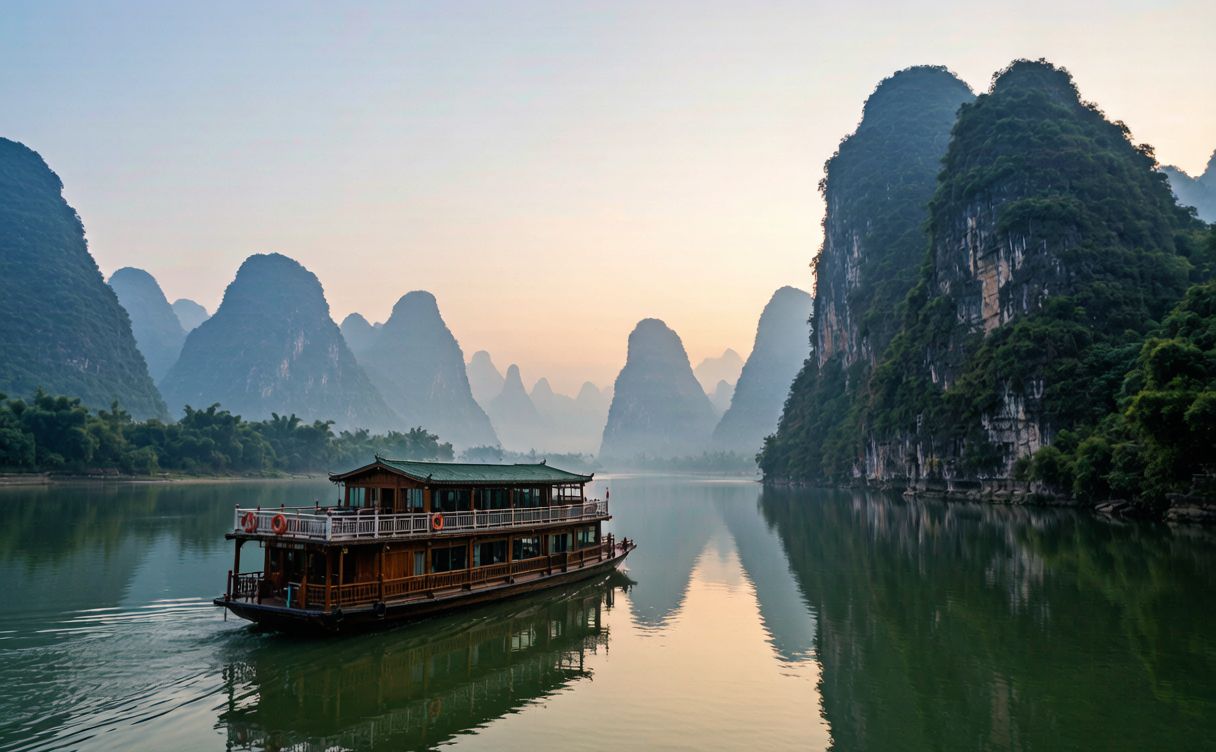
The first time I stood on the deck of a Li River cruise from Guilin, the mist had not yet burned off the water, and a fisherman in a bamboo hat was drifting past a karst peak that looked painted rather than real. I had read about this landscape for years and still was not ready for how quietly it lands on you. If you are planning a trip to southern China, a Li River cruise Guilin experience is the single excursion I tell almost every first-time visitor not to skip. In this guide I will walk you through the boat types, the real ticket prices in RMB and US dollars, the route and what you actually see, the famous 20-yuan banknote view at Xingping, the best months to go, how to get there, and where to base yourself.
What the Li River Actually Is
The Li River (漓江, Lí Jiāng) is not a single dramatic waterfall or a giant lake. It is a slow, green ribbon of water that snakes about 83 kilometers through Guangxi, from Guilin down to Yangshuo, hemmed in by the rounded limestone hills that give this part of China its postcard identity. The geology is no accident. These karst formations were shaped over hundreds of millions of years, and the wider Guilin region is recognized by UNESCO for exactly this reason — the karst landscape here is part of the South China Karst World Heritage property (UNESCO, whc.unesco.org/en/list/1248).
Most travelers talk about “the Li River cruise” as if it were one product. It is really a spectrum, ranging from a well-run four-star boat with a buffet lunch to a rustic bamboo raft shared with three other people. Knowing which one fits your trip is the difference between a relaxed highlight and a crowded, overpriced morning.
Boat Types — 4-Star Cruise, Budget Ferry, Bamboo Raft & Kayak
The classic option, and the one most foreign visitors book, is the 4-star motorized cruise that runs the full Guilin to Yangshuo route. These boats carry a few hundred passengers, have indoor and open-air decks, an included Chinese buffet lunch, and English-language commentary. They leave from the Mopanshan or Zhujiang Wharf north of Guilin and take roughly four hours to reach Yangshuo.
If you want the scenery without the price tag, local ferries and smaller shuttle boats run shorter hops, especially the Yangdi to Xingping stretch. These are cheaper and slower and attract fewer tour groups, but they lack the comforts and the on-board narration. A Guilin to Yangshuo boat of this type is a good pick if you are on a tight schedule and only want the middle, most photogenic section.
Then there are the private bamboo rafts (筏, fá). These are not the full cruise — they run on calmer, regulated sections, most often around Xingping or the Yulong River near Yangshuo. A raft seats two to four people, the poler stands at the back, and you sit low enough to feel the current. It is the most intimate way to see the hills, though it is weather-dependent and not suited to small children or anyone unsteady on their feet.
Kayaking and stand-up paddleboarding exist too, mostly on the Yulong River, which is a tributary rather than the main Li. I mention it because many people confuse the two; the Yangshuo river cruise marketing often blends them. The Yulong is gentler and great for paddling, but it is not the classic Guilin-to-Yangshuo run.
Tickets & Prices (RMB + USD)
Prices shift a little by season, but here is the range you can plan around. I am using ¥1 ≈ $0.14 to convert.
- 4-star Guilin → Yangshuo cruise: ¥210–¥360 (about $29–$50) one way, lunch included. Peak-season and foreigner-friendly operators sit at the higher end.
- Budget local ferry (Yangdi → Xingping): roughly ¥60–¥95 (about $8–$13).
- Private bamboo raft (Xingping or Yulong): around ¥100–¥200 per raft (about $14–$28), depending on length and group size.
- Kayak rental on the Yulong: from ¥80 (about $11) for a couple of hours.
Book the 4-star boat through your hotel, a licensed agent, or the official wharf counters. Li River cruise tickets for the big boats sell out on national holidays, so buy at least a few days ahead in spring and October. Keep your passport handy — boats check ID against the ticket.
The Route & What You See
The full cruise opens with a view of Elephant Trunk Hill (象鼻山) as you clear Guilin — a rock formation that genuinely looks like an elephant dipping its trunk into the water. From there the city falls away and the karst begins in earnest: pea-green hills rising straight out of the rice paddies, fishing cormorants on perches, and the occasional water buffalo standing chest-deep and unbothered.
The most photographed stretch is Yangdi to Xingping, roughly the middle of the journey. This is where the hills stack up into the composition you have seen on every China poster. Disembark at Xingping (兴坪), an old town with cobbled lanes, and walk or take the short shuttle to the 20-yuan viewpoint. Pull a ¥20 note from your wallet and hold it up: the printed scene — a calm bend in the river, a lone hill, and a cluster of peaks behind — lines up almost exactly with what is in front of you. It is the one spot where the cliché is true, and yes, half the people there are doing the same side-by-side photo.
From Xingping you can continue by road to Yangshuo (about 40 minutes), or stay in Xingping itself, which I actually prefer for a night of quiet over Yangshuo’s busy West Street.
Best Time & Weather
Spring (April to May) and autumn (September to early November) are the sweet spots. April and May bring the famous mist that sits low on the water — moody and beautiful, though it can obscure distant peaks. October is dry, clear, and crowded. Summer is hot and humid with sudden heavy rain; winter is cold but sparse and startlingly clear on good days.
Avoid the week-long national holidays (early May and early October) if you can. The boats and the viewpoint both turn into scrums. If your trip allows, a weekday in late April or mid-October gave me the best balance of light, mist, and breathing room.
How to Get There
Guilin is well connected. Guilin Liangjiang International Airport (KWL) has direct flights from major Chinese cities and a few regional international routes; from the airport it is about 30–40 minutes by car or shuttle to the city and the cruise wharves.
By train, the high-speed network makes Guilin an easy add-on. From Guangzhou you can reach Guilin North in roughly 2.5–3 hours, which pairs neatly with our Guangzhou travel guide if you are starting in the south. From Shanghai the ride is longer, around 7–8 hours, but comfortable; see our Shanghai first-time travel guide for context on that end of the trip. Travelers coming from Hong Kong usually take the high-speed train via Shenzhen or Guangzhou, a half-day journey that beats flying for central-city convenience.
Where to Stay: Yangshuo vs Guilin
Base in Guilin if you want city comforts, easy airport access, and a couple of nights before an early cruise departure. Base in Yangshuo if the landscape is the point and you want to wake up among the hills, rent an e-bike, and paddle the Yulong. I lean toward splitting it: one night in Guilin, then the cruise, then two or three nights in Yangshuo or Xingping.
Yangshuo’s West Street is lively and touristy with bars and cafés; Xingping is sleepier and closer to the 20-yuan view, so you can be at the river at first light before the day-trippers arrive. Book riverside guesthouses a month ahead in peak season — the good ones with a balcony over the water go first.
Photography Tips (Xingping 20-Yuan Viewpoint)
Get to the viewpoint before 9 a.m. The light is softer, the river is still, and you beat the bus tours. Bring a ¥20 note for the matching shot, but also shoot wider — the hills change character every few minutes as clouds move. A polarizing filter cuts the glare on the water; a small drone is technically restricted near the scenic zone, so check locally rather than assume.
For the cruise itself, the open top deck gives the cleanest sightlines, but it is exposed. I kept a light rain shell in my bag even in October. Shoot in bursts when the boat slows at the famous bends — the crew knows the photo stops and eases off the throttle.
Safety & Comfort
The 4-star cruise is safe and stable; life jackets are on board and the route is calm. Bamboo rafts are regulated but sit low, so listen to your poler and sit still when passing other rafts. In summer, heat is the real hazard — bring water, a hat, and sunscreen; the open deck has little shade.
Keep an eye on your belongings at the wharves, which get busy. If you are traveling with young kids or older relatives, the big boat is the comfortable choice; rafts and kayaks are better for agile adults. General street- and transit-level advice for the rest of your China trip is worth a read in our China travel safety tips.
The Bottom Line
A Li River cruise from Guilin to Yangshuo is the rare attraction that earns its reputation. The 4-star boat gives you the full, comfortable sweep in about four hours for ¥210–¥360, while budget ferries and bamboo rafts let you slow down and pick your own section. Do not miss Xingping and that 20-yuan view — it is the one postcard that holds up in person. Go in spring or autumn, book ahead, and let the hills do the rest.
Written by Karl — last updated July 2026. Karl has spent three years helping foreign visitors plan low-stress trips across China.