

At 7:10 a.m., a stainless cart rattles past your table at Guangzhou Restaurant on Wenchang Road, and a server lifts the lid off a bamboo steamer — har gow, shrimp dumplings so translucent you can count the pleats. This is the real start of any Guangzhou travel guide: not a monument, but a breakfast. Guangzhou (called Canton by foreign traders for centuries) is southern China’s food capital, a 2,200-year-old port where Cantonese cooking was born and where the Pearl River still carries cargo ships past a skyline of LED towers.
If you came for the Great Wall and imperial palaces, you came to the wrong city. Guangzhou suits people who like to eat their way through a place, wander leafy colonial lanes, and watch a megacity that never slows down. It’s also the easiest launchpad in China for Hong Kong, Shenzhen, and the diaspora towns of the Pearl River Delta. My short version: spend three days here eating, walking, and cruising the river, then train south.
This guide covers the best time to visit, how to ride the metro, the sights worth your time, where to eat dim sum, and a couple of day trips that justify the trip on their own. New to China entirely? Start with our China travel guide for first-timers for visas, money, and the basics that apply everywhere.
Key takeaways
– Visit in October–November or March–April for dry, mild weather; summer (May–Sept) is 32–35°C with choking humidity, and winter gets a damp chill that bites.
– The metro (¥2–7 / $0.30–1.00 a ride) reaches every major sight — link a foreign card to Alipay before you fly for tap-to-ride access.
– Canton Tower, Shamian Island, Chen Clan Ancestral Hall, and the Pearl River night cruise are the four anchors of a first visit.
– Dim sum is a morning ritual, not just a meal — arrive before 11 a.m. at Panxi or Guangzhou Restaurant and let the carts come to you.
– Kaiping’s diaolou (UNESCO-listed watchtower villages) make the best day trip; Hong Kong is only an hour away by train.
Best Time to Visit Guangzhou
Guangzhou sits at the same latitude as Hawaii and shares the heat. The best time to visit China generally favors spring and autumn, and Guangzhou is the poster child for it.
- October–November (best): 22–28°C (72–82°F), low humidity, blue skies. This is when the city breathes.
- March–April (good): Warm and blooming, but the “plum rain” front brings a few soggy weeks in April.
- May–September (hard): Daytime highs of 32–35°C (90–95°F) with humidity that sticks to your shirt. Afternoon thunderstorms are routine.
- December–February: Mild on paper (12–18°C / 54–64°F) but damp and gray, with the occasional cold snap dropping to 5°C (41°F).
A story worth hearing. My friend Tom flew in one July convinced Guangzhou would feel like “a warm beach.” It didn’t. By his second afternoon he’d gone through four shirts, bought a folding fan from a street vendor for ¥15 ($2), and was plotting his next move around which metro stations had the strongest air-con. He still rated the trip a 9 out of 10 — but he’d have rated it higher in November. Check the month before you book.
Getting Around: The Metro Does the Work
Forget taxis for daily movement. Guangzhou’s metro is clean, fast, fully bilingual (every sign and announcement runs in English), and connects the airport, the train stations, and every sight in this guide. A single ride runs ¥2–7 ($0.30–1.00) depending on distance. Buy a rechargeable Yangcheng Tong card, or — easier — link a foreign card to Alipay and use the “Metro” mini-app to scan in and out. No paper tickets, no queues.
Buses are cheaper but harder without Chinese reading skills. DiDi (China’s Uber) works through Alipay, though the metro beats it for first-timers during rush hour.
[CTA] Before you land, sort out mobile payment — our Alipay and WeChat Pay for foreigners guide walks you through binding a foreign card in about 15 minutes, so you can scan-and-go on the metro from hour one.
Top Things to Do in Guangzhou
Canton Tower (广州塔)
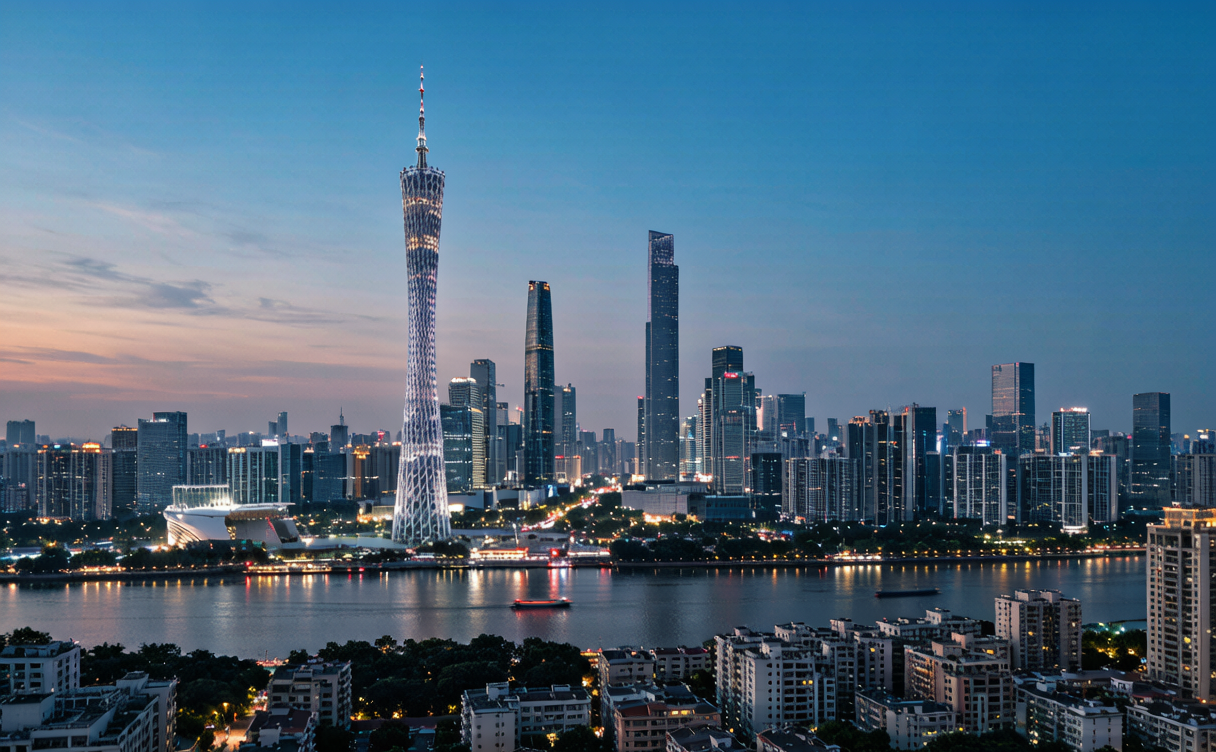
The city’s calling card is a 600-meter (1,968-ft) slender twist of steel locals call “Little Waist” for its hourglass shape. Ride to the indoor observation deck (¥150 / $21) for a view over the Pearl River Delta, or pay extra for the outdoor sky deck and the bubble-shaped Ferris cars that hang off the side. At night the tower runs a shifting LED light show that reflects on the water — come for the 7 p.m. switch-on.
Shamian Island (沙面岛)
A ten-minute walk from the train-bus hub of Huangsha drops you onto Shamian, a car-light islet of broad promenades and 150-odd European buildings from the 19th-century foreign concessions. White colonial villas, cast-iron lampposts, and banyan shade make it the calmest square kilometer in the city. It’s free, flat, and built for a slow morning with a coffee. Wedding couples pose under the arches on weekends — join the audience.
Chen Clan Ancestral Hall (陈家祠)
This 1894 clan academy is the finest surviving example of Cantonese decorative art in one place: carved wood, lattice screens, ceramic figurines, and iron engravings covering every surface. Entry is a steal at ¥10 ($1.40). Give it 90 minutes and look up — the ridge ceramics tell operas you’ll never finish decoding. It’s a five-minute walk from Chen Clan Academy metro (line 1).
Yuexiu Park & the Five Rams Statue (越秀公园)
Guangzhou’s largest park wraps a hill, lakes, and the Ming-era Zhenhai Tower (now the City Museum, ¥10 / $1.40). At its base sits the Five Rams statue, the city’s official symbol — legend says five celestial rams brought rice to a starving city and turned to stone. The park is free and a easy half-morning of shade and stairs. Come early to watch tai chi and sword practice on the lawns.
Beijing Road Pedestrian Street (北京路)
A covered shopping promenade in the old city center where you can walk directly over a glass-protected section of a 2,000-year-old Song dynasty roadbed, with Tang and Ming layers beneath. Above it: malls, sneaker shops, and street snacks. It’s busy, commercial, and fun for an evening stroll — the archaeology under your feet is the part you won’t find in Shanghai or Beijing.
Pearl River Night Cruise (珠江夜游)
The single best first-night activity. Boats leave from Tianzi or Dashatou pier and loop past Canton Tower, the bridges, and the lit riverfront for about an hour. Tickets run ¥68–138 ($9.50–19) depending on deck and boat class; book the 7:30 p.m. sailing. A reader emailed me about her solo trip: she took the top deck on a clear November night, the tower pulsing purple and gold, and wrote that it was “the moment Guangzhou finally made sense.” That’s the cruise — it ties the whole city together in one slow loop.
Eating in Guangzhou: Dim Sum & Morning Tea
Cantonese food is the gentle, fresh side of Chinese cooking — and Guangzhou is its home. For the full picture across regions, our guide to China’s 8 great cuisines breaks down where each style comes from and what to order. But here, it’s all about yum cha — “drinking tea” — the morning ritual of small plates and endless pots.
The rules are simple. Arrive before 11 a.m. (locals are done by then). Sit, and the carts come to you — point at what you want. Must-orders: har gow (shrimp dumplings, ¥18–28 / $2.50–4 a basket), siu mai (pork-and-shrimp open tops, ¥16–24 / $2.20–3.30), char siu bao (barbecue pork buns, ¥12 / $1.70), and cheung fun (rice noodle rolls with soy, ¥14 / $2). A full table for one runs ¥50–90 ($7–12.50); for two, ¥120–180 ($17–25).
Where to eat:
– Panxi Restaurant (泮溪酒家): A garden teahouse on the edge of Liwan Lake, the most atmospheric dim sum in the city. Expect ¥80–140 ($11–19) per person and a line on weekends — go at 9 a.m.
– Guangzhou Restaurant (广州酒家): The old-school flagship on Wenchang Road; reliable, central, and tourist-friendly with picture menus. ¥70–110 ($9.50–15).
– Dian Dou De (点都德): A modern chain with English menus and consistent quality — the safe pick if you’re nervous about pointing. ¥60–100 ($8–14).
– Late-night: Guangzhou never stops eating. Congee and clay-pot rice (bao zai fan) joints run past midnight; a clay-pot rice with sausage is ¥28–45 ($3.80–6.20).
Day Trips from Guangzhou
Kaiping Diaolou (开平碉楼) — the best day trip
About 130 km (80 mi) southwest, the villages of Kaiping hold the diaolou: multi-story fortified towers built by overseas Chinese in the early 1900s, blending Chinese layout with European domes and turrets. They’re a UNESCO World Heritage site — see the UNESCO listing for Kaiping Diaolou and Villages for the official record. Get there by high-speed train to Kaiping South (about 1 hour, ¥45 / $6) then a taxi or local bus to the Zili Village or Liyuan Garden clusters. Plan a full day; the rice-field setting is half the magic.
Shenzhen & Hong Kong
Shenzhen, China’s instant metropolis, is 30 minutes west by high-speed train (¥75 / $10). Hong Kong sits just beyond: direct trains from Guangzhou South to Hong Kong West Kowloon take about an hour (¥215 / $30). If you’re combining mainland China with a Hong Kong stop, Guangzhou is the natural bridge — and our China high-speed train guide for foreigners covers booking on 12306 and Trip.com without a Chinese phone number.
Who Guangzhou Suits (and Who It Doesn’t)
Guangzhou is ideal for:
– Food-first travelers. If your favorite part of any trip is the next meal, this is your city.
– Repeat visitors to China who’ve done Beijing and Shanghai and want the Cantonese south.
– Hong Kong / Shenzhen combiners who want a mainland base with colonial character.
– Photographers chasing the contrast of colonial lanes against a sci-fi skyline.
It’s a weaker pick if: you want imperial grandeur (go Beijing), fairy-tale old towns (go Chengdu or the water towns), or cool dry air in summer (go north). Guangzhou is humid, loud, and proudly commercial — and that’s exactly why its fans love it.
Practical Tips Before You Go
- Internet: Google, WhatsApp, and Instagram don’t work without a workaround. Set up a China eSIM for tourists before you fly so maps and messaging work on landing.
- Payment: Cash is fading fast. Alipay or WeChat Pay with a linked foreign card covers metro, restaurants, and taxis.
- Apps: Alipay (pay + metro), Amap or Baidu Maps (Google Maps is unreliable here), DiDi (rides).
- Language: Cantonese is spoken locally, but Mandarin works everywhere; translation apps handle menus.
- Safety: Guangzhou is very safe for tourists, including solo women. The only real risk is phone snatching in crowded metro cars — keep it in a zipped pocket.
[CTA] Planning a multi-city China trip? Our China travel guide for first-timers ties together visas, trains, money, and the other cities worth your time — read it before you book flights.
Written by Karl · Updated July 2026