

At 6:12 p.m. on a wet Tuesday in April, I stood on the overpass at Liziba and watched a red light-rail train slide straight into the 6th floor of a concrete apartment block and emerge from the far side like nothing had happened. In this Chongqing travel guide I want to start right there, because that single absurd, real moment sums up the whole city: in Chongqing, the map lies. A “ground floor” might secretly be the 11th floor depending on which hill you climbed from, and 32 million people built a metropolis that folds upward instead of spreading out.
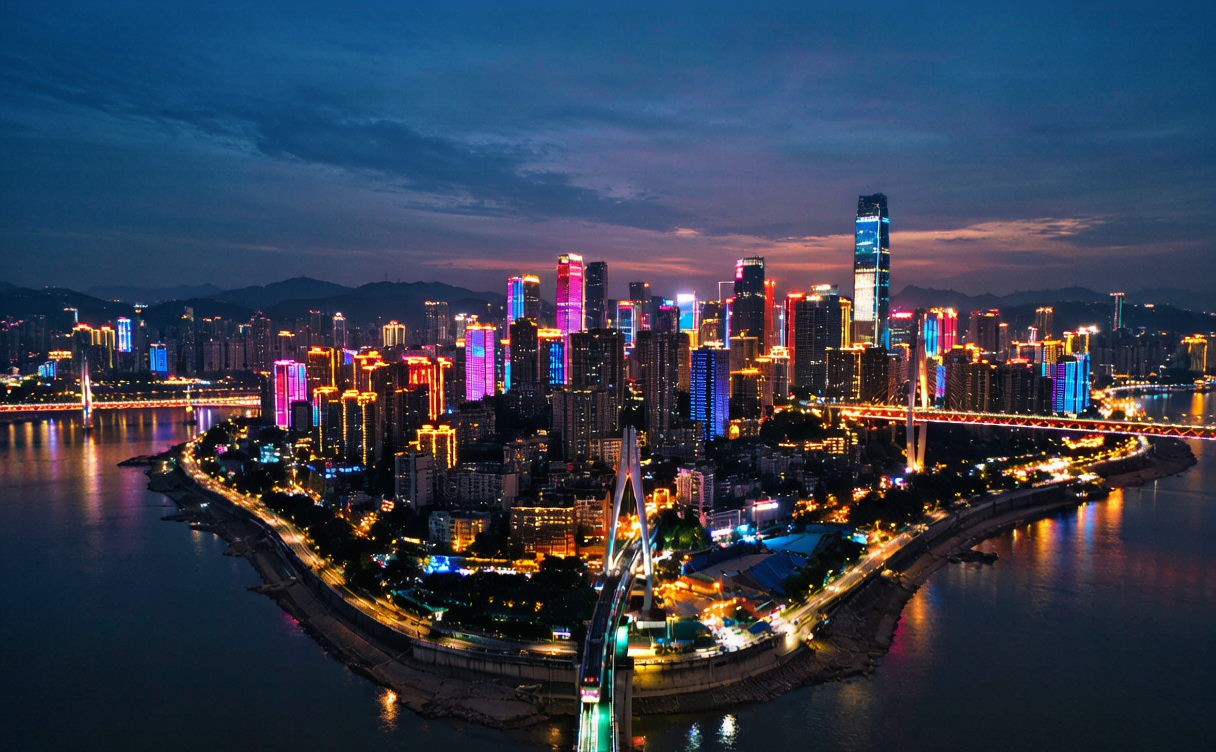
You’ve probably seen the photos — the layered night skyline dripping in neon, a train vanishing into a bedroom, stilted wooden towers glowing above a black river. This guide goes past the screenshots. I spent four days there in spring 2026 and ate more hotpot than was wise. Below: the sights, the hotpot table, the UNESCO day trip, and who this city is for.
Key takeaways
– Chongqing is a 3D mountain city where the Yangtze and Jialing meet — bring Baidu/Amap maps, because Google Maps fails and the streets stack on each other.
– The Liziba monorail-through-building and Hongyadong’s cliffside stilt towers are the two shots you came for; both are free and best at dusk.
– Budget about ¥80–150 (≈ $11–21) per person for a proper mala hotpot, and order the nine-grid pot with tripe and duck intestine.
– The Yangtze River cable car (≈ ¥30 / $4 each way) and the Nanshan “One Tree” platform give you the classic night-view postcards.
– Dazu Rock Carvings, a UNESCO site 160 km west, make an easy day trip by high-speed train — pair Chongqing with Chengdu or Xi’an using the rail network.
Why Chongqing is unlike any other Chinese city
Most Chinese megacities sit on flat plains; Chongqing dropped into a river gorge. The Yangtze comes in from the southwest, the Jialing cuts down from the north, and they collide in the middle of town, splitting the core into steep peninsulas that locals call “mountains” and the rest of us call “vertical.” Builders had no choice but to go up: highways thread through lobbies, footbridges link rooftops, and the metro runs overhead, underground, even through a kitchen.
The rivers shaped the city’s character too. Chongqing grew as a river port and wartime capital in the 1930s–40s. It’s also famously foggy: the old nickname is “Foggy City” (雾都), because humid river air pools in the valleys. On a clear night that fog actually helps, softening the light into the layered glow everyone photographs.
[CTA] Planning the rest of your route? Our China travel guide for first-timers covers visas, mobile payments, and how to chain cities by train — read it before you book flights.
The Liziba light rail: a train that lives in an apartment
Line 2’s Liziba Station (李子坝) is the city’s signature image, and better in person than online. The monorail doesn’t pass near a building — it runs straight through floors 6 to 8 of a residential block, apartments on either side of the track. Engineers dampened the vibration so residents barely notice the trains, though the tourists on the opposite overpass definitely do.
Get there on Line 2: ride to Liziba Station, step off, and walk to the viewing platform across the road. Go around 6 p.m. for the red train against the blue hour — it’s free and the one thing every first-timer should see.
Mini story: Marco, a graphic designer from Lisbon, built his entire morning around this. He took Line 2 from Jiefangbei, rode through the building (yes, you can be on the train that goes through the building), then doubled back to photograph it from outside. “I’ve shot metros in Tokyo and Berlin,” he told me over a later beer, “but none of them commit to the bit like this. The whole city is a practical joke played on gravity.”
Hongyadong: the cliffside village of lights
A ten-minute walk from Jiefangbei (the central business district and its clock-tower plaza), Hongyadong (洪崖洞) is an 11-story stack of Bayu-style stilted houses (吊脚楼) clinging to the riverside cliff. By day it’s a touristy warren of snack stalls; at night it transforms — every tier lights up in gold and red, the Jialing reflects it back, and you get why people call Chongqing the “real-life Spirited Away.”
Here’s the trick most visitors miss — the building terraces down the cliff, so the “first floor” at the top entrance dumps you eleven levels above the riverside walk at the bottom. Walk down through the levels for the shops, then step out at river level for the postcard view back up. Free to enter; go after 7 p.m. and, if possible, on a weekday — weekends are shoulder-to-shoulder.
The Yangtze River cable car: cross the water by gondola
Before the bridges multiplied, the only way across the Yangtze was the 长江索道 (Yangtze River Cableway). It’s still running — a 1,160-meter span, about a five-minute ride high above the brown, fast water between the Yuzhong peninsula and Nan’an district on the south bank. Operating since 1987, it’s now mostly visitors but a real piece of transport history.
A single ride costs about ¥30 (≈ $4). Go from the Yuzhong (north) side to Nan’an in late afternoon, then return after dark for the skyline. Buy at the station or on Trip.com; queues build on weekends, so an early ride saves time.
Ciqikou: the old town that survived
For a hit of pre-megacity Chongqing, take metro Line 1 to Ciqikou (磁器口), an old trading town roughly a thousand years old, with Ming- and Qing-dynasty lanes of grey brick, teahouses, and the smell of 陈麻花 (Chen mahua) — crispy twisted sesame biscuits sold by the bagful. Entry is free. Wander the main street and duck into a riverside teahouse for a ¥20 gaiwan of jasmine.
It’s commercialized, no question, but it’s one of the few places where you feel the port-town bones under the neon. Go before 11 a.m. for the lanes to yourself.
Where to watch the night view: Eling Park and Nanshan
Chongqing’s skyline is the attraction, and there are two classic vantage points.
Eling Park (鹅岭公园) sits on a central hilltop and costs only a few yuan (≈ ¥10 / $1.40). an old garden with a clear sightline down the peninsula — a quick in-town overview without crossing a river.
Nanshan “One Tree” viewing platform (一棵树) is the famous one. Across the river in the south, it looks straight back at the lit-up core — the postcard angle you’ve seen online. Entry is about ¥30 (≈ $4). Take a Didi or bus up after dark; bring a jacket.
Hotpot: the religion of Chongqing
Chongqing claims to be the birthplace of mala (麻辣) hotpot — a numbing, fiery broth built on beef tallow (牛油), douban chili paste, and Sichuan peppercorns that makes your lips buzz. If you eat one meal here, make it this. A sit-down hotpot for one runs about ¥80–150 (≈ $11–21), beer included.
A few tips that save first-timers from a rough night:
- Order the nine-grid pot (九宫格). The center boils hottest; slide tripe (毛肚), duck intestine (鸭肠), and thin beef in for seconds, not minutes.
- Don’t drink the broth — it’s pure chili oil. Order iced soy milk (豆奶) or beer to cool the burn, like locals do.
- Manage the spice. Ask for “weijian” (微辣, mild) if you’re unsure; “zhongla” (重辣) is a dare you may regret.
- Find a neighborhood spot. The best hotpot isn’t in a mall — it’s a hole-in-the-wall in districts like 较场口 or 李子坝, full of locals sweating happily. Look for the red signage.
Getting around: the metro is your lifeline
Chongqing isn’t a walking city in the normal sense — it’s a climbing city. The metro (轻轨/地铁) is clean, cheap (¥2–7 / $0.30–1 a ride), signposted in English, and the only sane way to get around. Key lines: Line 1 (Ciqikou), Line 2 (through Liziba), Line 3 (airport), Line 6, and the Loop Line.
Two cautions. First, use Baidu Maps or Amap, not Google Maps — Google’s routing is unreliable on the mainland, and the local apps handle the 3D chaos. Second, set up Alipay or WeChat Pay before you land to scan into the metro and pay for Didi. For longer hops, our China high-speed train guide covers buying 12306 tickets and scanning your passport at the gate.
Day trip: the Dazu Rock Carvings (UNESCO)
If you do one excursion out of the city, make it Dazu (大足石刻), a UNESCO World Heritage Site inscribed in 1999 and about 160 km west of Chongqing. These are Buddhist cliff carvings — a 1,000-year-old gallery, with the 30-meter reclining Buddha and Thousand-Hand Guanyin at Baodingshan (宝顶山) as highlights.
Getting there is easy: a high-speed train from Chongqing West or Shapingba to Dazu takes 30–50 minutes, then a short bus or taxi to the site. Entry to Baodingshan runs about ¥115 (≈ $16). Give it a half-day plus travel. For current opening hours, check Chongqing’s official tourism website before you go.
[CTA] Ready to chain Chongqing with pandas and the Terracotta Army? Our China high-speed train guide shows you how to hop between cities, and the Chengdu panda and city guide maps the next stop.
Weather and the best time to visit
Chongqing is hot, humid, and wrapped in river fog for much of the year. Summers are brutal — regularly 35–40°C (95–104°F) with sticky humidity and little relief at night. Winters are mild (around 8°C / 46°F) but grey, damp, and foggy, with almost no snow. Spring (March–May) and autumn (September–November) are the sweet spots.
If your dates are flexible, our best time to visit China guide breaks the weather down region by region. Whatever season you pick, carry water and save uphill walks for the cool of morning.
Who Chongqing is for (and who it isn’t)
Chongqing is a dream for photographers and urban explorers — the verticality and night lights are unmatched in China. It’s a must for food lovers after the origin-story version of Sichuan hotpot, not the toned-down tourist spread, and ideal for return visitors who’ve done Beijing, Xi’an, and Shanghai.
It’s a tougher sell for travelers who want calm, walkable old towns and easy orientation — the hills, fog, and stacked highways wear you down if you like a predictable plan. Pair it with a slower city; the China travel budget per day guide helps balance a few intense days here against gentler stops elsewhere.
The bottom line
Chongqing doesn’t follow the rules other cities obey. It sends trains through apartments, stacks its old town down a cliff, and serves a broth that apologizes to no one. Spend three or four days: one for the Liziba–Hongyadong–cable-car core, one for hotpot and Ciqikou, one for the Dazu day trip. Ride the metro, trust Amap, and lower your spice until you’ve earned it. You’ll leave hoarse from laughing, slightly numb from the pepper, already planning that night shot.
Written by Karl · Updated July 2026
Internal Links Used
- China travel guide for first-timers → https://www.chinatravelplaces.com/china-travel-guide-for-first-timers/
- China high-speed train guide → https://www.chinatravelplaces.com/china-high-speed-train-guide-foreigners/
- Chengdu panda and city guide → https://www.chinatravelplaces.com/chengdu-pandas-and-city-guide/
- Terracotta Warriors in Xi’an → https://www.chinatravelplaces.com/xian-terracotta-warriors-visit/
- best time to visit China → https://www.chinatravelplaces.com/best-time-to-visit-china/
- China travel budget per day → https://www.chinatravelplaces.com/china-travel-budget-per-day/
Meta Title: Chongqing Travel Guide 2026: Hotpot, Light Rails & Night Views
Meta Description: Your 2026 Chongqing travel guide: ride the monorail through an apartment building, eat real mala hotpot, see Hongyadong at night, and visit the Dazu rock carvings (UNESCO).
Primary Keyword: Chongqing travel guide
Secondary Keywords: things to do in Chongqing, Chongqing itinerary, Chongqing hotpot
URL Slug: /chongqing-travel-guide
Word Count: ~1,950