

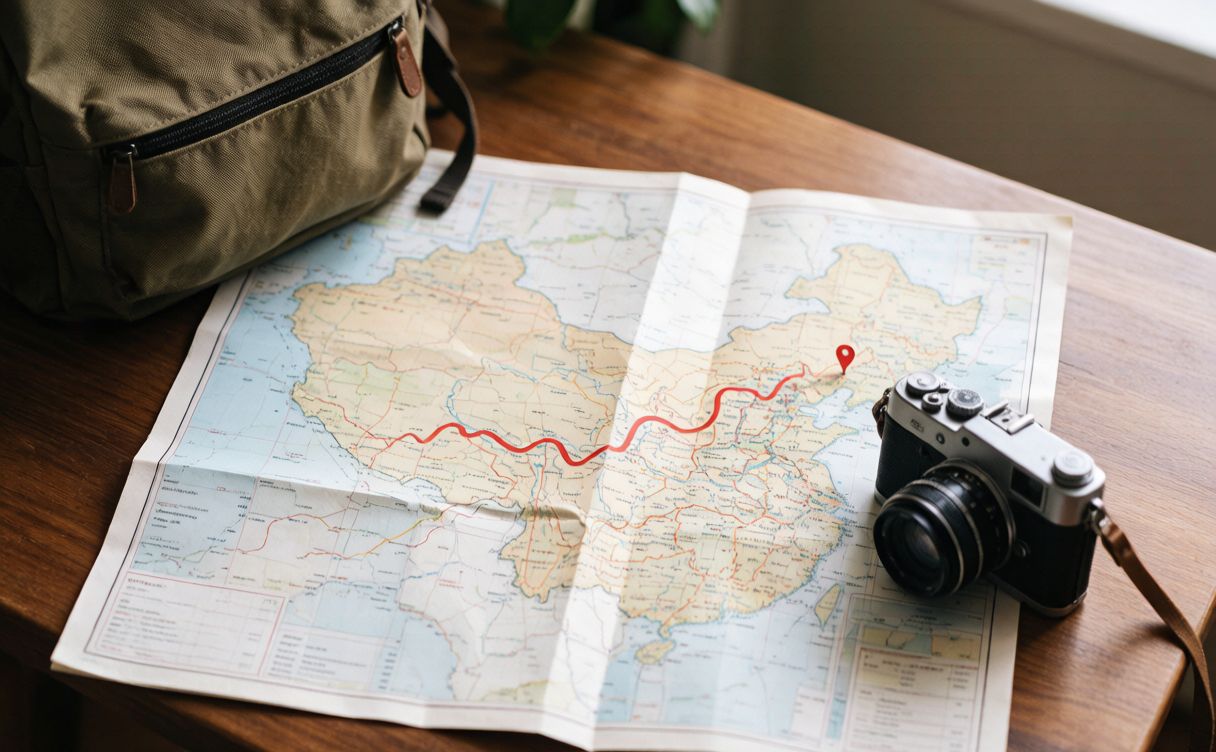
When people ask me for the single best way to experience China travel on a first trip, I always give the same answer: don’t try to see everything. A well-built 10-day China itinerary should connect a handful of iconic, well-connected cities and let each one breathe. After eight trips and countless train rides across the country, I’ve refined a route that hits the greatest hits — imperial Beijing, ancient Xi’an, modern Shanghai, and the surreal karst landscapes of Guilin and Yangshuo — without the burnout that comes from cramming in too much. This is the exact route I send to friends, with the pacing, train connections, and hard-won tips that make it work in real life. It also follows one of the smoothest transport corridors in the country, so you spend your time looking at China rather than waiting in its airports.
Why This Route Works for First-Timers
China is huge, and the temptation is to bolt on Chengdu, Zhangjiajie, or even farther-flung regions. Resist it on a first visit. Beijing, Xi’an, Shanghai, and Guilin sit on one of the country’s busiest high-speed rail corridors, which means short, comfortable train hops instead of draining flights. You get history (the Great Wall, the Terracotta Army), contrast (capital versus megacity versus countryside), and a natural north-to-south flow that ends somewhere calm and beautiful. Before you lock in dates, skim our things to know before visiting China so the logistics don’t catch you off guard.
One practical note up front: book your long trains early. China’s high-speed network sells out, especially on Friday and Sunday evenings. I use the official 12306 system through our guide to booking China train tickets on 12306 — it walks you through passport verification, which trips up almost every first-timer I’ve advised. Having your train tickets locked in also lets you book hotels with confidence, which matters more than people expect.
Days 1–3: Beijing, the Imperial Heart
Land in Beijing and give yourself three full days. The city is sprawling, but its headline sights cluster in ways that make planning easy. I’d resist the urge to add a fourth day just to “see more” — three well-spent days here sets the tone for the whole trip, and you’ll want that energy for the wall.
Day 1 — Forbidden City and Tiananmen. Start at the Forbidden City, arriving at opening to beat both the heat and the tour groups. Walk north through to Jingshan Park for the classic rooftop photo, then ease into the afternoon at the Temple of Heaven. I made the mistake once of “just popping into” the Forbidden City at noon in July — by 2 p.m. I was cooked and saw maybe a third of it. Mornings are everything here, and the same logic applies to the Temple of Heaven: go early, when locals are doing tai chi under the cypress trees and the light is forgiving for photos.
Day 2 — The Great Wall at Mutianyu. Take a half-day trip to the Mutianyu section. It’s restored but far less crowded than Badaling, and the cable car up plus toboggan down is genuinely fun. This is your one “must” outside the ring road, so don’t skip it. A first-timer I was advising tried to combine the wall with the Summer Palace on the same day — we caught a 7 a.m. shuttle, but by late afternoon the palace was closing and she’d walked close to 30,000 steps. Split them. The wall deserves a clear, unhurried morning, and the toboggan alone is worth the trip out.
Day 3 — Summer Palace and hutongs. Spend the morning at the Summer Palace, then wander the hutongs (alley neighborhoods) by foot or rickshaw in the afternoon. Save your last Beijing evening for Peking duck — it’s a ritual, not just a meal. The lake at the Summer Palace is enormous, so pick the long corridor and the marble boat, then bail to the hutongs while you still have legs.
Days 4–5: Xi’an, Where China’s History Begins
Catch a morning high-speed train from Beijing West to Xi’an North — about 4.5 to 5.5 hours depending on the train, and the business-class seats are a bargain compared with flying once you add airport time. Xi’an is compact, so two days is plenty. The city was the eastern terminus of the Silk Road, and that history is everywhere you look.
Day 4 — Terracotta Warriors. The Terracotta Army is a half-day trip east of the city. Go early, hire a guide at the site (or use the official audio tour), and don’t miss Pit 1 — it’s the one that stops you cold. In the evening, walk the Xi’an city wall at dusk; renting a bike on top is the move, and the loop is about 14 kilometers if you want the full circuit. I’ve done it both on foot and by bike, and the bike wins every time as the light fades.
Day 5 — Muslim Quarter and the Big Wild Goose Pagoda. Spend the morning in the Muslim Quarter eating your way through lamb skewers and persimmon cakes, then see the pagoda before an evening train or next-morning departure. A friend once told me Xi’an “felt more like Central Asia than China” — and that crossroads identity is exactly what makes it unforgettable. The quarter gets crowded after dark, so a late-morning visit lets you actually talk to the vendors instead of just shuffling through the crowd.
Days 6–7: Shanghai, China at Full Speed
The Xi’an-to-Shanghai high-speed train runs roughly 6 to 7 hours, so treat this as a travel day and arrive ready to explore. Shanghai is the counterpoint to everything before it: Art Deco facades, a futuristic skyline, and a pace that never slows. After the wall and the warriors, the city is a deliberate change of gear.
Day 6 — The Bund and old town. Start on the Bund for the postcard view across the river to Lujiazui, then cross to explore the super-tall towers. Our Shanghai 2-day itinerary has the exact walking loop I recommend, including where to catch the Bund light show without the crowds. Time your river crossing for late afternoon so you watch the towers light up from the promenade — it’s the single best free show in the city.
Day 7 — Museums and neighborhoods. Spend the morning at the Shanghai Museum or the former French Concession’s tree-lined streets, and keep the late afternoon loose. Shanghai is where you’ll feel China’s modern confidence most sharply. The museum closes on its own schedule, so check the day before; the French Concession, by contrast, is best when you have nowhere specific to be.
Days 8–10: Guilin and Yangshuo, the Calm Finish
Fly or take an overnight train south to Guilin, then transfer to Yangshuo (about an hour by bus or private car). This is the soft landing your trip deserves, and the contrast with Shanghai could not be sharper. After two days of megacity, the green hills feel like exhaling.
Day 8 — Li River cruise. The Li River cruise from Guilin to Yangshuo is the signature experience — misted karst peaks rising straight out of green water. Book the morning boat; the light is softer and the famous “20-yuan view” actually lives up to the hype. I still have the photo as my phone wallpaper three years later. Bring a light jacket even in summer — the open deck gets cool once the boat picks up speed.
Day 9 — Yangshuo countryside. Rent an e-bike and ride past rice paddies and fishing villages, or climb Xianggong Hill for the panorama. In the evening, watch the Impression Sanjie Liu light show if you’re into spectacle. The e-bike loop from Yangshuo town to the Yulong River is flat, well-paved, and safe even for nervous riders — I’ve sent my parents on it.
Day 10 — Slow morning, then fly out. Yangshuo to Guilin airport is easy, and from there you can connect to major hubs for your flight home. Don’t overschedule this last day; the point is to let the trip settle. A long lakeside breakfast and a final walk through town is a better send-off than one more checklist sight.
Pacing Tips I Wish I’d Known
- Build in buffer half-days. Three full cities plus a countryside finish is the sweet spot. Every extra stop you add costs you a half-day of transit and a night of sleep.
- Trains over flights domestically. The rail network is fast, punctual, and city-center to city-center. It’s also where you’ll meet regular Chinese travelers, which is half the fun.
- Match the season to the route. Spring and autumn are ideal across all four stops. If you’re traveling in summer, pace the midday heat in Beijing and Xi’an and lean into early-morning sightseeing.
- Pack light and move simply. You’ll be in and out of hotels every two or three days. One carry-on-size case each makes the train transfers painless, and you’ll never waste a morning hunting for a lost bag.
- Keep one “do nothing” window. My best China memories are the unplanned ones — a random noodle stall, a night market, a conversation that started with a translated joke. Leave room for them.
This 10-day China itinerary is the route I’d hand my own family. It’s ambitious without being exhausting, iconic without being generic, and it leaves you wanting more — which is the best thing any first trip to China can do. For verified travel advisories, visa rules, and official background as you plan, the China National Tourism Administration’s English portal is a reliable starting point. Safe travels, and trust the trains.