

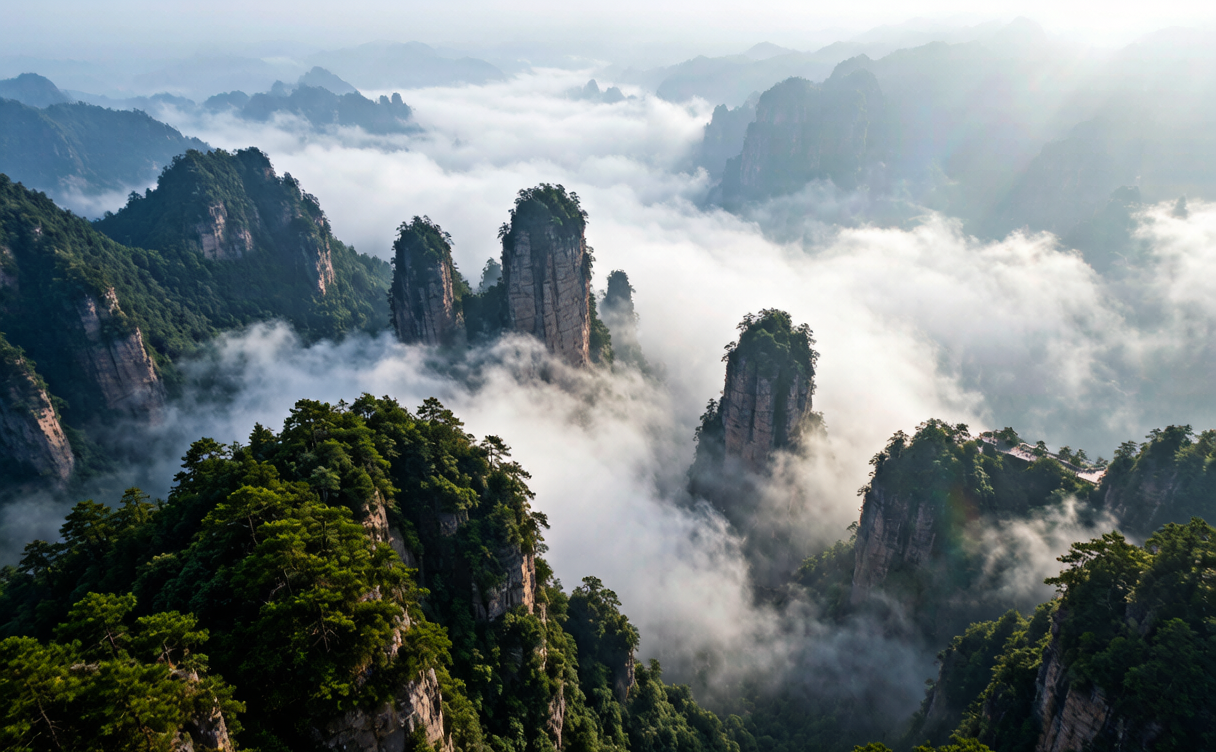
The first time I stepped off the shuttle bus at the Zhangjiajie National Forest Park east gate, I honestly thought the postcards were lying. Then the morning fog lifted for ninety seconds, and a wall of quartz-sandstone pillars — some 200 meters tall, thin as knives, crowned with tufts of green — rose out of a sea of cloud right in front of me. That is the moment the park earns its reputation — and it happens daily if you know where to stand. This guide is the one I wish I had before my first visit: real ticket prices, the trails worth your legs, the viewpoints that deliver, and the logistical traps that catch first-timers.
What Makes the Park Different From the Rest of Zhangjiajie
Most travelers say “Zhangjiajie” and mean the whole Wulingyuan Scenic Area, but the National Forest Park is the original core — China’s first national forest park, established in 1982, and the piece of the landscape inscribed as a UNESCO World Heritage Site in 1992. You can read the official listing on the UNESCO World Heritage Centre. The park protects more than 3,000 of those freestanding sandstone pillars across roughly 480 square kilometers, and it is the section that directly inspired the floating Hallelujah Mountains in Avatar.
The thing to understand before you buy anything: the single ticket covers the Wulingyuan core (the National Forest Park and its internal zones), but it does not cover Tianmen Mountain on the city side, the Grand Canyon Glass Bridge, or the separate cable cars and elevators inside the park. Plan those as add-ons. If you want the bigger picture before you commit, our Zhangjiajie travel guide maps the whole region and explains how the park fits with the other sights.
Tickets, Passes & Prices (in RMB and USD)
These are the walk-up prices as they stood in 2025–2026. Exchange rate used: ¥1 ≈ $0.14 USD. Always confirm at the gate, but budget around these.
- Park admission (3-day pass): ¥248 (about $34). This includes the mandatory environmental shuttle bus that loops the internal zones. It is valid for three days with multiple same-day re-entries — a huge deal, because you cannot see this place in one rushed day.
- Bailong Elevator (one way): ¥65 (about $9). The glass outdoor lift bolted to a cliff that climbs 326 meters in under two minutes.
- Tianzi Mountain cable car (one way): ¥72 (about $10).
- Yangjiajie cable car (one way): ¥76 (about $10.50).
- Golden Whip Stream: free with park admission.
- Separate, not included: Grand Canyon Glass Bridge ¥138 (about $19) and Tianmen Mountain ¥261 (about $36) — buy those independently.
A few things I learned the hard way. First, buy with your passport, because every scan-in checks the exact document you used at purchase. Second, skip the resellers lurking outside the gates in Wulingyuan town; buy at the official visitor center or the verified app, or you risk a ticket that will not scan. Third, the 3-day pass is dramatically cheaper per day than single entries, so even if you only plan two days, take the multi-day version and keep a buffer.
Opening Hours & When to Arrive
The east gate (Wulingyuan entrance) generally opens around 7:00–7:30 a.m., with last entry typically around 4:00 p.m. and internal attractions closing near 5:30 p.m. Shuttle buses start running at opening.
Here is the single most valuable tip in this guide: be at the gate before 7:30 a.m. On my second trip I arrived at 9:15 and queued forty minutes for the first shuttle. On my third I arrived at 6:50, was through at 7:05, and had the Avatar Mountain viewpoint to myself for twenty minutes. Beat the buses by 90 minutes and the park feels private.
Best Viewpoints Inside the Park
Yuanjiajie — the Avatar Hallelujah Mountain
Yuanjiajie is the plateau where the “Avatar Hallelujah Mountain” (officially renamed in 2010) stands — the pillar James Cameron’s team studied for the film. The “Platform Between Two Wells” and the “First Bridge Under Heaven” lookouts are the money shots. Reach it by riding the Bailong Elevator up from the valley floor, then a short shuttle ride. Go first thing; by 10 a.m. in peak season this plateau is shoulder-to-shoulder.
When I rode the Bailong Elevator for the first time, I expected a gimmick. It is not. As the glass car climbs the cliff face, the pillars that towered over you at the base swing down below your feet, and the whole forest unfolds into a layered green-and-grey maze. The two-minute ride costs ¥65, but it saves you a 90-minute uphill hike and buys you morning light at the top.
Tianzi Mountain — the Ridgeline Panorama
Tianzi Mountain is the high western ridge and, for my money, the best wide-angle view in the park. From “Imperial Brush Peak” and the “West Sea” lookout you see hundreds of pillars in a single frame — the classic poster image. I rode the cable car up at 8 a.m. and watched cloud roll through the gaps between peaks. Descend by cable car or hike down toward the Ten-Mile Gallery if your legs are fresh.
Yangjiajie — the Quiet Loop
Most day-trippers skip Yangjiajie, which is exactly why I love it. The “Natural Great Wall” is a row of blade-thin pillars lined up like a ruined fortress, and the loop sees a fraction of the Yuanjiajie crowds. The cable car is ¥76 one way, but the upper trail is calm and shaded. Save it for your second or third day.
The Trails Worth Walking
Not every path in the park justifies the steps. These three do.
Golden Whip Stream (Jinbian Xi)
A flat, shaded 7.5 km boardwalk along a clear mountain stream, flanked by pillars and bold macaques. I walked it after two vertical, exhausting days and it was the perfect comedown — no elevators, no queues, just water and stone. Families and older travelers will appreciate how gentle it is; allow 2–3 hours one way.
Ten-Mile Gallery (Shili Gallery)
A gentle valley with a small train (¥38, about $5) past oddly shaped rocks like “Old Man Gathering Herbs.” You can walk instead of ride. It sits between Tianzi Mountain and the north exit, slotting into a Tianzi day.
The Avatar Mountain Hike (Yuanjiajie Loop)
Paved and railed, about 2 km of easy walking between the Bailong Elevator top and the main lookouts. Do it slowly — every few meters opens a new angle on the pillars, and you’ll see why people call the place “another planet.”
First-Hand Notes: Fog Is the Main Event
Let me kill the biggest myth. Tourists check the forecast, see “fog,” and panic. In Zhangjiajie, mist is often the headline act, not a spoiler. On April 14, 2024, I woke to a whiteout at my Wulingyuan hotel and almost skipped the Bailong Elevator. I went anyway. At the top, the clouds cracked open and a single pillar materialized about 40 meters away — then dissolved again into white. That fleeting moment is the signature experience, and you only get it on foggy days. Clear days show you the range’s full scale; foggy days give you the mystery. Build a buffer day so you catch both moods. For the seasonal breakdown, our best time to visit Zhangjiajie guide explains which months balance clear and misty days best.
How to Get There (Train Beats Flying for Most)
Zhangjiajie West high-speed railway station is now the easiest way in. Bullet trains run from Changsha (about 2.5–3 hours), Wuhan (4–5 hours), and Guangzhou (5–6 hours), and they are comfortable and cheaper than flying once you add airport transfers. From the station it is a 30–40 minute drive to the Wulingyuan gate. If rail booking feels intimidating, our China high-speed train guide for foreigners walks through apps, seat classes, and passport rules. Flying is still fine — Zhangjiajie Hehua Airport (DYG) has direct domestic flights from Beijing, Shanghai, Guangzhou, Xi’an, and Chengdu — but the station is closer to the park.
Where to Base: Wulingyuan, Not the City
Stay in Wulingyuan town, wrapped around the east gate. Being steps from the entrance means you catch the first shuttle at dawn and skip the 30–40 minute commute from Zhangjiajie city. The trade-off is quieter nightlife, but for sightseeing efficiency it wins. Sleep in the city only if Tianmen Mountain is your priority or you have a late flight.
Practical Tips That Actually Matter
- Passport on you always. Needed for every ticket scan and for most hotel check-ins.
- Internet before you land. Google Maps and translation apps need a workaround in China. Sort it early with our China eSIM and SIM card guide for tourists so navigation works the moment you arrive.
- Comfortable shoes. Peak days easily hit 15,000+ steps across steep, damp paths.
- Layers and a rain shell. Mountain weather flips fast; a light jacket earns its place even in dry season.
- Cash backup. Smaller vendors near the gates may not take foreign cards or international phone payments.
- First-timer context. If this is your debut China trip, our China travel guide for first-timers covers visas, payments, and transport so the park logistics sit on solid groundwork.
A Note on Safety and Comfort
The park is well maintained with railings and paved paths, but the cliffs are real and the weather is wet. Keep kids close at open lookouts, skip the selfie ledge crowd, and turn back if a trail feels beyond your fitness. Save the local emergency number and basic health contacts before you go, and watch the weather apps for afternoon thunderstorms.
The Bottom Line
Zhangjiajie National Forest Park rewards preparation more than almost any other sight in China. Buy the 3-day pass with your passport, sleep in Wulingyuan, be at the gate before 7:30 a.m., and split your time between Yuanjiajie’s Avatar pillars, Tianzi Mountain’s ridgeline, and the calm of Golden Whip Stream. Embrace the fog instead of fighting it, and you will leave with the photo everyone else misses. Give it two full days minimum — three if you can — and the place will feel like it belongs to you.
Written by Karl — last updated July 2026. Karl has spent three years helping foreign visitors plan low-stress trips across China, including four trips into the Wulingyuan core.