

The best time to visit Zhangjiajie is April to early June or September to mid-November, with late September and October offering the rare combination of comfortable weather, thin crowds, and the clearest chance of seeing the sandstone pillars float above a sea of cloud. I’m Karl, and I’ve stood on those mist-wrapped cliffs in three different seasons. This guide breaks down the weather month by month, explains the fog factor, and gives you a crowd calendar built around China’s holiday peaks.
If you’ve already booked your flights, jump straight to our Zhangjiajie travel guide for day-by-day logistics. If you’re still deciding which month works, read on — the difference between a serene sunrise and a two-hour elevator queue often comes down to a single week on the calendar.
Key Takeaways
– The best time to visit Zhangjiajie is April–June and September–November; October delivers the best light and autumn color, while September is the quietest “golden” month.
– Zhangjiajie is foggy or rainy more than 200 days a year — but the famous cloud sea (sea of clouds) appears most reliably from October through December after a cold front.
– Avoid China’s three extreme holiday weeks: Labor Day (May 1–5), National Day (Oct 1–7), and Chinese New Year (Feb 16–23 in 2026). Queues for the Bailong Elevator can exceed two hours.
– Mountain temperatures run about 5°C (9°F) cooler than the city, and July highs hit 33°C (91°F) — pack layers no matter the season.
– Enter before 8 AM and use the South or West gates to dodge the worst crowds even in peak season.
– Build 3+ nights into your trip so you get multiple mornings to catch the pillars after the fog lifts.
Zhangjiajie Weather, Month by Month
Zhangjiajie sits in a subtropical humid monsoon zone. The annual average temperature is about 16.6°C (62°F), and the region receives roughly 1,400 mm of rain a year — about 73% of it falling between April and September. The city center sits at just 183 m, but the scenic areas (Wulingyuan, Tianmen Mountain) average around 1,000 m, so the peaks run several degrees cooler. Plan for the mountain, not the town.
Here’s the month-by-month picture, combining long-term averages from local climate records:
| Month | High / Low (°C) | High / Low (°F) | What it’s like |
|---|---|---|---|
| January | 8 / 1 | 46 / 34 | Coldest; occasional snow, quietest time |
| February | 11 / 3 | 52 / 37 | Cold, possible snow on peaks |
| March | 16 / 8 | 61 / 46 | Warming, higher rain and fog |
| April | 22 / 14 | 72 / 57 | Comfortable, blooming, light crowds |
| May | 27 / 18 | 81 / 64 | Warm; crowds spike for Labor Day |
| June | 30 / 22 | 86 / 72 | Hot, humid, afternoon storms |
| July | 33 / 24 | 91 / 75 | Hottest; peak summer crowds |
| August | 33 / 24 | 91 / 75 | Hot; families on school break |
| September | 27 / 19 | 81 / 66 | Warm, drying out, quietest window |
| October | 22 / 13 | 72 / 55 | Cool, clear, autumn color (avoid Oct 1–7) |
| November | 15 / 7 | 59 / 45 | Cool, misty, thin crowds |
| December | 9 / 2 | 48 / 36 | Cold, dry, possible light snow |
The Four Seasons at a Glance
Spring (March–May) brings temperatures of 15–25°C and fresh green growth. April is genuinely lovely, with wild cherry and azalea blooming on the pillar slopes. The catch is rain: spring is one of the wetter, foggier stretches, so views can be hit-or-miss. Crowds stay manageable except during the Qingming Festival (April 4–6 in 2026) and Labor Day at the start of May.
Summer (June–August) is hot and humid, with daytime highs of 28–33°C. It’s also the single busiest period, because Chinese schools close for summer vacation and families flood the park. On peak summer days the core Wulingyuan area receives more than 50,000 visitors. The upside: the forest is at its most lush, waterfalls run full, and afternoon thunderstorms are common. The fog that follows can be enchanting — or obscuring.
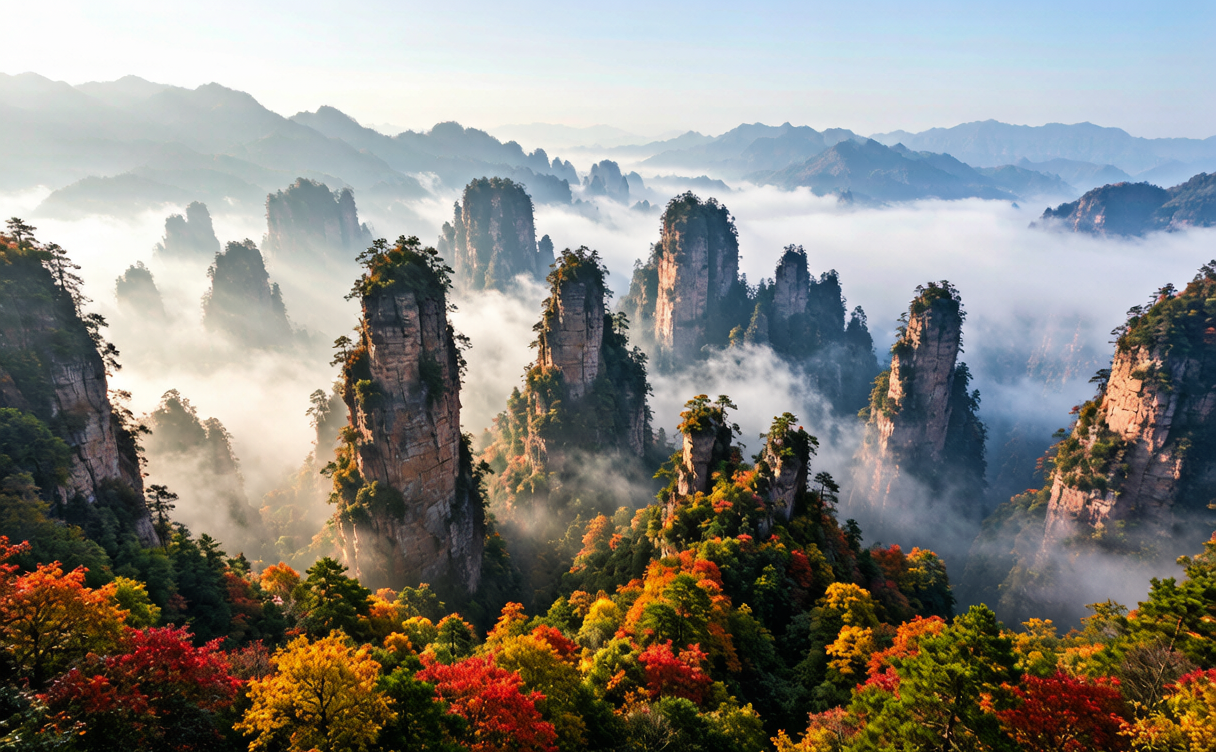
Autumn (September–November) is the season most repeat visitors name as their favorite. The air turns clear, temperatures settle into a comfortable 10–25°C, and the maple, ginkgo, and birch light up red and gold. September is the quietest “golden” month of the year; October adds peak foliage but also the National Day crush in its first week.
Winter (December–February) is the secret season. Crowds drop to a fraction of summer levels, and when snow or rime ice coats the pillars the park looks like a monochrome ink painting. The trade-offs are real: temperatures can dip below freezing, and persistent low cloud can hide the views for days. For solitude seekers willing to gamble on weather, it’s magical.
The Fog Factor — Why Zhangjiajie’s Weather Is Unpredictable
Here’s the thing nobody warns you about: Zhangjiajie is foggy or rainy more than 200 days a year. That same mist makes the “Avatar mountains” look otherworldly — the pillars erupting from a white void is the postcard shot everyone wants. But it also means you can arrive at a viewpoint and see nothing but grey.
The park’s signature sight is the cloud inversion, or “sea of clouds” — fog trapped in the valleys while the peaks poke through. It’s most likely from October through December and again in spring, usually one to two hours after rainfall.
Mini-story (Karl): In early November 2023 I rode the cable car up Tianzi Mountain at 8 a.m. to a wall of white — zero visibility, not a single pillar in sight. Our group nearly gave up and headed down. But mountain fog is fickle: by 9:30 a.m. the cloud had dropped into the valleys and the quartz peaks erupted out of a glowing sea of white. We’d have missed it entirely had we left at 9. The lesson stuck with me — in Zhangjiajie, fog is a timing problem, not a weather problem. Give it a morning and it often clears.
The practical takeaway: never judge a day by its first hour. Build buffer days into your schedule so a foggy morning doesn’t tank your whole trip.
The Crowd Calendar — When to Stay Away
If you’re wondering about the best time to visit Zhangjiajie, the honest answer about timing depends less on weather than on China’s holiday calendar. Domestic tourism surges during a handful of fixed holiday weeks, and the park’s infrastructure — the Bailong Elevator, cable cars, and shuttle buses — becomes a bottleneck fast. During peak holidays, Bailong Elevator queues regularly hit 1.5 to 2+ hours for a two-minute ride.
Mark these 2026 dates and plan around them:
| Holiday | 2026 Dates | Crowd Level |
|---|---|---|
| Chinese New Year | Feb 16–23 | Extreme |
| Qingming Festival | Apr 4–6 | High |
| Labor Day (May Day) | May 1–5 | Extreme |
| Dragon Boat Festival | May 30–Jun 1 | Moderate |
| Mid-Autumn Festival | Sep 25–27 | Moderate |
| National Day Golden Week | Oct 1–7 | Extreme |
| Summer vacation | Jul–Aug | Very high |
The rule of thumb: the week after a major holiday is always quieter than the week before, as domestic travelers rush home. Target those post-holiday windows.
Mini-story (Karl): My favorite Zhangjiajie morning came on a late-September Thursday in 2024. I entered through the South Gate at 7:30 a.m. and had the Avatar Hallelujah Mountain viewpoint nearly to myself for a full ten minutes. A friend who visited during National Day that same year waited 110 minutes for the Bailong Elevator and described the main platforms as “shoulder to shoulder.” Same park, same pillars — completely different trips. The calendar decided everything.
Plan your route: Add Zhangjiajie to a wider trip with our China 2-week itinerary — it slots in perfectly after Chengdu or Guilin.
My Recommended Windows
So what is the single best time to visit Zhangjiajie? For most first-timers, I’d point to late September — warm, dry, quiet, with autumn color just starting to stain the slopes. If you want the full red-and-gold payoff, aim for mid-October to mid-November, ideally after the National Day crowds have gone home. And if you prefer misty spring softness with fewer people than October draws, April is a strong, underrated choice.
Mini-story (Karl): On my October 2022 trip a cold front swept through the night after I arrived. I expected washed-out views — instead I woke to the park’s famous autumn cloud sea, red maple framing the grey-white peaks. That single morning is why I now tell first-timers: aim for October, but give yourself buffer days, because the mountain decides what it shows you.
Whatever window you choose, two moves change the game regardless of season: arrive before 8 a.m., and use the South or West gates instead of the East Gate, which absorbs about 70% of visitors. You’ll see the same pillars with a tenth of the people.
Practical Tips for Any Season
No matter which month you choose, your ideal window is the stretch you can keep clear of the three extreme holiday weeks. A few habits pay off in any season:
- Book 3+ nights in or near Wulingyuan so you get multiple mornings to catch clearing fog.
- Enter at opening (often 7:00–7:30 a.m.) to beat both the crowds and the midday haze.
- Pack layers and rain gear year-round — mountain temps swing 5°C below the city, and a sudden downpour is always possible.
- Book timed-entry tickets 3–5 days ahead if you must travel during a holiday week.
- Check the 2026 holiday dates before locking in flights; a one-week shift can mean the difference between serenity and a two-hour queue.
Zhangjiajie National Forest Park is the centerpiece of the Wulingyuan Scenic Area, inscribed as a UNESCO World Heritage Site in 1992 for its quartz-sandstone peak forest — more than 3,000 pillars, some over 200 m tall. It’s a landscape worth timing well.
If you’re weighing Zhangjiajie against the rest of the country, our best time to visit China guide maps the ideal months region by region. And if this is your first trip to the mainland, start with the China travel guide for first-timers before diving into the details.
Pack smart: Our China packing list for first-timers covers the rain gear and layers Zhangjiajie demands.
Getting there: Read the China high-speed train guide for foreigners to reach Zhangjiajie from Changsha or Guilin by rail.
The Bottom Line
The best time to visit Zhangjiajie is a trade-off: chase the April–June and September–November sweet spots for comfortable weather and clearer views, and simply avoid the three holiday weeks that turn the park into a pressure cooker. Build buffer days for the fog, arrive early, and pick your gate wisely. Do that, and you’ll likely catch the pillars floating above the cloud sea — the image that makes the trip unforgettable.
Ready to turn timing into a plan? Our full Zhangjiajie travel guide walks you through tickets, routes, and where to stay inside the park.
Written by Karl · Updated July 2026