

The first time I stood on the viewing platform at Yuanjiajie, the clouds peeled back and I finally understood why James Cameron filmed Pandora’s floating mountains here. If you’re planning a Zhangjiajie 3 day itinerary, you’ve chosen one of the most surreal landscapes in all of China — and three days is exactly the right amount of time to see the headline sights without feeling rushed. On my last trip I spent four days around Zhangjiajie, and by the third morning I had the rhythm of the place figured out: arrive early, ride the shuttles, and let the cable cars do the climbing. This guide packs everything I learned into a tight, follow-almost-on-autopilot plan. This Zhangjiajie 3 day itinerary assumes you arrive the evening before Day 1, so you can hit the gates fresh. Whether you’re building a longer China trip or just want the greatest hits, this is the route I’d hand my own visiting friends.
Key Takeaways
– Three days covers the essentials: Zhangjiajie National Forest Park (Day 1), Tianmen Mountain (Day 2), and the Grand Canyon Glass Bridge (Day 3).
– Buy park tickets online in advance and reach the east gate before 8 a.m. to beat both the tour buses and the midday haze.
– Stay in Zhangjiajie City near the train station rather than inside the park — it’s cheaper, has better food, and puts you 30–40 minutes from every gate.
– The Bailong Elevator and Tianmen cable car are engineering marvels, but both get crowded; go up early and descend late.
– Spring (April–May) and autumn (September–October) give the clearest skies for an Avatar mountains itinerary like this one.
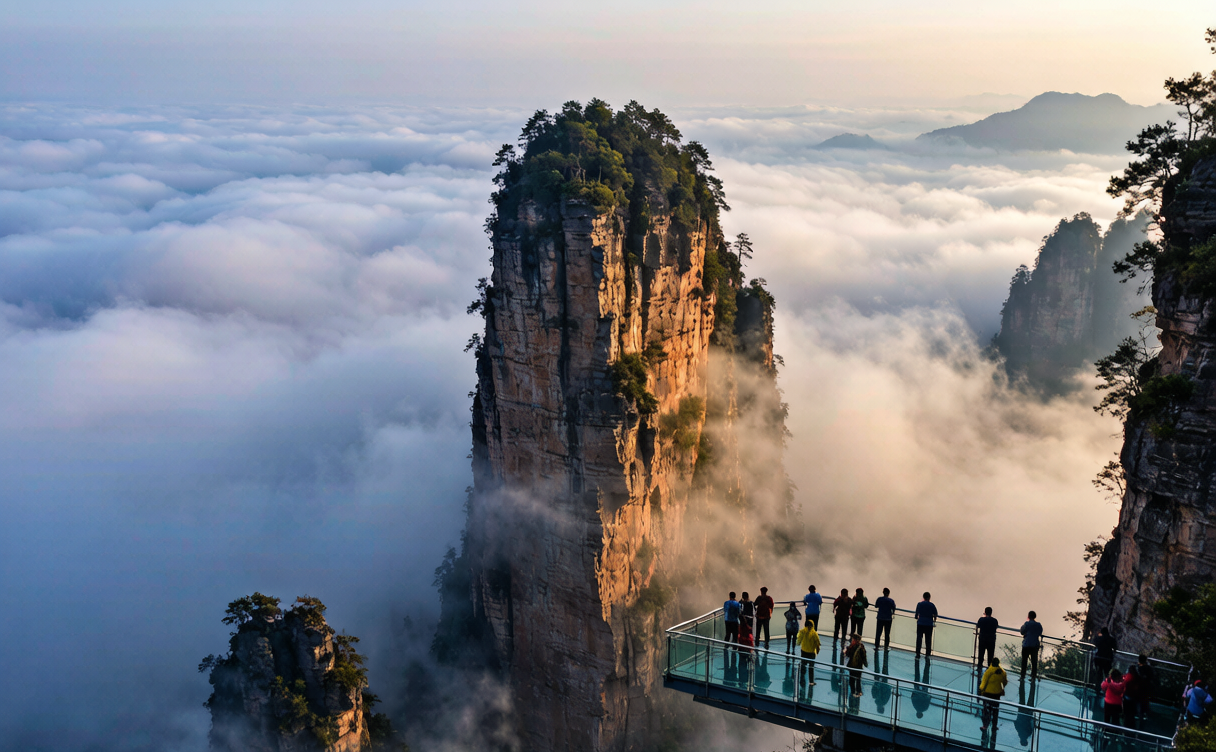
Day 1 — Zhangjiajie National Forest Park: The Avatar Mountains
Spend your first full day inside Zhangjiajie National Forest Park, the UNESCO-listed core of the region and the home of the “Avatar mountains” that made this place famous. I’d point you straight to the east gate (Wulingyuan) and buy the multi-day park pass online before you come — the on-site queues can eat an hour of your morning, and the park opens at 7:30 a.m.
Start with the Bailong Elevator, a glass-and-steel lift that shoots 326 meters up the cliff face in under two minutes. It’s a genuine “did that really just happen” moment, and it spits you out right where the plateau walks begin. From the top, hop the shuttle to Yuanjiajie, the mesa where you’ll find the Avatar Hallelujah Mountain (renamed in 2010 from “Southern Sky Column”). This is the pinnacle that inspired the floating Hallelujah Mountains in Avatar — and on a clear morning the karst spires really do look like they’re floating on a sea of cloud.
After Yuanjiajie, take the shuttle west to Tianzi Mountain. The “Imperial Brush Peaks” and “West Sea” viewpoints are the postcard shots. I spent a lazy hour here just watching the fog roll through the valleys, and it was the calmest moment of the whole trip. By late afternoon, ride the cable car down (or loop back via the shuttle) and catch a bus to your hotel.
One practical note: the park is enormous, and the free shuttle buses only run certain loops. Grab a paper map at the gate and ask the driver which bus goes where — most speak enough to point. For a deeper dive into routes, trails, and ticket types, see our full Zhangjiajie travel guide.
Day 2 — Tianmen Mountain: Cable Car, Glass Walkway & Heaven’s Gate
Day two belongs to Tianmen Mountain, the dramatic peak that looms directly behind Zhangjiajie City. A classic Avatar mountains itinerary pairs Tianmen with the forest park, and the contrast is the point: yesterday was spires, today is a single soaring summit with a hole punched through it.
The experience starts before you reach the top. The Tianmen Mountain cable car is one of the longest passenger cableways in the world — a 7,455-meter ride that climbs from the city center straight to the summit in about 30 minutes. On my ride the cabin glided over rooftops, then forests, then sheer cliffs; keep your camera ready because the last stretch is the best.
At the top, the must-do is the glass walkway, a section of cliff-edge path with a transparent floor bolted to the rock face roughly 1,400 meters above the valley. If heights aren’t your thing, there’s a parallel solid-wood path — no shame in taking it. From the summit, a series of escalators (yes, escalators built into a mountain) carry you down toward Tianmen Cave, the 131-meter natural arch nicknamed “Heaven’s Gate.” To reach it you descend 999 steps — a number chosen for luck — or dodge them on the shuttle.
The descent is its own show: the 99-bend road, a switchback highway that coils down the mountain like a dragon. Sit on the left side of the bus for the best view. Buy your Tianmen ticket the day before on Trip.com or at the city tourist center; same-day tickets often sell out in peak season, and timed entry is enforced.
Day 3 — Zhangjiajie Grand Canyon Glass Bridge (or Cave & Lake Alternatives)
For your final day, the Zhangjiajie Grand Canyon Glass Bridge is the headline act: a 430-meter span suspended about 300 meters above the gorge, and until recently the longest and highest glass-bottom bridge in the world. Walking it is equal parts thrill and photo opportunity — the floor is transparent, the railings are glass, and the canyon drops away beneath your feet. Go right at opening (around 8 a.m.) to have the bridge to yourself and avoid the tour-group crush that builds by mid-morning.
If you’d rather not do heights twice in three days, two calmer alternatives sit nearby. Huanglong Cave is a vast limestone cavern with underground rivers and a light show that takes about two hours; Baofeng Lake is a tranquil boat ride ringed by green peaks, perfect if your legs need a rest after two big hiking days. I did the bridge one year and the lake the next, and both were worth it.
Whichever you pick, keep the afternoon light. Use the late hours to sort photos, grab a proper Hunan dinner, and prep for your onward journey. If Zhangjiajie is one stop on a bigger trip, our China 2-week itinerary shows exactly how to slot it between Chengdu, Xi’an, and Guilin without backtracking.
Logistics: Getting There, Tickets, Buses & Where to Stay
Getting to Zhangjiajie is easier than it looks. The city has a small airport (Zhangjiajie Hehua) with domestic flights from Beijing, Shanghai, Guangzhou, and Chengdu, plus a high-speed rail station on the Zhangjiajie–Jishou–Huaihua line with direct trains from Changsha (about 2–3 hours). Most travelers build this Zhangjiajie 3 day itinerary as part of a longer Hunan loop, hopping the train in from Changsha or out to Fenghuang. If you’re traveling between cities by rail, our China high-speed train guide for foreigners walks through booking, ID requirements, and what to expect at the station.
Inside the area, free shuttle buses connect the city, the east gate, and Tianmen Mountain. Ride-hailing works but can be thin outside the center — I used the ride function inside Alipay for foreigners the whole trip and rarely waited more than five minutes. For tickets: the Forest Park sells a multi-day pass (use it across Day 1 and any return visit); Tianmen and the Glass Bridge sell separate timed tickets. Book all of them a day ahead online to skip the worst lines.
Where to stay? Base yourself in Zhangjiajie City, not inside the park. The Wulingyuan area near the east gate has hotels too, but the city has better food, cheaper rooms, and a train station on your doorstep. I stayed a five-minute walk from the station and never regretted it — I could be at Tianmen’s cable car in ten minutes and at the east gate in forty.
Packing & Practical Tips
Zhangjiajie’s weather swings hard between the valley floor and the summit, so layer. I packed a light rain shell, a fleece, and trail shoes with real grip — the stone paths get slick when it drizzles, which it does often. Bring a power bank (you’ll burn through photos fast), cash in small notes for snacks, and your passport, which you need to collect every ticket.
Timing matters more than gear. The region is busiest from June to August and during Chinese public holidays; the clearest, most comfortable conditions fall in spring and autumn. Our best time to visit Zhangjiajie guide breaks it down month by month so you can dodge the haze and the crowds.
A few final pointers from someone who learned the hard way: download maps offline before you leave wifi, carry tissues (park restrooms are basic), and start every day at first light. Do that, and your Zhangjiajie 3 day itinerary will deliver the kind of photos your friends assume are Photoshopped.
Written by Karl, a traveler who has spent the better part of a decade exploring China’s national parks and megacities alike. He last walked the Zhangjiajie glass bridge and rode the Tianmen cable car in 2026, and this itinerary reflects what actually worked on the ground.