

First, a quick promise: this is Taishan in Guangdong province, the Pearl River Delta county-level city whose name you will see on old North American immigration records as “Toishan.” It is not the famous Mount Tai (Tai Shan) sacred mountain in Shandong, hundreds of kilometers to the north — a mix-up we see constantly, and one worth clearing up before you book a ticket. We have taken travelers here who wanted a coastal Guangdong escape with real history, and Taishan delivers both: quiet island beaches and a diaspora story woven through almost every village. This Taishan Guangdong travel guide covers the overseas Chinese heritage, the Shangchuan and Xiachuan island beaches, and the practical transport you need.

Taishan (台山) sits in the southwest corner of the Pearl River Delta, administered by Jiangmen city, about two hours by road from both Guangzhou and Shenzhen. What makes it unusual is people, not scenery. From the 19th century onward, waves of Taishanese left for the Americas, Southeast Asia, and Australia, and today the overseas Taishanese population is estimated to outnumber the roughly 950,000 people still living in the county. Walk into almost any rural village and you will find stone watchtowers (碉楼) built with remittance money, ancestral halls inscribed with surnames now common in San Francisco and Vancouver, and old men who will patiently tell you which cousin runs a restaurant in Chinatown.
The overseas Chinese heritage
The diaspora is the cultural core of a Taishan trip. The most visible relics are the diaolou — fortified multi-story towers blending Chinese and European details, built in the early 1900s for defense and to show off overseas wealth. While the densest cluster is in neighboring Kaiping, Taishan has its own scattered towers and several restored ancestral halls worth a half day. The Taishan Museum in the county seat lays out the emigration story with passenger lists and old steamship tickets, and the Overseas Chinese Farm (华侨农场) south of town still hosts returnee families who came back from Indonesia and Vietnam in the mid-20th century.
We tell travelers to read the village name boards carefully. Many carry both the Chinese characters and a romanized “Toishan” spelling, a direct trace of how the name traveled abroad. The local dialect, Taishanese, is mutually unintelligible with standard Cantonese, and you will hear it everywhere — a living link to the speech of early Chinese immigrants across the Pacific.
Shangchuan and Xiachuan island beaches
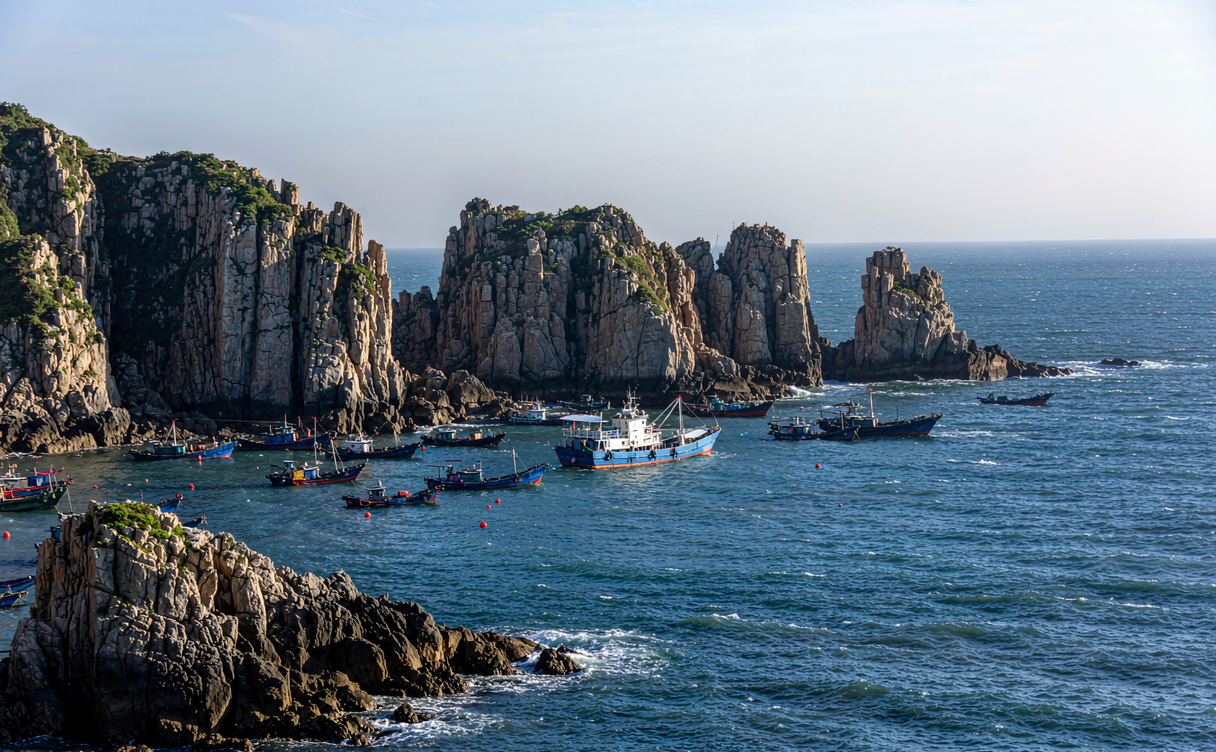
The beaches are why summer visitors come. Shangchuan Island (上川岛) is the larger of the pair, reached by ferry from Shanzui Port (山咀港) on the mainland, a crossing of about 30–40 minutes with tickets around ¥42 one way. Its main draw is Feisha Beach (飞沙滩), a several-kilometer sweep of pale sand with basic showers, umbrellas for rent at ¥30–50 a day, and a clutter of seafood stalls behind the dunes. Xiachuan Island (下川岛) is smaller and sleepier, better for travelers who want to read a book and swim, with the Wangfuzhou beach strip as the hub.
On Shangchuan, history adds a layer: the Portuguese missionary Francis Xavier died on the island in 1552, and a small monument and chapel near the eastern tip mark the spot. We route history-minded travelers there by hired island minivan (about ¥150 for a half-day round trip) because public transport on the islands is thin. Bring cash for the ferry top-up and the chapel donation box; card readers are unreliable on the water.
Island practicalities are worth knowing before you go. Ferries run roughly every 30 minutes from 07:30 to 17:30 and you buy tickets on site with your passport; during the October National Day week the queue can mean a 90-minute wait, so an early sailing is wise. Both islands rent electric buggies and bicycles near the landing, and we suggest arranging the buggy through your guesthouse to avoid the touts who meet each boat. Swimming is safe inside the flagged zones at Feisha, but the open South China Sea side has strong currents, so we keep travelers within the patrolled area and out of the rip channels.
Take the Shanzui Port ferry to Shangchuan Island early to claim a shaded spot on Feisha Beach before the day-trippers land.
Best time to visit and weather
The best time to visit Taishan is October through April, when temperatures sit in a comfortable 18–26°C range and the humidity drops. Winter is mild and the beaches are quiet, though the sea is cool for swimming until late March. Avoid July to September if you can: it is hot at 32–35°C, and this stretch of the Guangdong coast sits squarely in the South China Sea typhoon path, with sudden closures of the island ferries that can strand you for a day. We always check the typhoon forecast three days out before committing to an overnight on the islands.
For broader planning, our best time to visit China guide maps the national weather patterns, and the Zhuhai travel guide makes a natural coastal add-on just east along the delta. Pack reef-safe sunscreen even in spring — the island sun reflects hard off the sand.
How to get to Taishan
Getting to Taishan is straightforward now that the Shenzhen–Zhanjiang high-speed railway has a Taishan Station (台山站). From Guangzhou South, direct trains take roughly 50–70 minutes and cost about ¥60–80 second class; from Zhuhai it is around 40 minutes and ¥40; from Shenzhen North you change at Guangzhou South or Humen, totaling about two hours. The China high-speed train guide for foreigners walks through passport booking, which you will need since there are no paper tickets. From Taishan Station a taxi to the ferry port for the islands runs about 50 minutes and ¥120, or a local bus to the county seat is ¥6.
If you are driving, the G15 Shenyang–Haikou expressway puts Taishan about two hours from Guangzhou and 2.5 hours from Shenzhen. We usually combine Taishan with a delta circuit: start in Guangzhou, hop to Foshan for food, then down to Taishan and on to Shenzhen for the flight out. That loop uses well-paved toll roads the whole way and avoids backtracking.
Base yourself in the Taishan county seat and hire a driver for the day to reach both the diaolou villages and the ferry port.
Food and where to stay
Taishan food is a highlight and distinct from Cantonese city cooking. The signature dish is eel rice (黄鳝饭), where live pond eel is boned, stir-fried with ginger, and folded into clay-pot rice — expect ¥45–70 for a small pot at a specialist shop. Five-spice goose (五味鹅), clay-pot frog, and heaping plates of just-caught island seafood follow close behind; a seafood dinner for two on Shangchuan runs ¥120–200. The county seat has noodle breakfasts of beef offal and rice-flour rolls for under ¥20 a head.
Accommodation is split between the mainland and the islands. On the mainland, county-seat business hotels run ¥180–320 a night and are an easy launch point; on Shangchuan and Xiachuan, beachfront guesthouses cluster near the ferry landings at ¥200–400 in season, dropping by half midweek in winter. Book the island rooms ahead in the October National Day week, when Guangdong families flood the ferries and prices double; our Guangzhou guide has the airport and hotel details if you start there.
The county’s emigration history is summarized by the Wikipedia overview of Taishan, Guangdong, which traces the “Toishan” spelling and the scale of the overseas community. We have found that travelers who read a little of that background before arriving get far more from the villages — the watchtowers stop being curiosities and start being letters home in stone.
Sample 2-Day Taishan Guangdong Plan
A fixed rhythm made my Taishan Guangdong trip easy. Day 1: I took the 10:05 train from Guangzhou South to Taishan Station (¥72, 60 minutes), then a taxi to the county seat (¥30, 20 minutes) and checked into a business hotel (¥260 a night). I hired a driver for the afternoon (¥300 for four hours) to see the scattered diaolou watchtowers and a restored ancestral hall, ending with eel rice at a clay-pot shop (¥58 for a small pot) before an evening walk through the old village lanes.
Day 2 I left at 08:00 by taxi to Shanzui Port (¥120, 50 minutes) and caught the 08:40 ferry to Shangchuan Island (¥42 one way, 35 minutes). I rented a beach umbrella (¥40) on Feisha Beach, swam inside the flagged zone, and had a seafood lunch of just-caught prawns and squid (¥150 for two). At 14:00 a hired island minivan (¥150 half-day) took me to the Francis Xavier monument at the eastern tip, then back for the 16:30 ferry and the 17:20 train to Guangzhou. All in, two days cost about ¥1,100 per person: ¥144 trains, ¥610 transport and driver, ¥260 lodging, ¥328 food and entries. This Taishan Guangdong travel guide route gives you the diaspora towers one day and the South China Sea the next, both within a two-hour rail hop of the delta’s big cities.
Order the eel rice at a specialist clay-pot shop in the county seat before you head out to the islands the next morning.