

Most travelers have never heard of Jinyun (缙云), and that is exactly why we send people there. Tucked into the mountains of southwestern Zhejiang, this county is home to Xiandu (仙都), a scenic area of lone limestone pillars rising from rice paddies and a slow river — a landscape so clean and otherworldly that Chinese costume-drama crews have filmed dozens of wuxia and fantasy series here. We have stood at the foot of its tallest peak at dawn with travelers who expected a minor park and instead felt they had walked onto a soundstage built by nature. This Jinyun travel guide covers the Xiandu scenic area, how to get there from Hangzhou, and the local food that deserves its own trip.
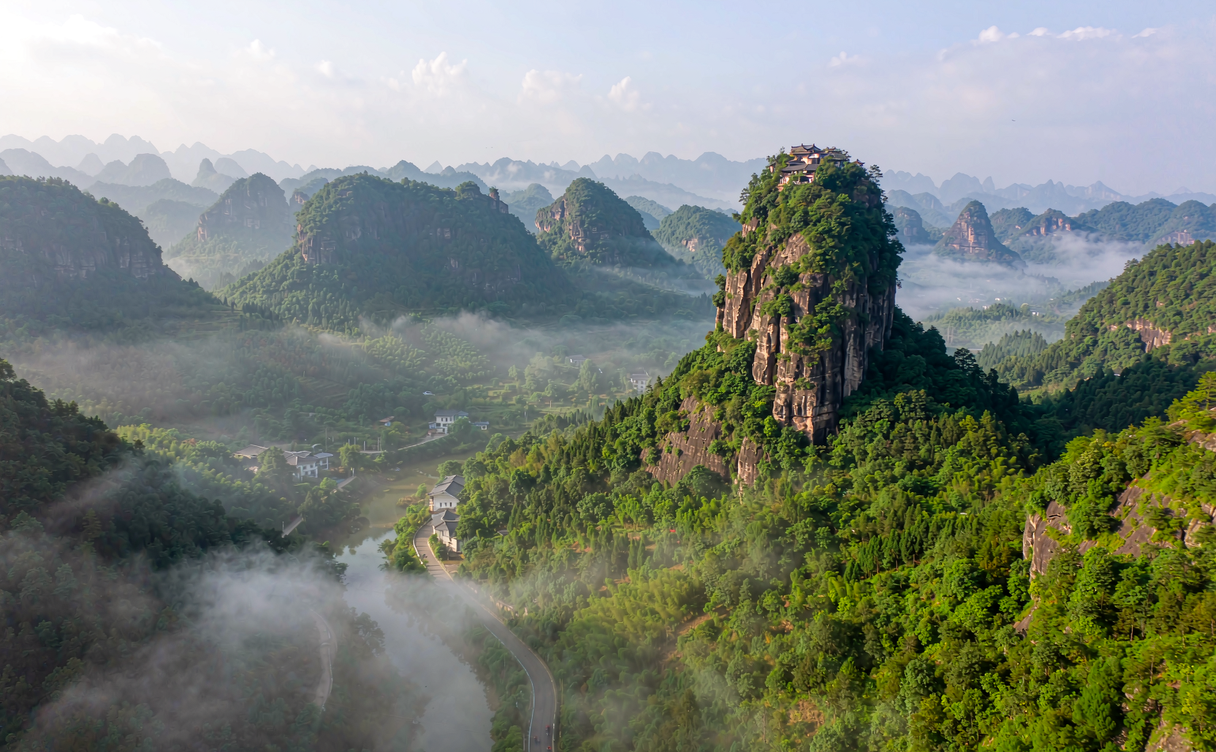
Jinyun sits in Lishui prefecture, about as far south as Zhejiang gets while still being an easy rail hop from the provincial capital. The county is hilly, green, and quiet, with terraced fields climbing the slopes and a slow river, the Haoxi, bending through the valley. What draws visitors is the karst: not the towering Guilin-style peaks, but isolated monoliths of pale stone that stand alone in the flat farmland like chess pieces left on a board. The effect is surreal, and the local tourism board leans into it with the slogan that Xiandu is “a landscape borrowed by heaven.”
The Xiandu scenic area and Dinghu Peak
Xiandu is the heart of any Jinyun trip, and its centerpiece is Dinghu Peak (鼎湖峰), a single limestone column about 170 meters tall that the locals call the “number-one peak under heaven” for its shape. A flight of stone steps and a cable option lift you to a viewing terrace partway up, and from there the pillar fills your whole field of view while egrets drift across the paddies below. At the base sits the Yellow Emperor Temple (黄帝祠宇), a red-walled complex where seasonal rites honor the mythical Huangdi; the morning bell and the reflection in the adjoining pond make it the most photographed frame in the park.
Admission to the Xiandu scenic area is sold as a through ticket covering the main sections, roughly ¥95 in peak season and ¥65 off-season, with the internal shuttle bus included. Opening hours run 07:30 to 17:30. We tell travelers to enter at the Dinghu gate right at opening: the first hour has no tour buses, the light rakes sideways across the stone, and you can photograph the peak with only egrets for company.
Why film crews love Xiandu
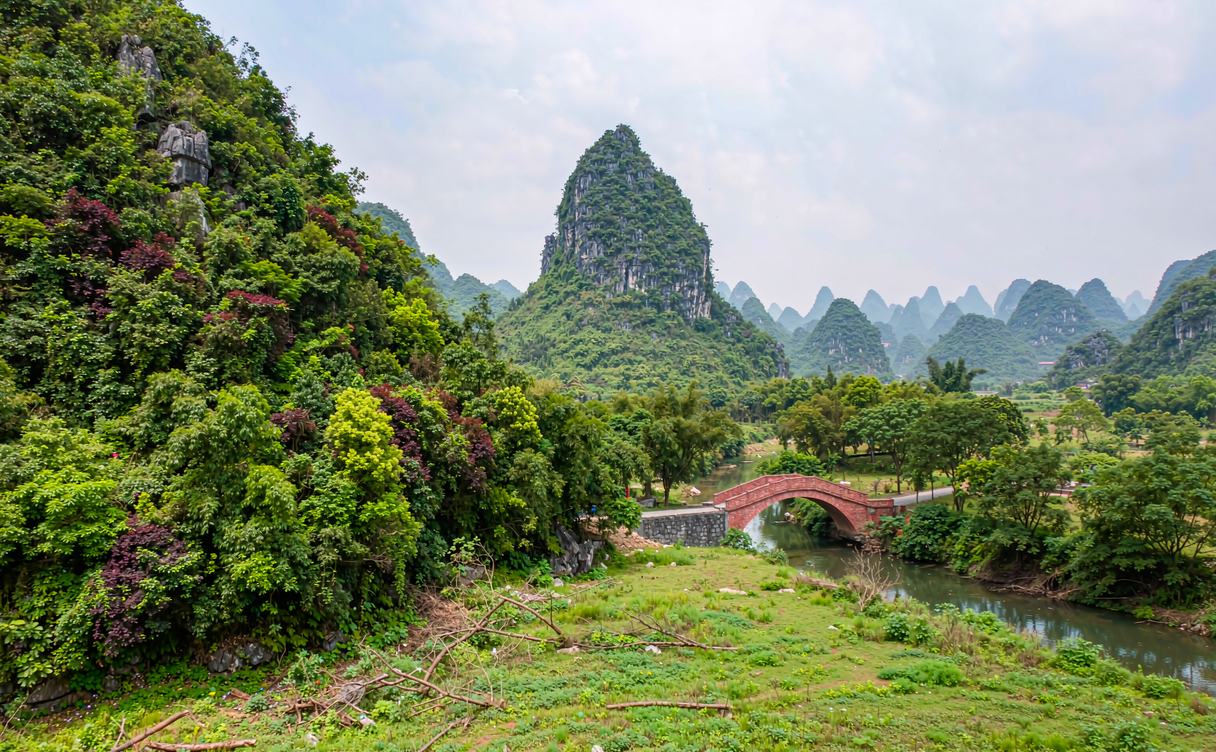
The reason Jinyun shows up on screens worldwide is the combination of isolation and accessibility. The monoliths rise straight out of working farmland, so a camera placed low catches a peak, a farmer, and a misty ridge in one shot without a city in sight. Crews have used Xiandu for historical epics, fantasy serials, and period comedies; you will recognize the little stone arched bridge over the Haoxi and the bamboo-fringed river bends from a dozen shows. We have timed visits to catch a live shoot — they are common on weekday mornings in spring and autumn — and watching a costume drama come together on its natural set is a oddly joyful add-on to the walk.
Beyond Dinghu, the smaller sections reward exploration. Xiaochibi (小赤壁) is a red-cliff riverside walk with carved poems from scholars; Niweng Cave (倪翁洞) hides Tang-dynasty inscriptions in a grotto; and Furong Gorge (芙蓉峡) narrows to a slot canyon where the rock walls nearly meet overhead. Allow a full day if you want all four, or a relaxed half day for Dinghu plus one side section. The internal shuttle runs every twenty minutes between sections for about ¥15, and a rented e-bike from the gate gives you the freedom to chase light across the paddies at your own pace.
Enter Xiandu at the Dinghu gate at 07:30 to photograph the peak before the tour buses and film crews arrive.
Best time to visit and what to pack
The best time to visit Jinyun is April to May and September to early November. Spring brings 20–26°C days, flooded paddies that mirror the peaks, and fresh green terraces; autumn is crisper at 18–24°C with low rain and the clearest mountain air. Summer is hot and humid at 30–34°C with afternoon storms, though the shade along the river stays bearable. Winter can dip near freezing and the paddies go brown, but off-season tickets and empty paths suit photographers who want the monoliths alone.
For broader planning, our best time to visit China guide lays out national weather by month, and the Hangzhou travel guide is your natural starting point since most visitors rail in from there. Pack good walking shoes for the riverside stone paths, and a light rain shell even in spring, because valley weather turns fast. Photographers should note that the paddies flood highest in late April and reflect the peaks like mirrors, while the autumn harvest turns the terraces gold; either window beats the flat green of high summer for pictures.
How to get to Jinyun
Getting to Jinyun is easy on the high-speed network. Jinyun West Station (缙云西站) sits on the Jinhua–Wenzhou line and is reached from Hangzhou East in about 1.5–2 hours (second class roughly ¥75–95), from Shanghai Hongqiao in about 2.5–3 hours with a change, and from Wenzhou in under an hour. The China high-speed train guide for foreigners covers the passport booking that the station requires. From Jinyun West, a taxi to the Xiandu scenic area takes about 20–25 minutes and costs ¥40–60; county buses 1 and 3 also run to the gate for ¥2 but move slowly with village stops.
If you are driving, the G25 Changchun–Shenzhen and S28 expressways put Jinyun about 2.5 hours south of Hangzhou. We often pair Jinyun with other Zhejiang water towns on a loop: start in Xitang water town, add Wuzhen near Hangzhou, detour to Qiandao Lake, then drop south to Jinyun for the karst before looping back. That sequence strings together canal towns, lake, and mountain scenery without backtracking.
Stay in the county seat and take a taxi to Xiandu at opening, then linger for the late-afternoon light on the paddies.
Jinyun food guide and where to stay
The food alone justifies the detour. Jinyun shaobing (缙云烧饼) is the county’s proudest snack: a palm-sized flatbread stuffed with pork and preserved vegetable, pressed into a clay oven wall and baked until blistered, sold from roadside stalls for ¥4–8. We have watched travelers buy a second before finishing the first. Other locals dishes include qiaorou geng (敲肉羹), a peppery meat-and-starch soup, and glutinous rice cakes (麻糍) pounded with brown sugar. A sit-down dinner of river fish and mountain greens runs ¥60–100 for two.
Accommodation is modest but comfortable. The county seat has business hotels from ¥180–300 a night, and a handful of guesthouses near the Xiandu gate run ¥220–380 in season with balconies facing the peaks. Book ahead for the May and October holiday weeks, when domestic drama fans flood in. The scenic area’s background is summarized by the Wikipedia entry on Jinyun County, Zhejiang, which places the county and its karst landscape in context; we find a quick read beforehand turns the walk from pretty to meaningful, because you start spotting the exact formations that have framed so many familiar scenes.
Sample 2-Day Jinyun Itinerary
I paced Jinyun slowly and it paid off. Day 1: I took the 09:20 high-speed train from Hangzhou East to Jinyun West (¥85, 1.8 hours), then a taxi to the county seat (¥45, 22 minutes) and checked into a business hotel (¥240 a night). I wandered the evening food street and bought a fresh Jinyun shaobing from a clay-oven stall (¥6) plus a bowl of qiaorou geng soup (¥18), an easy intro to the local flavors.
Day 2 I left at 07:10 by taxi to the Xiandu Dinghu gate (¥50, 20 minutes) and entered at opening. I climbed to the mid-peak viewing terrace, photographed Dinghu Peak with only egrets for company, then rode the shuttle (¥15) to Xiaochibi for the red-cliff riverside walk and Niweng Cave’s Tang inscriptions, about four hours total. Lunch was river fish and mountain greens (¥78 for two) at a gate restaurant, and I lingered for the 16:00 light on the paddies before a taxi back to the station and the 17:10 train to Hangzhou. My two-day total was roughly ¥780 per person: ¥170 trains, ¥190 local transport, ¥240 lodging, ¥195 food and entries. The Xiandu scenic area’s through ticket (¥95 peak) covered every section, and entering at 07:30 let me enjoy the limestone monoliths in near silence — the landscape borrowed by heaven, just as the local slogan claims.
Grab a fresh Jinyun shaobing from a clay-oven stall on your way out — it is the snack the county is famous for.