

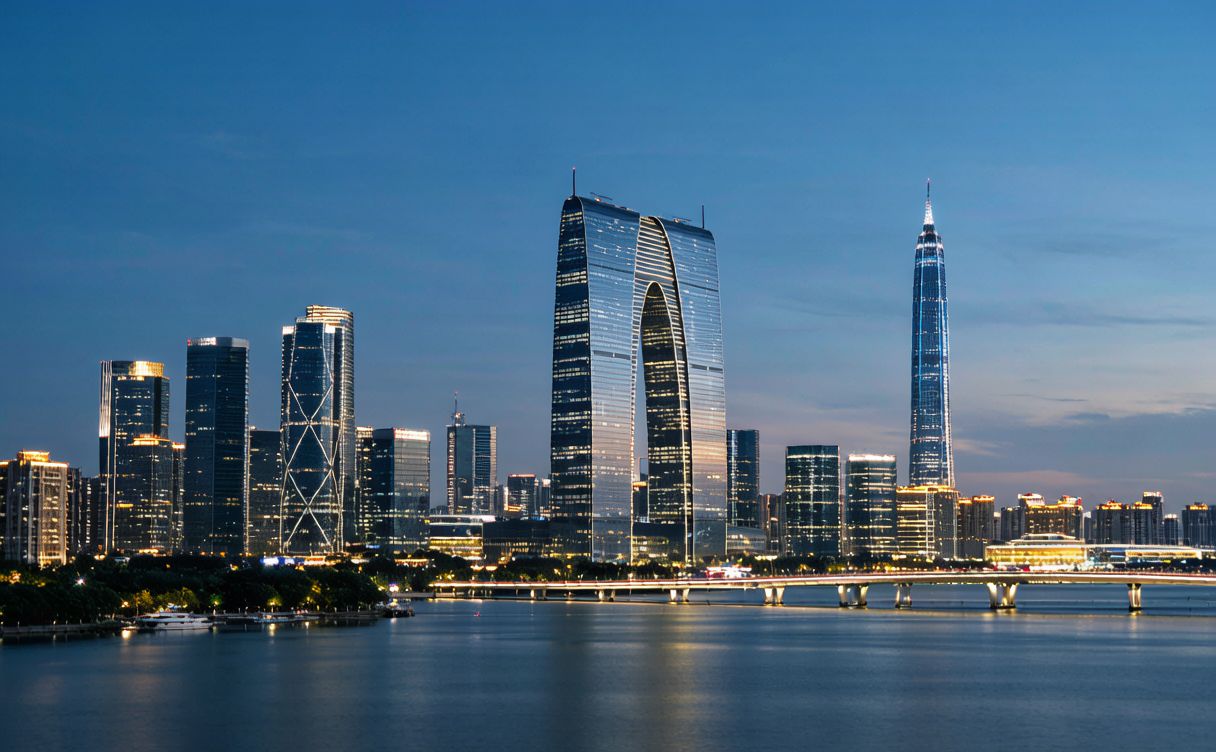
Forty years ago there was no city here worth marking on a map — just a scatter of fishing villages along the Pearl River Delta. Today Shenzhen is a metropolis of 17 million people, home to Huawei, Tencent, and some of the fastest elevators on earth. This Shenzhen travel guide is for travelers who want more than another temple-and-hutong itinerary. Shenzhen rewards curiosity: you can stand on a 115th-floor observation deck in the morning, haggle for a $3 phone case in the afternoon, and be in Hong Kong, China by dinner on the same metro card. It’s loud, new, and refreshingly unromantic about its own history.
At a Glance
- Best for: Tech lovers, shoppers, foodies, and anyone curious about modern China
- Language: Mandarin and Cantonese; English signage is decent in malls and metro
- Getting in: High-speed rail from Guangzhou (30 min) or Beijing (8–9 hrs); ferry and metro links to Hong Kong, China
- Don’t miss: Ping An Finance Centre Free Sky, Window of the World, OCT Loft, Huaqiangbei
- Local flavor: Cantonese dim sum plus a wild mix of migrant provincial cooking
- Budget: Mid-range; cheaper than Hong Kong, pricier than inland cities
From Fishing Village to Tech Capital
Shenzhen’s whole identity is built on speed. In 1980 it became China’s first Special Economic Zone, and the transformation since is the most dramatic any city on the planet has pulled off in a single lifetime. You won’t find centuries-old city walls here, and that’s precisely the point. The story Shenzhen tells is about what China built next, not what it preserved.
Walk the waterfront at Shekou and you can still feel the port-town roots. Head inland to Nanshan and you’re surrounded by the campuses of companies that shape global supply chains. The contrast is the attraction. Spend a day at the Shenzhen Museum (free, and genuinely good) to get the before-and-after, then go see the after for yourself. Before you fly, skim our China travel guide for first-timers so the payment apps and transit basics are sorted.
Theme Parks: Window of the World & Splendid China
Yes, they’re cheesy. Yes, you should go anyway. Window of the World packs miniature versions of the Eiffel Tower, the Pyramids, and the Taj Mahal into one walkable park — equal parts awkward and charming, and a hit if you’re traveling with kids or just want a silly afternoon. The night light show is better than it has any right to be.
Next door, Splendid China Folk Culture Villages is the more interesting of the two. It recreates ethnic-minority villages and historic buildings at small scale, with live performances of dance and craft. It won’t replace the real thing, but it’s a tidy primer if your China trip is short. Go on a weekday if you can; weekends get crowded.
Skyline Views From Ping An Finance Centre
At 599 meters, the Ping An Finance Centre is one of the tallest buildings in the world. Ride the elevator to Free Sky on the 116th floor and the city unspools beneath you — the bay, the grid of towers, the haze softening toward Hong Kong, China on the far shore. On a clear day the cross-border view is the whole reason to come up.
Time your visit for late afternoon so you catch golden hour and the switch to blue-hour lights. Tickets run around ¥150–200; book at the counter or through the official channel and avoid the touts outside. If heights aren’t your thing, the surrounding Futian CBD is pleasant to wander, and the mall at the base is enormous.
OCT Loft: Shenzhen’s Creative Side
OCT Loft (华侨城创意文化园) is what happens when a disused industrial district gets handed to designers instead of developers. The result is a low-rise warren of galleries, indie bookshops, boutique coffee roasters, and restaurants tucked into repainted factory blocks. It’s the most walkable, human-scale corner of a city that otherwise loves its scale.
Come on a Saturday for the small design market, or just drift between cafés with a flat white. It’s also one of the better spots in town for live music. Bring a camera — the murals alone are worth the subway ride.
Huaqiangbei: The Electronics Wonderland
Huaqiangbei is the largest electronics market on earth, and it feels like it. Dozens of multi-story buildings sell everything from raw circuit boards to the latest drones, often at prices that make you double-check the decimal. Even if you’re not buying, the energy is a spectacle — stalls stacked floor to ceiling, repair kiosks that will fix anything, and a constant hum of commerce.
A few honest tips: bargain hard (start at half the quoted price), keep your wits about you, and don’t expect name-brand authenticity on the cheap stuff. For legitimate gear and a cleaner experience, the upper floors of SEG Plaza and the official brand stores are reliable. Traveling with devices from home? Check our China plug adapter and power outlets guide before you pack.
Eating in Shenzhen: Cantonese Roots, Migrant Soul
Shenzhen sits on the edge of Cantonese country, so dim sum here is the real deal. For a classic experience, head to a bustling teahouse in Luohu or Futian, order har gow, siu mai, and cheung fun by the basket, and wash it down with pu’er tea. Our Cantonese food guide to dim sum breaks down what to order and how the ritual works.
What makes Shenzhen’s table different is the migration. As a boomtown it pulled cooks from every province, so within a few blocks you can eat Hunan, Sichuan, northeast dumplings, or halal Xinjiang, China noodles. Dongmen and the streets around Huaqiangbei are cheap and chaotic; the coastal areas lean seafood. One rule worth following anywhere in the country: read our street food safety in China notes before you go fully feral at a night market.
Shopping and the Border Day-Trip to Hong Kong, China
Shenzhen is a shopper’s city, from luxury malls in Luohu to the bargain piles of Lo Wu Commercial City right by the border. The same metro line that runs through town continues straight into Hong Kong, China at Lo Wu or Lok Ma Chau, so a cross-border day is almost frictionless — one train, one immigration hall, and you’re in a different world of harbor views and egg tarts.
If you want to plan that side trip properly, our Victoria Harbour Hong Kong guide covers the must-sees. Carry your passport, check visa rules before you cross, and keep an eye on the clock — the last trains back aren’t all-night.
Getting There: High-Speed Rail
Shenzhen is a major stop on China’s high-speed network. From Guangzhou it’s a half-hour hop; from Beijing you can ride the rails in a single (long) day, and from most eastern hubs it’s an afternoon. The main stations are Shenzhen North (high-speed) and Futian (convenient for the CBD). Booking is straightforward once you know the system — our high-speed train guide for foreigners walks through 12306, passport use, and seat classes.
Practical Tips Before You Go
- Weather: Hot and humid May–September, with a real typhoon risk in summer. October–December is the sweet spot.
- Transport: Metro is clean, cheap, and English-labeled. Alipay and WeChat Pay cover nearly everything, so set those up early.
- SIM/data: Grab a tourist eSIM or local SIM at the airport so maps work the moment you land.
- Cash: Useful as backup but rarely needed; see do you need cash in China for the current reality.
For official border and transit details, the Shenzhen Municipal Government portal publishes visitor information in English.
Shenzhen won’t seduce you with antiquity. It will impress you with momentum — a city that decided what it wanted to be and built it faster than anywhere else on earth. Spend three days here and you’ll understand a side of China that guidebooks to the old capitals quietly skip.
Written by Karl.