

Most visitors to northern China build their trip around Beijing and call it a day. They’re missing something. A proper Tianjin travel guide should start with a simple fact: this port city sits just 30 minutes from the capital on a high-speed train, yet feels like a different country. One hour you’re dodging crowds at the Forbidden City; the next you’re sipping espresso on a piazza that could pass for Milan. Tianjin is where 19th-century European concessions left a strange, beautiful layer of architecture over a very old Chinese river town — and it’s the easiest day trip you’ll make in the north.
Why Tianjin Wins as a Day Trip
Beijing exhausts you. The sights are staggering, but the scale is relentless. Tianjin is the exhale. It’s walkable, low-stakes, and genuinely pretty in a way that doesn’t require a ticket or a two-hour queue. You can leave Beijing after breakfast and be back before dinner with a full camera roll and a full stomach.
The payoff is contrast. Few places let you stand under a giant riverside ferris wheel, wander a rebuilt Ming-dynasty market street, and get lost among hundreds of villa facades from a dozen nations — all before lunch.
At a glance
- Best for: Easy day trip from Beijing, architecture lovers, food crawls, photography
- Getting there: 30–35 min high-speed train from Beijing South to Tianjin Station
- Top sights: Five Great Avenues, Italian Style Street, Tianjin Eye, Haihe River, Ancient Culture Street
- Must-eat: jianbing (savory crepe), goubuli baozi (steamed buns), mahua (fried dough twist)
- Time needed: Half a day to a full day
- Walkability: High — most sights cluster near the river
The Architecture: A World’s Fair That Stayed
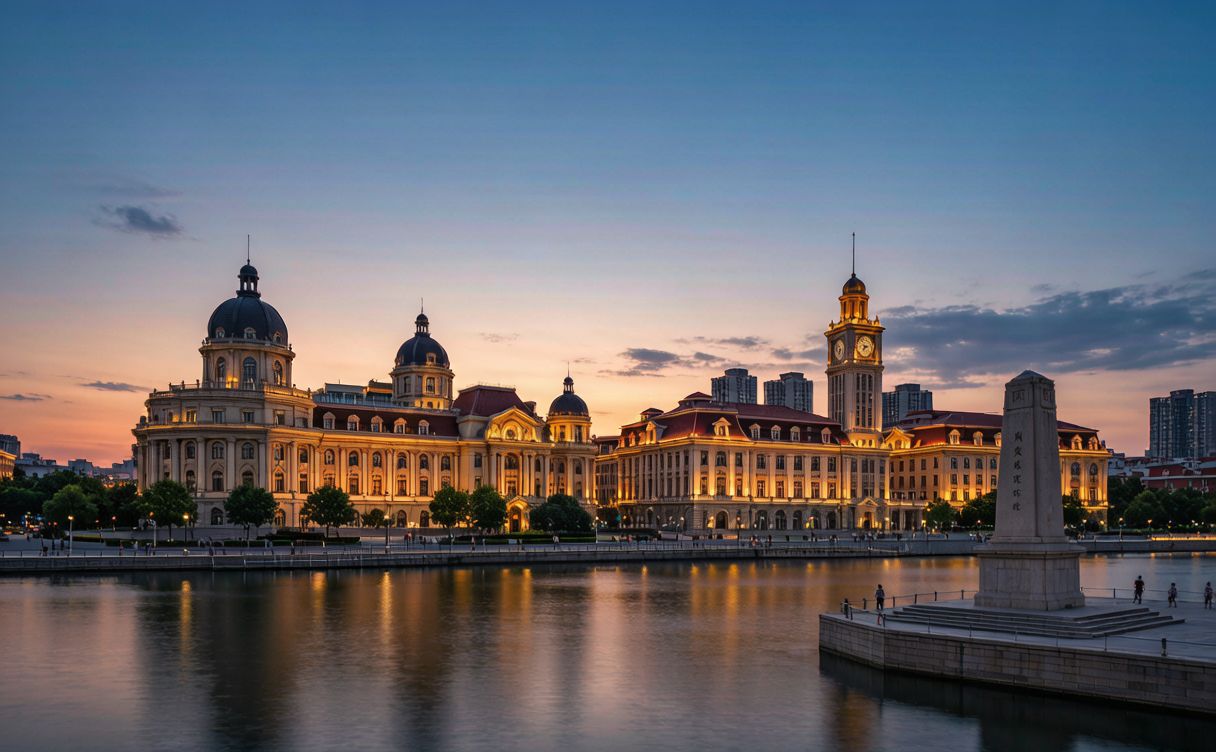
Tianjin’s strangest feature is its past. After the Second Opium War, several foreign powers established concessions here, each building its own quarter in its own style. The result is a city where whole neighborhoods wear someone else’s hometown.
Five Great Avenues (Wudadao)
This is the headline act. Five Great Avenues — Wudadao — is a grid of leafy streets holding more than 2,000 surviving villas in British, French, Italian, and Spanish styles. Rent a bicycle or just wander. The houses are private now, but the streets are public, quiet, and shaded. Go early; midday tour buses thin the charm.
Italian Style Street (Yishifengqingqu)
A short hop away, the Italian Style Street rebuilt the old Italian concession into a pedestrian district of cafés, trattorias, and arched arcades. It’s touristy, sure, but the setting is real and the espresso is decent. At night the plaza lights up and street musicians appear. It’s the one spot in China where ordering a spritz feels completely normal.
The River and the Wheel
The Haihe River cuts through the center, and the city organized itself around it. The waterfront is where Tianjin relaxes.
Tianjin Eye
The Tianjin Eye is a 120-meter ferris wheel built right over a bridge on the Haihe. You ride in enclosed cabins that circle slowly, giving you the whole city laid out below. Time it for late afternoon so you catch the sunset on the way up and the city lights on the way down. Tickets run about 70 RMB. Go on a weekday if you can — weekends build a line.
Haihe at night
After dark, the river becomes the main event. Boat cruises leave from near the eye and drift past bridges lit in shifting colors. Even from the bank it’s a show. The riverside promenade is flat, well-lit, and safe for a slow evening walk.
Ancient Culture Street (Guwenhua Jie)
If the European quarters are Tianjin’s borrowed face, Ancient Culture Street is its own. Rebuilt in the style of a Qing-dynasty market, it runs a few blocks packed with craft shops, calligraphy stalls, and snack vendors. It’s commercial, but the goods are real: hand-painted kites, clay figurines (the local “Clay Figure Zhang” style), and paper cuttings.
Come here hungry. This is the best single place in the city to graze your way through Tianjin’s snacks without chasing them across town.
Eating in Tianjin
Tianjin food is northern Chinese comfort — wheat-heavy, salty, fried, and unpretentious. Three things you should not leave without trying.
- Jianbing — the savory breakfast crepe with egg, crispy cracker, scallion, and chili sauce, folded and handed to you warm from a street cart. Tianjin claims the original. Eat it standing up, in the morning, from a cart with a line.
- Goubuli baozi — steamed buns with a 160-year-old name and a rumpled, pleated top. The main shops are tourist-facing and overpriced, but the experience is part of the lore. Try a half-steamer, not a full banquet.
- Mahua — fried dough twisted into braids and sometimes coated in sesame. The Guifaxiang brand is the famous one; buy a bag to snack on or take home. It keeps for weeks.
For a wider frame on what you’ll eat across the country, our Chinese regional cuisines guide maps the eight great traditions, with Tianjin sitting inside the northern wheat belt.
Planning the Trip
The logistics are the easy part, which is exactly why Tianjin works as a day trip.
Getting there from Beijing
Trains leave Beijing South Station for Tianjin Station roughly every 10–20 minutes, and the fastest take about 30 minutes. Buy ahead through the official system — our high-speed train guide for foreigners walks through the process, and the 12306 ticket booking explainer covers the app and account setup. Fares are modest, usually 50–70 RMB each way.
Pairing it with Beijing
Treat Tianjin as a pressure valve on a Beijing-heavy trip. If you’re still planning that leg, the Beijing first-time travel guide lays out the capital’s essentials, and where to stay in Beijing helps you pick a base with fast rail access. Tianjin Station puts you a short taxi or metro ride from every sight listed above.
When to go
Spring (April–May) and autumn (September–October) are best — mild, clear, and good for walking. Summer is hot and humid; winter is cold but the riverside lights feel cozier. For the broader picture across the country, our China travel guide for first-timers covers seasonal planning in depth.
A note on timing: most sights are free or cheap, but the Tianjin Eye and any river cruise sell timed tickets. Book the wheel online in peak season to skip the stall.
Suggested Half-Day Loop
If you have one afternoon, do this: arrive at Tianjin Station, walk the Haihe bank to the Tianjin Eye, cross to Italian Style Street for coffee, taxi to Five Great Avenues for a slow wander, then finish at Ancient Culture Street for snacks before your train back. It’s about five hours door to door, with room for a long lunch.
For background on the city’s layered history and concession-era districts, the Tianjin entry on Wikipedia is a solid, well-sourced starting point.
Practical Tips
- Cash vs card: Alipay and WeChat Pay rule here, same as everywhere. A little cash helps at old-market snack stalls.
- Language: English signage is patchy outside the train station. Have your destination in Chinese characters saved on your phone.
- Footwear: This is a walking city. Comfortable shoes beat fashion on the Five Great Avenues.
- Crowds: Skip the eye and Italian Street on Saturday nights if you dislike shoulder-to-shoulder.
Tianjin won’t top anyone’s once-in-a-lifetime list. That’s the point. It’s the low-pressure side trip that makes a stressful Beijing run feel like a real vacation — colonial facades, a glowing riverside wheel, and a crepe eaten standing in the street. Spend the half day. You’ll be glad you did.
Written by Karl.