

Rising behind the city of Huizhou in Guangdong, Luofu Mountain is one of the sacred peaks of Chinese Taoism and one of the easier day trips from the Pearl River Delta. Known in Taoist lore as the “Ninth Celestial Abode,” it pairs a genuinely forested granite summit with a deep bathing culture — the hot springs at its foot have drawn visitors for over a thousand years. Most travelers blow through Guangdong en route to Guangzhou or Hong Kong, but if you want a slower, greener stop, Luofu Mountain delivers: moderate hikes, old temples, and soaking pools within an hour of a high-speed rail station. This Luofu Mountain guide covers how to get there from Huizhou, when to go, and how to combine the climb with a soak. For the wider area, our Huizhou travel guide maps the lake and coastal sides of the city too.
Why Luofu Mountain
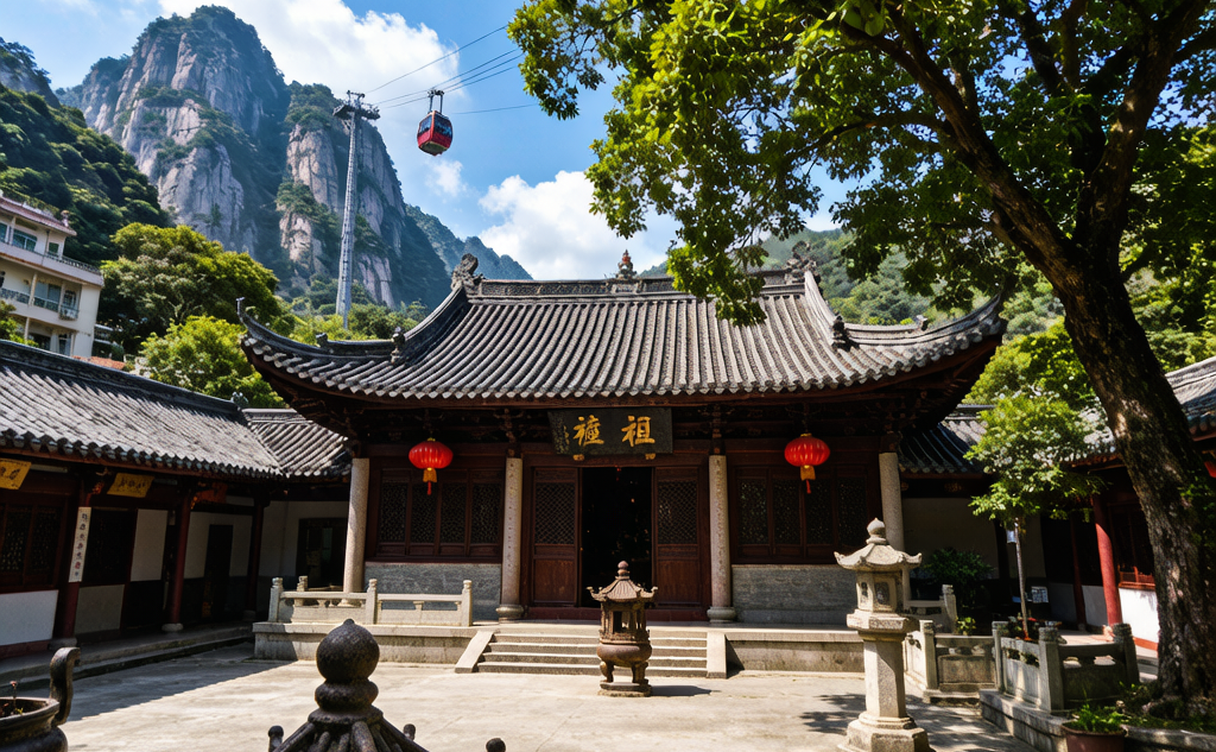
Luofu has been a Taoist retreat since at least the Eastern Jin, when the alchemist Ge Hong is said to have practiced and written here. The mountain’s draw is less about a single monument and more about atmosphere: a chain of ridges, waterfalls, and cave shrines threaded with stone paths, plus a founding story tied to the pursuit of longevity. Unlike the dramatic karst of Guilin, Luofu is rounded and wooded, with a subtropical humidity that keeps it green year-round. The Luofu Mountain temple at the base, Chongxu Guan, is the ceremonial heart and a good place to understand the site’s religious role before you climb. For a city contrast, our Guangzhou travel guide is an hour north by train.
Luofu’s religious pedigree is real rather than decorative. Ge Hong’s writings here, especially his alchemical and medical manuals, fed into both Taoist practice and early Chinese pharmacology, and the mountain is still associated with herbal retreats. The official China tourism portal (travelchina.gov.cn) lists Luofu among Guangdong’s key cultural mountains, which is a fair signal that the infrastructure — paths, signage, cable car — is maintained to a national standard. That makes it an easy introduction to sacred-mountain travel for visitors who are not yet ready for the high passes of the west.
How to get to Luofu Mountain
The nearest hub is Huizhou, reachable by high-speed train from Guangzhou (about an hour) and Shenzhen (under an hour). From Huizhou station or the city center, a taxi or rideshare covers the roughly 40 kilometers to the Luofu scenic area in under an hour. Buses also run, but they are slower and less frequent. If you are coming from Guangzhou or Hong Kong for the day, train to Huizhou then a car is the cleanest route. Knowing how to get to Luofu Mountain in advance helps because the last shuttle up the access road leaves in the late afternoon, and you do not want to be descending in the dark. Our China high-speed train guide for foreigners explains ticketing and ID requirements for the line.
Best time to visit Luofu Mountain
The best time to visit Luofu Mountain is spring (March to May) and autumn (October to November), when the heat eases and the trails are dry. Guangdong summers are long, hot, and sticky, with afternoon thunderstorms that can make the granite slick — still doable, but less pleasant. Winter is mild by northern standards and a fine time for hot-spring soaking without crowds. Aim for a weekday if you can; weekends bring families from the Delta. Arrive at opening to catch the morning mist on the ridges and beat both the heat and the coach tours. For seasonal planning across the country, our best time to visit China guide breaks down each region month by month.
Two local events are worth timing around if your dates are flexible. The Luofu temple fairs, held on traditional dates in spring and autumn, bring Cantonese families, opera troupes, and food stalls to the base — lively but crowded. The nearby Huizhou West Lake and the Dongjiang river scenes are best in the same mild months, so a Luofu day extends easily into a Huizhou night. Avoid the May and October holiday weeks if you dislike queues; the cable car line can run an hour then. A clear weekday in April or November is the sweet spot for both weather and solitude.
Luofu Mountain hiking
Luofu Mountain hiking is flexible rather than extreme. The most common route climbs from the base temple to the Feiyun Summit, the highest point at just over 1,200 meters, via a mix of stone steps and cable car. You can ride the cable car partway and walk the rest, which suits casual hikers and older travelers. The full ascent on foot takes three to four hours round trip; the views across the Huizhou plain and, on clear days, toward the coast, are the payoff. Side paths lead to waterfalls and the cave shrines associated with Ge Hong. Wear proper shoes — the steps are numerous and the descent is harder on the knees than the climb. Carry water; the humidity makes you sweat more than the gradient suggests.
If you want a gentler walk, the lower temple loop and the spring-fed ponds near Chongxu Guan take under an hour and still deliver the forest and the architecture without the summit effort. Families with children or older travelers should treat that loop as the main event and save the cable car for a quick look at the viewpoint. The full Feiyun climb is rewarding but repetitive in places; do not feel obliged to tag the summit if the clouds have dropped and the view is gone.
Hot springs and where to soak
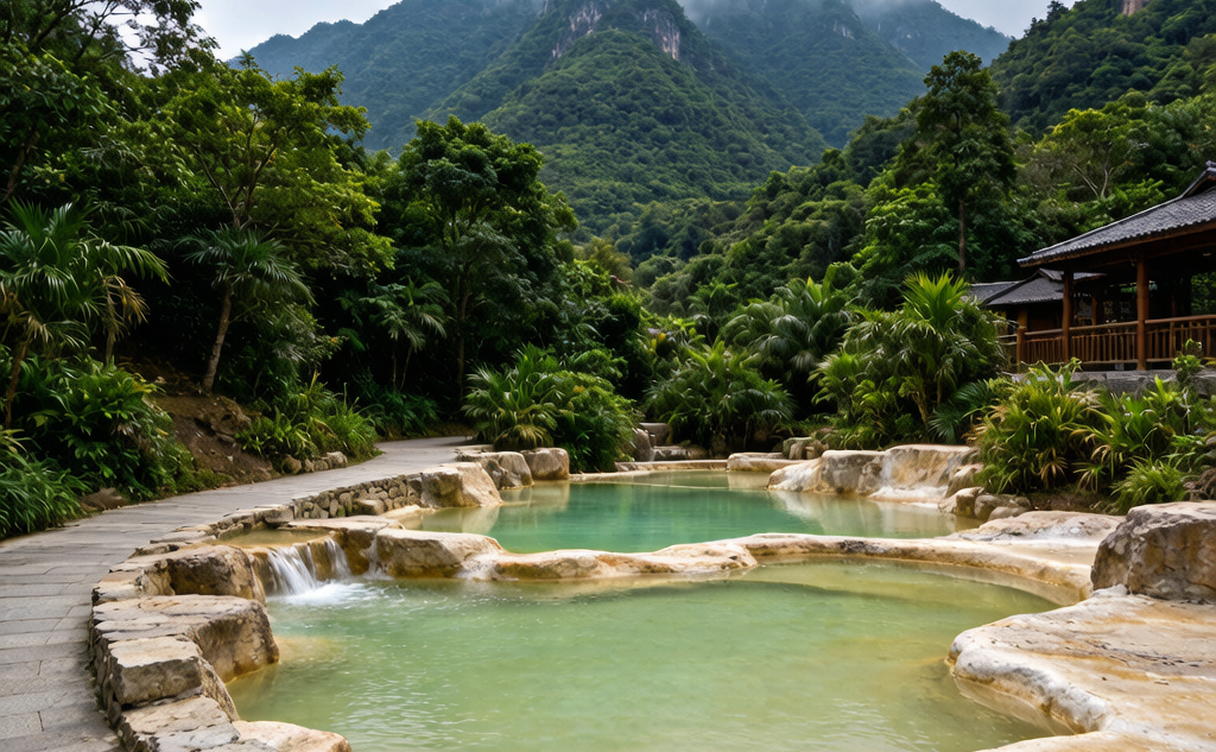
The hot-spring resorts at Luofu’s foot are the natural complement to the climb. Several hotels and day-spas offer outdoor pools fed by the same mineral sources Taoists prized centuries ago. After a morning on the steps, an afternoon soak is the local ritual, and it is a genuinely good one. Pools range from large communal baths to private indoor rooms; pick according to your comfort level, and note that mixed public bathing follows local etiquette — swimwear is standard at the resort pools, not the temple. If soaking is the main event, our China hot springs resorts guide covers other notable bathing regions from Yunnan to the northeast.
Food: the Huizhou table
Huizhou cooking is one of China’s quieter regional styles, built on preserved vegetables, river fish, and gentle braises rather than heat. Around Luofu you will find mountain herbs, free-range chicken, and tofu made at small workshops — the sort of food that pairs naturally with a day of walking. The base town has noodle shops and a few banquet restaurants; the hot-spring resorts usually include a decent buffet. Try the local stuffed tofu and the dried-bamboo shoots if they are on the menu. None of it is destination dining on the level of Chengdu or Guangzhou, but it is honest, cheap, and restorative after the steps. Carry some snacks for the climb, since options on the mountain itself are limited to a couple of stalls.
Practical tips
Buy your entry and cable-car tickets together at the gate to save time. The scenic area is large, so decide upfront whether you are hiking, riding, or mixing both. Food inside is basic — noodles and snacks — so eat a real meal in Huizhou before you set out, or plan dinner after. Bring insect repellent in summer; the forest is alive. English signage is limited, so download a translation app or save your route offline. Accommodation ranges from the hot-spring resorts at the base to budget stays in Huizhou city, so you can easily make this an overnight rather than a rushed day trip.
Who should visit
Luofu is ideal if you want spiritual scenery without altitude or remote travel. It suits families, older travelers, and anyone burned out on megacity itineraries who still wants an easy rail connection. It is not a wilderness expedition — expect managed paths and some development — but the forest is real and the temples are active. For travelers compiling a southern China list, our best things to do in China includes Luofu among its nature-and-culture picks.
Final thoughts
Luofu Mountain is the kind of place that rewards a loose plan: climb a bit, sit in a temple, then sink into a hot pool while the mist lifts off the ridges. It will not top any list of China’s most spectacular peaks, but few sacred mountains are this accessible from a high-speed rail line. Go midweek, go early, and let the Taoist calm do the rest.