

Some 70 kilometers southwest of Dunhuang, where the Hexi Corridor finally runs dry and the edge of the Taklamakan begins, the Yangguan pass survives as a low earth-colored monument to the Silk Road’s western threshold. If you have read a single line of Tang poetry, you have probably already met it. Wang Wei’s farewell verse — “west of Yangguan there are no old friends” — turned the pass into shorthand for every departure into the unknown. A visit here is less about ticking off a ruin and more about standing where the Han dynasty frontier met the caravan world beyond.
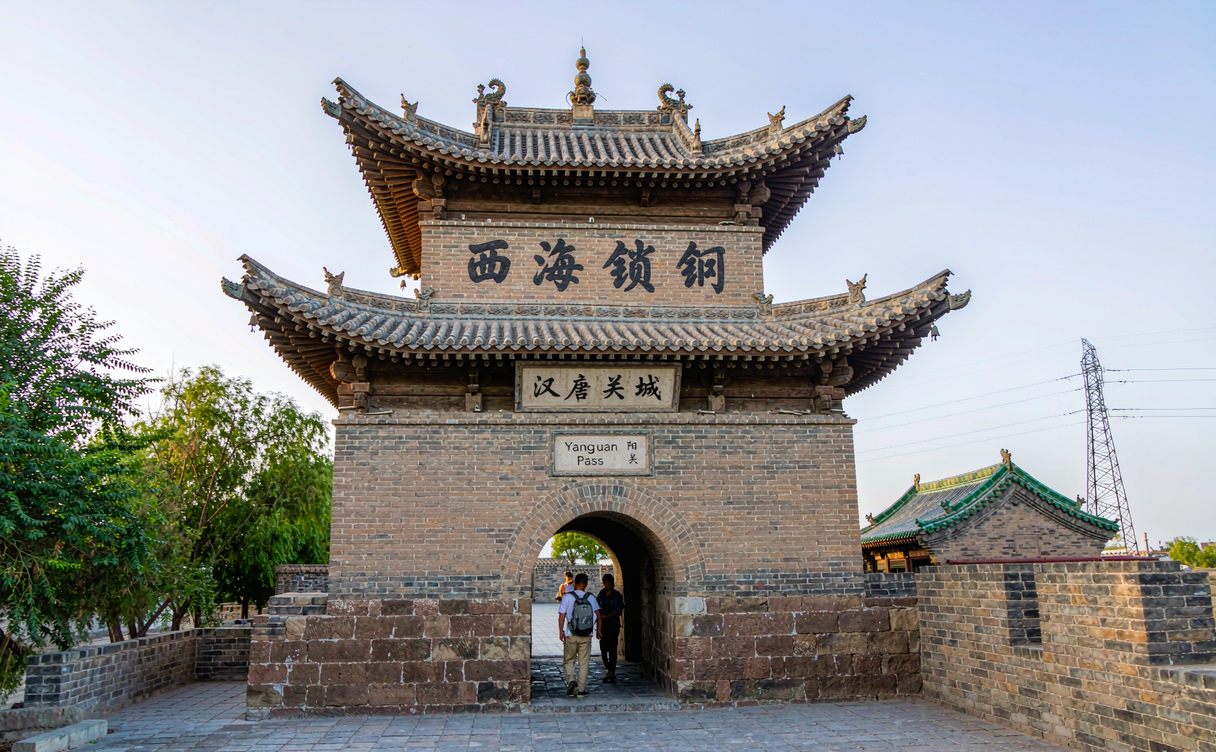
The Yangguan pass was founded in the early 2nd century BC under Emperor Wu of Han, alongside its sister gate Yumenguan, to protect the southern Silk Road route toward Loulan, Khotan and the Pamirs. For roughly a thousand years it controlled the movement of jade, silk, Buddhist scriptures and travelers between Chang’an and Central Asia. What remains today is humbler than the legend: a single restored beacon tower (fengtui) rising from the Gobi, a rebuilt pass gate, and a scatter of excavated foundation lines that archaeologists have marked for visitors. The romance lives in the landscape, not the masonry.
How to get to Yangguan from Dunhuang
The practical question for any Yangguan pass guide is transport, because the site is stranded in open desert with no public transit that fits a normal sightseeing day. From Dunhuang city the drive is about 70 km and takes 75 to 90 minutes along the G215 and a signed county road. There is no train. Your realistic options are a chartered car or taxi for the day (expect ¥400 to ¥600 round trip including waiting time, negotiable at the Dunhuang taxi rank or through your hotel); a seat on a Dunhuang–Yangguan shuttle that some hotels and the Drum Tower travel agencies run in peak season for roughly ¥80 to ¥120 per person; or a private guide-driver, the most comfortable choice if you also want Yumenguan and the Western Thousand Buddha Caves in one loop. If you are building a broader route, our China Silk Road itinerary explains how Yangguan fits between Dunhuang and the Hexi Corridor towns to the east.
Things to do at Yangguan
The ticketed scenic area (¥50 in 2025, with the museum included; a shuttle from the gate to the tower adds ¥10) is compact, and you can see the essentials in two to three hours. Start at the Yangguan Cultural Relics Exhibition Hall, a small museum that explains the pass layout with maps, Han-era pottery, and replicas of the wooden “pass permits” (guozuo) that travelers needed to cross. From there a shuttle or a 2 km walk brings you to the beacon tower itself, the one structure most visitors photograph. Climb the viewing platform and you get the point: on a clear day the Gobi stretches flat to every horizon, and you can see why a watchtower here could signal approaching caravans long before they arrived.
Beyond the tower, two experiences are worth your time. First, the “ancient pass road” walking trail, where the old tamped-earth causeway is still visible as a faint raised line crossing the gravel — walk it slowly and you are literally on the Silk Road. Second, the nearby Dunhuang Crescent Lake and Mingsha Dunes are an easy same-day pairing if you go early, though most people save the dunes for the evening when the light is best. The Mogao Caves are the headline Dunhuang sight and must be booked days ahead, so sequence Yangguan around that reservation rather than the other way round.
Best time to visit Yangguan
Yangguan sits in true Gobi desert: scorching summers (July highs above 38°C), bitter winters (January lows near -15°C), and spring winds that can close the access road with dust storms. The best time to visit China’s northwest for this region is late April to early June and again September to mid-October. In those windows daytime temperatures sit around 15 to 25°C, the light is photogenic, and the desert poplar (huyang) trees turn gold in October. Go at opening (around 08:30) to beat both heat and tour buses, and carry more water than you think you need — there is almost no shade.
Yangguan history and the poetry that made it famous
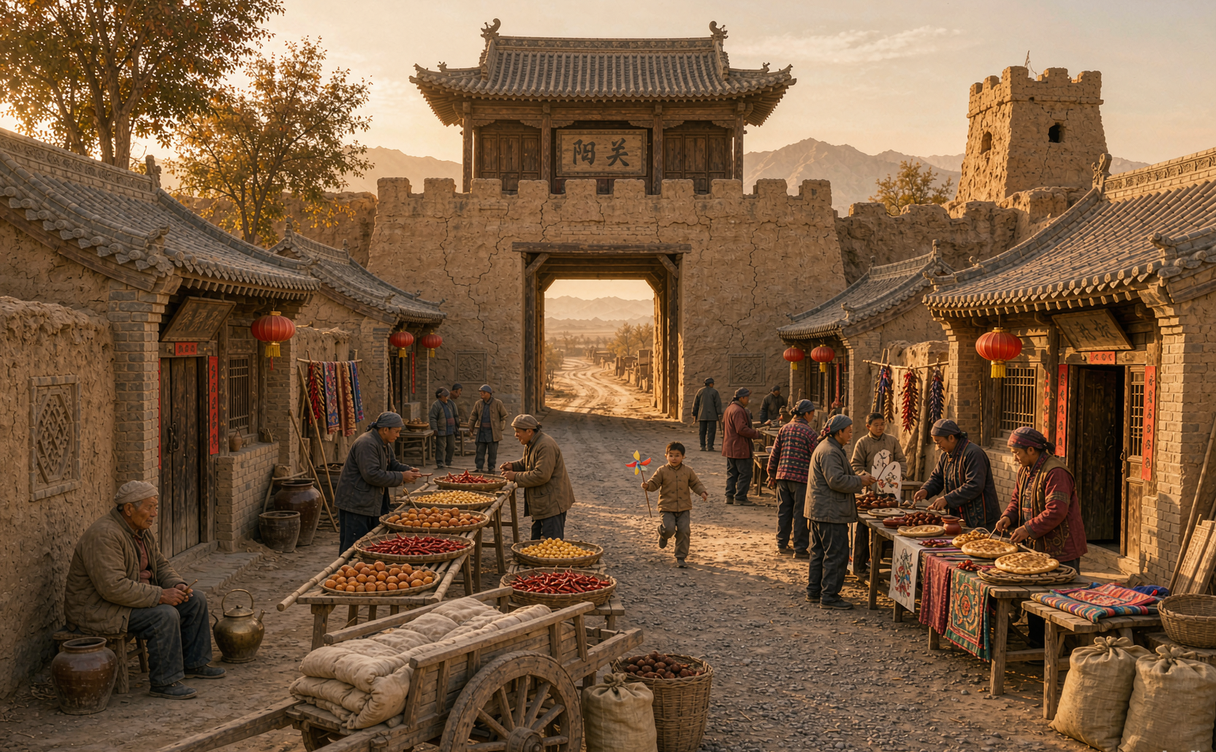
Understanding a little Yangguan history changes how you see the place. The pass guards the southern mouth of the Hexi Corridor; Yumenguan guarded the northern. Together they were the customs posts of the Han empire, and the phrase “chu Yangguan” (exit Yangguan) meant leaving the civilized heartland for the Western Regions. The Tang poet Wang Wei wrote his famous line at a friend’s send-off, and for a millennium after, “Yangguan” in Chinese poetry simply meant “the far edge of home.” The site was abandoned as the Silk Road shifted and the water table dropped; by the Ming dynasty it was ruin. Modern archaeology, much of it tied to the Dunhuang research institutes, has reconstructed the tower and mapped the lost town. For a deeper reference, the Wikipedia entry on Yangguan summarizes the historical record if you want primary sources before traveling.
Pairing Yangguan with Yumenguan and Dunhuang
Most travelers treat Yangguan and Yumenguan as a single day loop, and that is the efficient play. Yumenguan is another 80 km northwest and is even barer — a couple of squat Han watchtowers and a fierce sense of isolation — but the contrast is instructive: Yangguan was the “friendly” southern gate, Yumenguan the harsh northern one. Between them sits the Western Thousand Buddha Caves, a smaller, quieter cousin of Mogao with restored murals. A hired driver can cover all three plus the dunes in a long day for ¥700 to ¥900, which is far better value than three separate taxis. If your rail approach is from the east, our high-speed train guide for foreigners covers reaching Dunhuang from Lanzhou or Xi’an; from Dunhuang you still need road transport for the final 70 km.
Practical tips and what to book in advance
Book the Mogao Caves ticket online before anything else — it caps daily entries and sells out in peak season, sometimes a week ahead. For Yangguan itself, no advance booking is needed, but a driver should be arranged the day before, since desert taxis are scarce by mid-morning. Wear closed shoes (gravel and thorn bushes), bring a windbreaker even in summer, and download offline maps, as cell coverage thins past the dunes. The scenic area accepts Alipay, WeChat Pay and cash; foreign card readers are unreliable, so keep small notes. Give yourself a buffer: sandstorms can delay the access road for an hour or two, and there is nowhere to wait except your car.
Ready to walk the western threshold of the Silk Road? Build Yangguan into a Dunhuang day trip and pair it with the Mogao Caves before permits sell out.
Food and where to base yourself
Stay in Dunhuang city, not at the pass — there is no lodging at Yangguan and the desert gets cold after dark. Dunhuang has everything from hostels near the night market (¥120 to ¥200 a night) to the four-star Silk Road Dunhuang Hotel (¥600 to ¥1,000). Eat at the Shazhou Night Market: lamb skewers (¥3 to ¥5 each), the local “huyang stewed noodles,” and Dunhuang’s dried figs and melon seeds make good trail snacks for the Gobi. Leave the city by 08:00 and you can do Yangguan, grab lunch, and still reach the dunes for the 18:30 light. If you are continuing south into Qinghai, Xining is the natural next hub for the plateau leg of the loop.
Plan your Silk Road frontier trip now — reserve the Mogao Caves, lock in a Dunhuang driver, and let Yangguan be the quietest, most atmospheric stop on your route.
A note on expectations
Yangguan will disappoint travelers who expect a Great-Wall-scale monument. It rewards those who like ruins, distance and silence. Arrive with the poetry in mind, give it two unhurried hours, and the empty Gobi does the rest. The site is also a useful narrative beat: standing here, you understand exactly why the Silk Road was both a trade route and a test of nerve. Photographers should aim for the last hour before sunset, when the tower throws a long shadow and the gravel goes copper-red. Bring a wide lens and a polarizer; the glare is brutal at midday and flattens everything.
Make Yangguan the contemplative anchor of your Dunhuang journey — book the caves, hire the driver, and step onto the road west of which there are no old friends.