

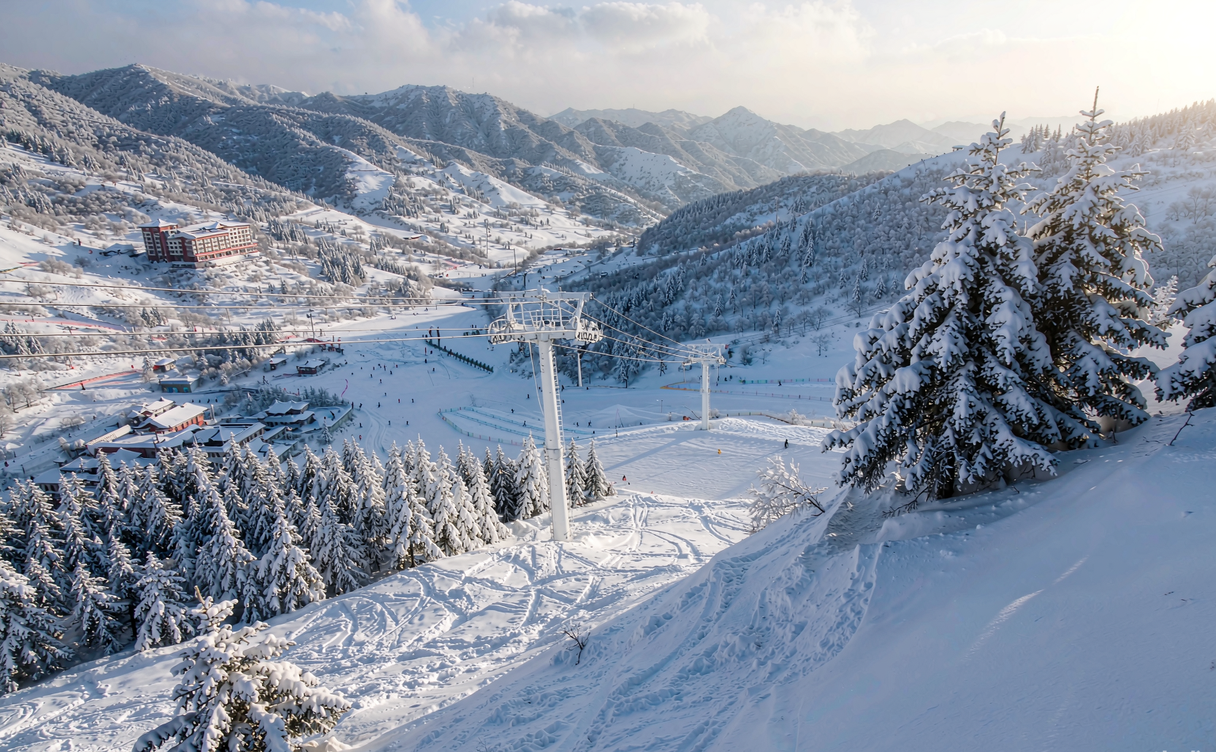
If China has a serious skiing reputation, it starts in Yabuli. Tucked into the Zhangguangcai range of Shangzhi city, about 193 km southeast of Harbin in Heilongjiang, the Yabuli ski resort is the country’s largest and most developed winter sports playground — the venue that hosted the 1996 Asian Winter Games and the 2009 Winter Universiade, and the training ground for much of China’s national alpine and freestyle squad. For foreign visitors who assumed Chinese skiing meant gentle mall slopes, Yabuli is the correction: real mountains, real vertical drop, and snow that lasts from November into April.
The resort actually spreads across several connected zones rather than one tidy base. The highest peak, Datudingzi (the “Big Balding” mountain), tops out around 1,374 m and gives a vertical of roughly 800 m — modest by Alpine standards but the best in the country’s northeast. Trails are graded for every level, from wide green nursery slopes to the steep “mountain back” blacks that the national team uses for slalom training. The China winter sports guide compares Yabuli with the other northern resorts if you are weighing where to spend your season.
Best time to visit Yabuli
The Yabuli winter sports season runs from mid-November to late March, but the quality of the snow varies sharply across those months. December through February is peak: cold, dry powder, reliably sub-zero temperatures, and the full festival atmosphere. January is the sweet spot — average highs around -15°C, overnight lows near -25°C, and the brightest, lightest snow. March warms up and gets slushy on south faces, but it is also cheaper and far less crowded. The best time to visit China for the northeast generally means the deep winter, and Yabuli is no exception. Avoid the Spring Festival week (usually late January or February), when lift lines triple and hotel prices jump 50 to 100 percent.
How to get to Yabuli from Harbin
The easy answer is the high-speed train. Harbin West or Harbin station runs direct services to Yabuli West (Yabuli Xi) station in about 1 hour 20 minutes to 1 hour 40 minutes, with second-class seats around ¥85 to ¥110. From the station it is another 20 to 40 minutes by the resort shuttle bus (¥15 to ¥25, timed to train arrivals) or a taxi (¥60 to ¥100) up to the base areas. Driving yourself from Harbin takes 2.5 to 3 hours on the G10 Suiman Expressway and is only worth it if you are carrying gear for a group. If you are arriving from farther south, our high-speed train guide for foreigners walks through booking Harbin-bound services on the 12306 system and what documents you need at the gate.
Things to do in Yabuli beyond alpine skiing
Yabuli is not only for downhillers. The cross-country loop near the former Universiade venue is groomed daily and free to use with a trail pass (¥40 to ¥60). The snow tubing hill behind the family base is a hit with non-skiers and costs about ¥50 for unlimited rides in a two-hour block. For something faster, the snowmobiling track runs ¥150 for a 15-minute guided loop, and the dedicated “joyful sled” (a steerable inflatable) is ¥30 a ride. In the evening, several of the resort hotels pipe in outdoor hot spring pools — Yabuli’s geothermal water sits around 40°C and is the single best cure for a day on icy slopes. Add the cable-car ride to the summit (included on most lift passes), which on a clear day looks straight across the forested ridge line into the Russian border country beyond.
For families and first-timers, Yabuli is more forgiving than its competition reputation suggests. The nursery slope at the family base has a dedicated magic carpet — a moving belt, not a chairlift — so beginners never fight a lift, and English-speaking instructors are available through the Club Med desk and the international ski school for about ¥400 to ¥600 for a private hour. Children under 1.2 m often ski free on a parent’s pass. Off the snow, the base restaurants serve acceptable dumplings and lamb hotpot (¥60 to ¥120 a head), and the town of Yabuli has cheaper noodle joints if you want to skip resort prices. Apres-ski is low-key — a few karaoke bars and the hotel lounges — so don’t arrive expecting a party slope; the draw here is the skiing, not the nightlife, and most people are asleep by 22:00.
Lift passes, gear rental and what it costs
A weekday adult day lift pass at Yabuli runs roughly ¥300 to ¥420 depending on the zone and whether it includes the gondola; weekend and holiday passes climb to ¥450 to ¥580. Multi-day and season passes are much better value if you ski more than three days. Equipment rental at the base is ¥120 to ¥200 per day for skis, boots and poles, or ¥200 to ¥300 for a snowboard setup; bring your own if you can, because rental boots are heavily used. A two-hour group lesson costs about ¥200 to ¥300 per person and is the fastest way past the falling-down phase. Clothing — jacket, pants, goggles, gloves — rents for another ¥100 to ¥150 if you did not pack for -20°C. Note that foreign card payments are patchy at the window; book through a Chinese platform or your hotel, or carry ¥500 to ¥1,000 in cash as backup.
Where to stay and how to book in advance
Lodging clusters in two places: the larger resort base (best for families and first-timers, with ski-in convenience) and the town of Yabuli itself, 15 minutes down the hill, where prices drop. On-mountain four-star hotels such as the Yabuli International Broadcasting and the Club Med (which runs an all-inclusive ski package) run ¥1,200 to ¥2,500 a night in peak season; the town has clean guesthouses from ¥200 to ¥400. Book at least a month ahead for January and the holiday weeks — Yabuli fills up, and the good slopeside rooms sell first. The Harbin Ice Festival travel guide pairs naturally with a Yabuli trip: most visitors do two or three days on the snow, then back to Harbin for the festival and the Russian-style architecture.
Want real mountain skiing in China? Lock in a Yabuli lift pass and slope-side room now, then stack a Harbin Ice Festival stop on the same winter trip.
Building a northeast China winter itinerary
Yabuli is the anchor of almost every serious northeast China winter itinerary: Harbin for the festival and frozen river, Yabuli for the skiing, and then east to Mudanjiang for Jingpo Lake’s frozen waterfall and the Siberian tiger park. The logic is geographic — all on or near the G10 corridor — and the cold is the same the whole way, so you only unpack your thermal layer once. If you are short on time, even a single night at Yabuli (train up in the morning, ski the afternoon, ski the next morning, train back) is doable from Harbin and costs under ¥1,000 all-in if you share a room.
Map your northeast winter loop today — Harbin, Yabuli and Mudanjiang slot together on one cold-weather route, and the trains make it easy.
Practical tips before you go
Dress for the cold, not the photos. Base layer, insulated pants, a real down jacket (not a fashion one), and chemical hand warmers in your pockets — glove liners help you handle zips and phones. Goggles beat sunglasses on windy days; the wind chill at the summit can hit -35°C. Take the first gondola at 08:30 to get corduroy snow before the crowds, and quit by mid-afternoon when the light flattens and the ice forms. For background on the resort’s competition history and facilities, the Wikipedia page on Yabuli Ski Resort is a useful pre-trip read. One last thing: altitude is low enough that there is no acclimatization issue, but the dry cold dehydrates you fast, so drink water even when you are not thirsty.
Book the train, the pass and the room this week — Yabuli’s best snow in January goes with the season, and the slope-side rooms will not wait.