

Meizhou calls itself the capital of the Hakka people, and if you eat your way across the city, you will understand why that title matters. The Hakka — literally “guest people” — are Han Chinese who migrated south centuries ago and settled in the hills of Guangdong, Fujian, and Jiangxi, building the round earthen fortresses and a cuisine shaped by hard land and harder winters. Meizhou, in northeastern Guangdong, is where that cooking is purest. This Meizhou food guide walks you through the dishes worth the trip and how to find them without a phrasebook.
If you are mapping a wider Guangdong route, our Meizhou travel guide explains how to reach the city and what the Hakka heritage sites look like between meals. For official background on the region’s culture and visitor information, the Guangdong provincial culture and tourism department publishes material in English at https://wlt.gd.gov.cn.
The logic of Hakka cooking
Hakka food is the opposite of the flashy Cantonese dim sum table. It is rustic, filling, and built to fuel people who worked the terraced fields. Three traits define it: preservation (salting, curing, pickling), thrift (using every part of the animal), and plainness (few aromatic spices, lots of ginger, scallion, and salt).
The result is food that tastes of its ingredients rather than its sauce. A Hakka cook is proud that the chicken tastes like chicken. That restraint is refreshing after the sugar-and-chili bombast of some neighboring regions, and it makes Meizhou a good stop for travelers who want to taste southern China without their palate going numb. The Meizhou food guide you actually need fits on a napkin: order the two classics, graze the snacks, and trust the morning market.
For a broader look at the province’s eating, our Guangzhou travel guide contrasts Hakka plainness with the coastal Cantonese style an hour’s flight away.
Hakka stuffed tofu
The dish every visitor should try first is niang dou fu, Hakka stuffed tofu. Squares of firm tofu are slit and packed with a seasoned pork and fish paste, then pan-fried until the faces are golden and simmered in a light broth. The contrast is the point: crisp-edged, savory-filled tofu against a clean, gingery sauce.
In Meizhou you will find it everywhere from hole-in-the-wall lunch counters to banquet halls, and the quality barely dips. The best versions use locally pressed tofu with a tender, almost custardy center. Order it with a bowl of plain rice and you have a meal that costs almost nothing and tastes like home cooking from a century ago. It is the dish I tell people to seek out first in any Meizhou food guide, because it teaches you the Hakka idea in one bite.
Salt-baked chicken
If stuffed tofu is the everyday face of Hakka food, salt-baked chicken — yan ju ji — is the celebration dish. The traditional method packs a whole chicken in layers of paper and buries it in hot salt, which cooks it gently and seasons it from the outside in. The meat comes out impossibly tender, faintly savory from the salt crust, and perfumed with the scallion and sesame oil tucked inside the cavity.
Modern restaurants often cheat with a salt-spice rub and oven, but the good ones still do it the slow way. Eat it at room temperature, torn by hand rather than chopped, with the rendered juices poured over. A whole chicken feeds three or four and makes a fine centerpiece for a table of travelers comparing notes. Ask whether they do it the buried way; the answer tells you which kitchen to trust.
Other Hakka standards
Beyond the two headliners, the Meizhou table has quiet stars. Yong tau foo — the broader family of stuffed vegetables, not just tofu — includes bitter melon and chili peppers crammed with the same pork paste. Kai zai noodles, or “abacus beads,” are chewy pellets of taro and flour tossed with minced pork and mushrooms, named for their resemblance to the old counting tools. And the preserved vegetable braises, especially with pork belly, are the kind of deep, funky comfort that rewards a second visit.
Our China food tour guide places Hakka cooking alongside the other southern regional styles if you want to see how it fits the map.
Meizhou snacks and breakfast
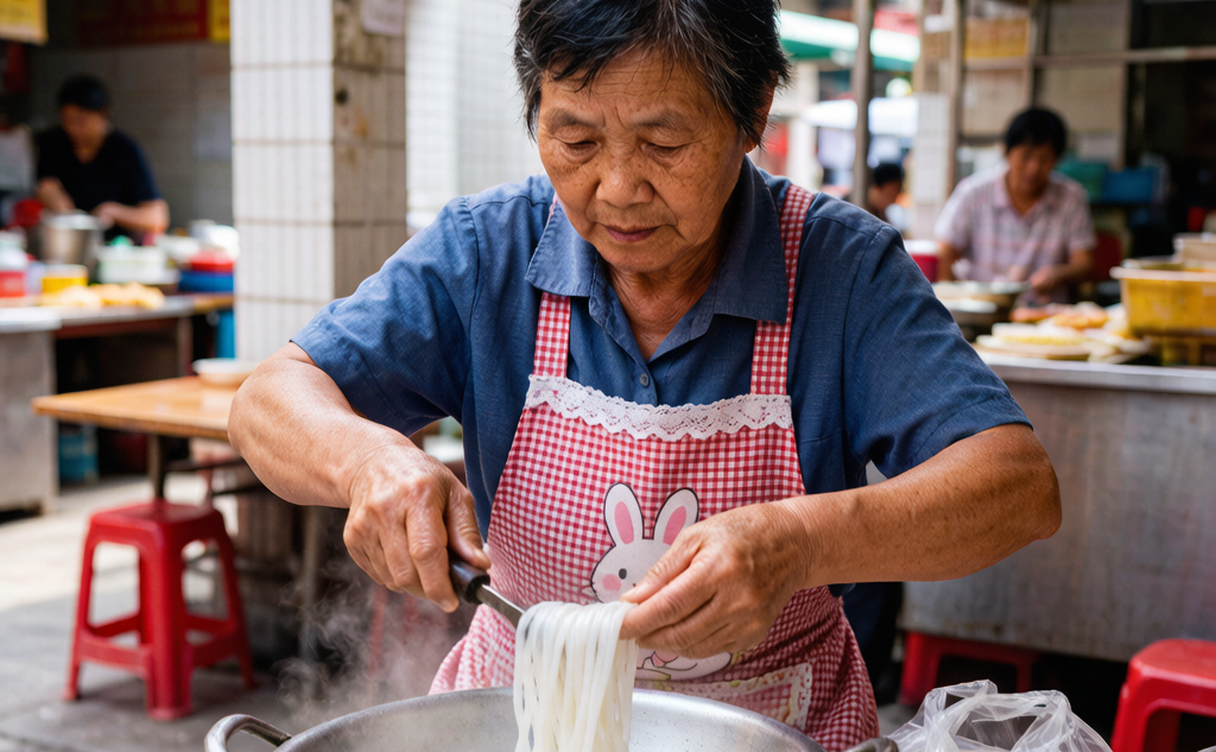
The snack game in Meizhou is gentle and carb-forward. Morning markets sell rice noodles in clear broth, steamed buns stuffed with sweet or savory fillings, and the local favorite, la fen — slippery sweet potato noodles dressed with scallion oil and a little chili. None of it is aggressive; Hakka snacks are about steady fuel, not fireworks.
Look for the women squatting beside bamboo steamers at the bus station and the older districts; that is where the real breakfast lives. A bowl and a bun will run you a couple of dollars and set you up for a morning of village wandering. The best time to catch these stalls is between six and eight, before the city fully wakes and the good fillings sell out.
Night markets and evening eating
Meizhou is not a party city, but its night markets are genuine and unpretentious. The strips near the river and the university area fill with carts selling grilled skewers, rice rolls, and the ever-present stuffed tofu in miniature form. Our China night markets guide covers how to order and stay safe, but here the atmosphere is relaxed — more families than drunks, more sniffing than shouting.
Hakka villages worth a side trip
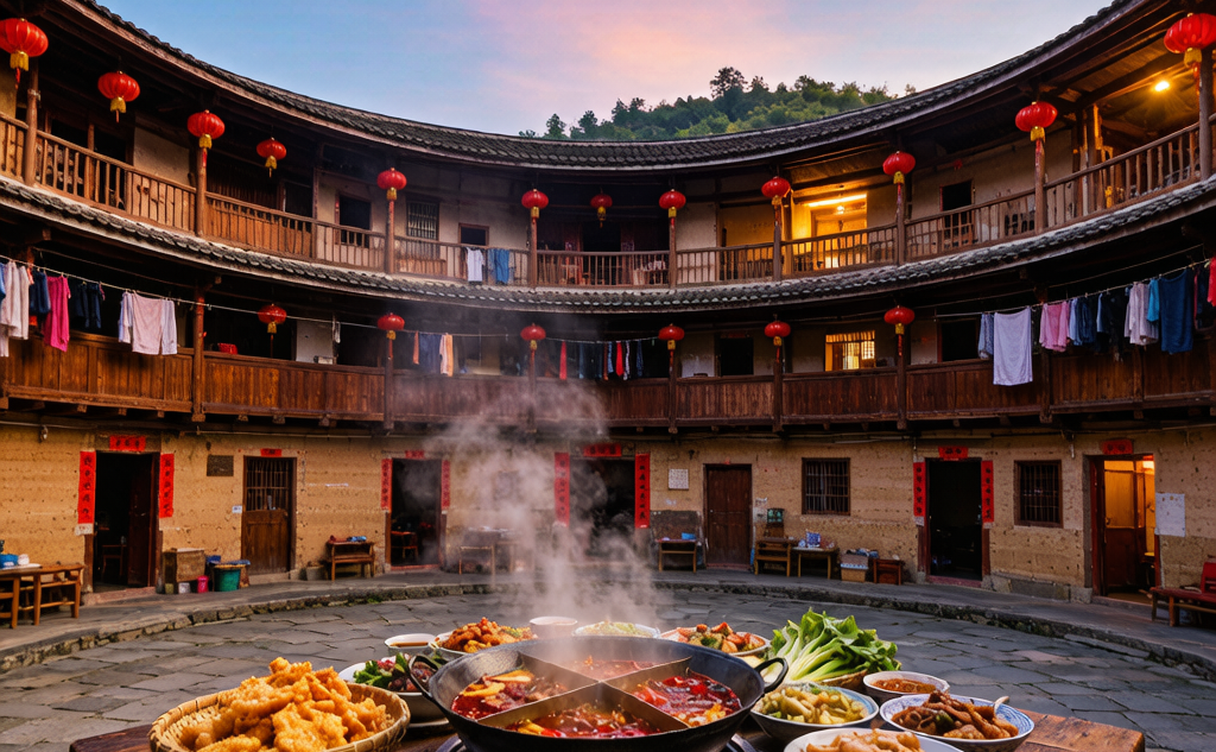
The food makes more sense once you see where it came from. A short drive from the city center sits a scatter of walled Hakka villages, some built around the square earthen houses that inspired the famous Fujian tulou. You will not find the giant round towers here, but you will find the same logic: a self-contained compound where a whole clan ate, slept, and defended itself. Eat in the village canteen — the same stuffed tofu and braised pork, cooked over a wood fire — and the rustic point of Hakka cuisine lands.
These trips are easy to arrange through your hotel and make a natural half-day around a long lunch. Bring cash; the smaller villages rarely take cards or mobile pay.
Drinks and the tea connection
Hakka country overlaps with Guangdong’s tea hills, so a pot of local oolong is the natural companion to a salty, savory meal. The Hakka also have a tradition of home-brewed rice wine, mild and faintly sweet, sometimes served warm with ginger — worth a try if a restaurant offers it, though go easy if you have somewhere to be. The tea, though, is the daily constant, and a shared pot is how business and family have been conducted here for generations.
Timing your visit
Meizhou eats by the season but is never closed. Spring and autumn are the pleasant times to walk the markets; summer is hot and humid but the night snacks shine; winter is the season for salt-baked chicken and preserved braises. Our best time to visit China piece lays out the national calendar, and for Meizhou specifically, autumn offers the clearest weather for both eating and the surrounding Hakka villages.
Practical notes
Menus in Meizhou are mostly in Chinese, and English is thin outside the hotels, so a phone translator is essential. Portions are large and meant for sharing, so order family-style and ask for less if you are solo. The city is small enough that a taxi or walking covers most food spots, and the surrounding villages are a cheap car ride away. And pace yourself: Hakka food is hearty, and the stuffed tofu-and-chicken one-two will test a light eater.
The Meizhou food guide in one line: come hungry, order the stuffed tofu and the salt-baked chicken without hesitation, and let the snacks fill the gaps. It is one of the most honest, unglamorous, and satisfying regional tables in southern China — exactly the kind of place the big guidebooks skip and the locals guard.