

Say “Hakka house” to most travellers and they picture the round earthen towers of Fujian. Meizhou, three hours inland from Guangzhou in the hills of eastern Guangdong, builds something different and, to my eye, more graceful: the weilongwu, a horseshoe of rooms curving around a hall block, with a crescent-shaped pond set in front like a mirror. Thousands of them still stand among the rice terraces here, many still lived in. This Meizhou travel guide is for travellers who want the Hakka world at its source — a self-declared “World Hakka Capital” of roughly four million people, ringed by tea hills and almost untouched by international tourism.
Why Visit Meizhou
Meizhou is the ancestral home of Hakka communities across Southeast Asia and beyond, and the city knows it. Descendants return to trace family halls, which is why Nanyang-style villas stand beside 200-year-old compounds in the same village.
The architecture is the reason to come, and it is worth being precise about what you are seeing. The Fujian tulou villages are tall, defensive, communal rings of rammed earth, listed by UNESCO in 2008. Meizhou’s weilongwu (围龙屋) is a low, open, grey-brick and earth compound: a formal ancestral hall at the centre, straight side wings, then one to three semicircular “dragon rings” of rooms wrapping the rear slope, with a raised terrace between hall and ring and a half-moon pond in front. It reads as a settled farming manor rather than a fortress.
Add tea plantations, a Tang-dynasty temple on a wooded peak and some of the best food in Guangdong outside the Cantonese cities, and two days fill easily.
Best Time to Visit Meizhou
October to December — the best window. Dry, clear and 18–27°C, with the rice harvest gold in the terraces and comfortable walking weather in the villages. This is the answer to the best time to visit Meizhou.
February to April. Warming and green, 15–25°C, plum and cherry blossom in the county parks, but increasingly wet as spring advances.
May to August. The rainy months: heavy afternoon downpours, humidity above 80% and 35°C peaks. Typhoon remnants can reach inland in July and August and disrupt mountain roads.
January. Cool, 8–17°C, dry and quiet. Houses have no heating and stone floors get cold, but this is the cheapest time to travel and the tea hills look superb in low sun.
If you can align with Chinese New Year, Hakka villages hold lantern-raising ceremonies in ancestral halls — extraordinary to see, though transport and rooms are booked solid.
How to Get to Meizhou from Guangzhou and Shenzhen
Rail access changed completely when the Meizhou–Longchuan high-speed line opened in 2024, cutting the run from the Pearl River Delta to around three hours. Meizhou West Station (梅州西站) handles high-speed services and sits about 20 minutes by taxi from the city centre. Meixian Airport (MXZ) has domestic flights, mostly to Guangzhou, Shenzhen and Shanghai.
| From | Mode | Typical duration | Approx. cost |
|—|—|—|—|
| Guangzhou East → Meizhou West | High-speed rail | around 3 hr | ¥180 (US$25) |
| Shenzhen North → Meizhou West | High-speed rail | 2 hr 30 min – 3 hr | ¥190 (US$27) |
| Chaozhou/Chaoshan → Meizhou West | High-speed rail | 1 hr 15 min | ¥70 (US$10) |
| Xiamen → Meizhou West | High-speed rail | around 3 hr | ¥180 (US$25) |
| Meizhou West → city centre | Taxi | 20 min | ¥40 (US$6) |
| Meizhou → Dabu County | Coach or car | 1 hr 20 min | ¥35 (US$5) |
Outside the city you need wheels. County buses reach the main towns but stop early, so most visitors hire a car with driver for ¥500–600 a day — the only sensible way to string together villages in Meixian and Dabu.
Top Things to Do in Meizhou
Qiaoxiang Village and its weilongwu
In Nankou town, about 40 minutes west of the city, Qiaoxiang Village (侨乡村) holds over a hundred traditional Hakka houses in one valley — the densest concentration anywhere. The showpiece is Nanhua You Lu (南华又庐), an 1904 mansion of eight linked courtyard units built with money made overseas. Most compounds are private homes; walk the lanes, greet people, and only enter where a ticket desk or an open gate invites you. Budget half a day and expect to pay ¥20–50 at the two or three managed houses.
Renjing Lu and the old town
In central Meijiang district, Renjing Lu (人境庐) is the compact garden residence of the late-Qing poet and diplomat Huang Zunxian, preserved with its study and inscribed rockery, next to the larger Ronglu Di compound. Around ¥20, an hour well spent, and within walking distance of the riverside old streets and the Confucian temple quarter.
Lingguang Temple on Yinna Mountain
An hour east in Yandong, Lingguang Temple (灵光寺) dates to the Tang dynasty and sits at 500 metres in dense forest. It is famous for three curiosities: a spiralling timber caisson ceiling that somehow stays free of fallen leaves, a pair of ancient cypresses — one living, one long dead and still standing — and the local claim that birds never fly over the main hall. Entry is around ¥50, usually combined with the mountain gate ticket.
Yannanfei tea plantation
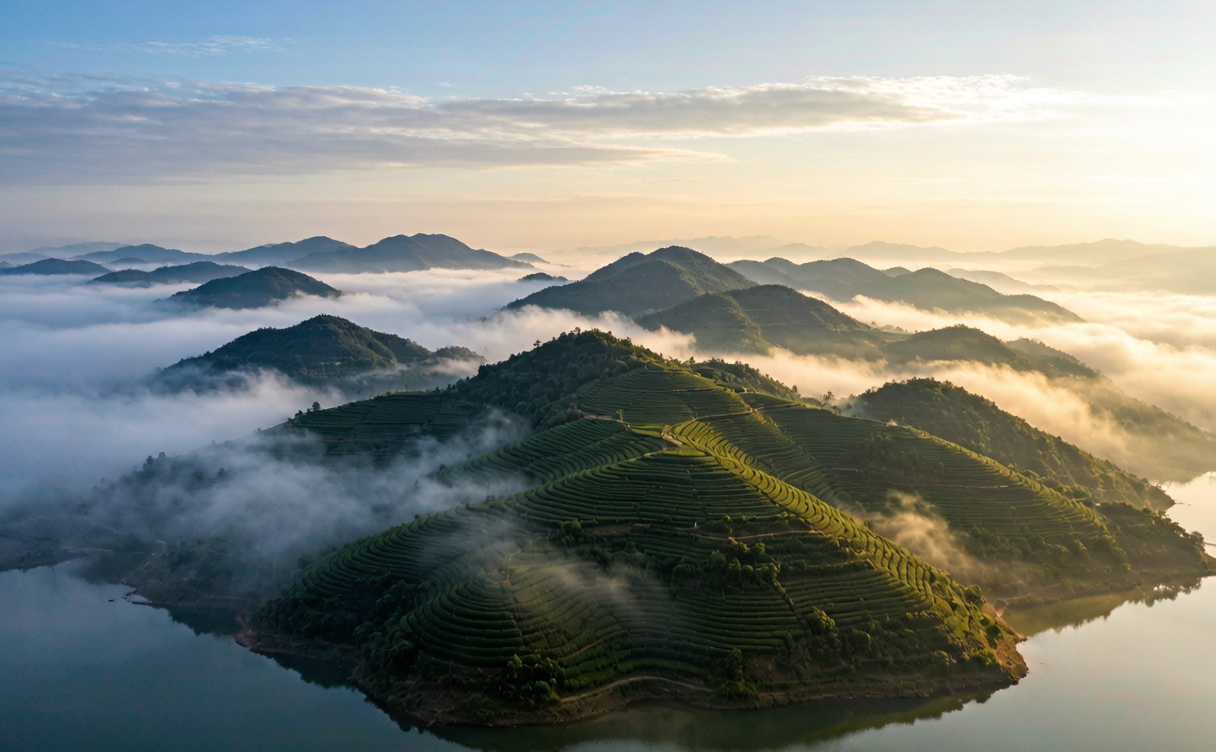
Next door to the temple, Yannanfei (雁南飞) is a 5A-rated tea estate turned resort: terraced rows on rounded hills, a working tea factory, a reconstructed Hakka village and walking paths through bamboo. Tickets around ¥60–80. Touristy, undeniably, but the tea tasting is genuine and the views on a misty morning justify it.
Baihou Ancient Town and Tai’an Lou
In Dabu County, 90 minutes east, Baihou (百侯古镇) is a Ming and Qing town of flagstone lanes and scholars’ mansions, largely free to wander. Nearby Tai’an Lou (泰安楼), built in 1764, is a rare square fortified Hakka block faced in stone — a useful contrast with the open weilongwu. Around ¥30.
Songkou Ancient Town
The Mei River port where generations of Hakka emigrants boarded boats for Southeast Asia. Waterfront arcades, the 1930s Songjiang Hotel and the migration memorial square make an atmospheric two hours.
Where to Stay in Meizhou
Budget — ¥120–250 (US$17–35). Domestic chains such as Hanting and Vienna cluster in Meijiang district near Binfang Avenue and the old town. Clean, functional, and accustomed to registering foreign passports.
Mid-range — ¥300–550 (US$42–77). Better business hotels along the Mei River in Jiangnan, the most convenient base for restaurants and evening walks.
Splurge — ¥700–1,200 (US$98–170). Resorts at Yannanfei or Yinna Mountain, plus a few restored Hakka compounds in Meixian run as boutique guesthouses. Book ahead; there are very few rooms.
Stay in the city two nights and use a driver for day trips, unless you specifically want a village overnight.
What to Eat
Hakka cooking is the counterweight to Cantonese refinement: salt, preserved vegetables, slow braises and a lot of pork. It travels well, which is why you have probably eaten a version of it abroad.
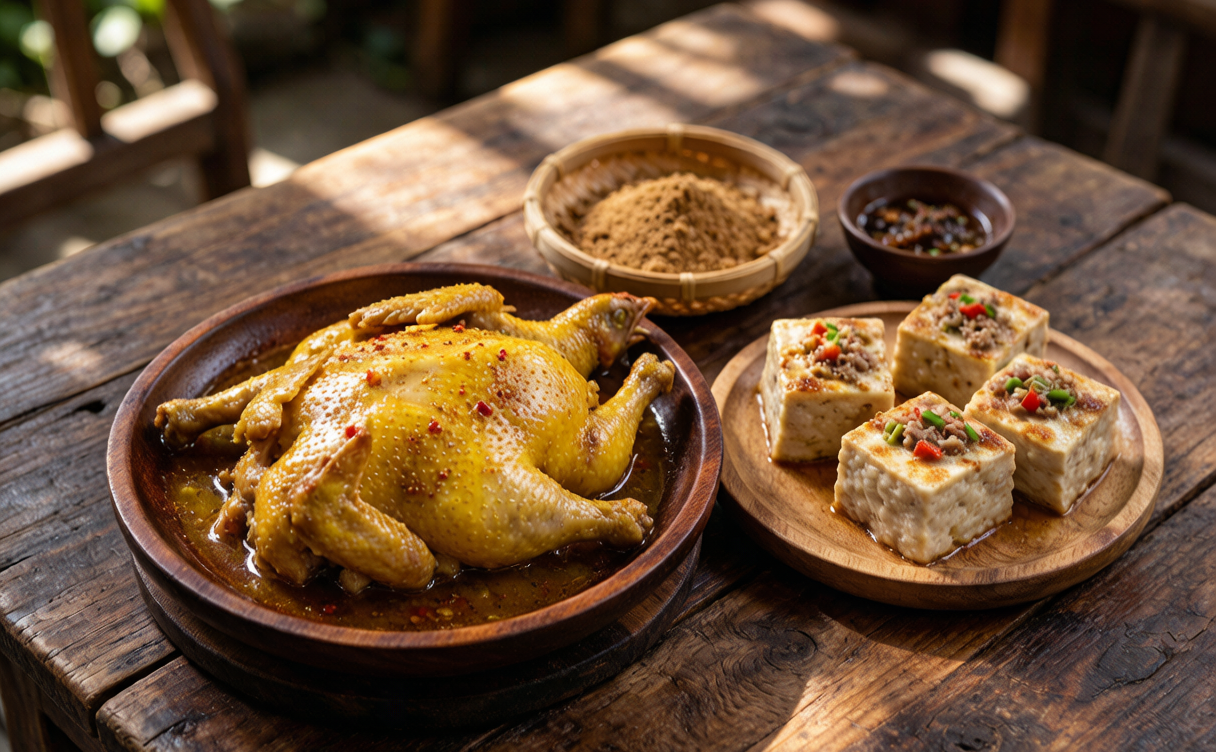
- Salt-baked chicken (盐焗鸡). A whole chicken buried in hot coarse salt until the skin turns amber and the meat stays juicy. The definitive dish. ¥60–90.
- Stuffed tofu (酿豆腐). Tofu blocks pocketed with seasoned pork, pan-fried then braised — a northern dumpling tradition adapted where wheat would not grow.
- Preserved mustard pork belly (梅菜扣肉). Fatty pork steamed over dried mustard greens until it collapses.
- Pickled noodles and sanjidi soup (腌面 + 三及第汤). The universal Meizhou breakfast: dry noodles tossed in lard and fried shallots, with a clear soup of pork liver, meatballs and greens. About ¥12.
- Hakka rice wine (客家娘酒). Amber, sweet and warming, often simmered with chicken and ginger.
- Abacus beads (算盘子). Chewy taro discs stir-fried with mushroom and minced pork.
Compare it with the seafood-driven cooking of the coast in our Chaozhou food guide — two Guangdong traditions that could not be less alike.
Sample Meizhou Itinerary for Foreign Tourists
Day 1 — city and western villages
- 08:00 pickled noodles and sanjidi soup for breakfast
- 09:00 Renjing Lu and the old town lanes
- 11:00 drive to Nankou; Qiaoxiang Village and Nanhua You Lu
- 14:00 lunch of salt-baked chicken in the village
- 17:00 back to the city; Mei River promenade at dusk
Day 2 — mountains and tea
- 08:30 drive east to Yinna Mountain
- 09:30 Lingguang Temple
- 11:30 Yannanfei tea estate, tasting and terraces
- 14:00 continue to Baihou Ancient Town and Tai’an Lou
- 18:00 return, or push on to Chaozhou by evening train
Practical Tips
- Hire a driver. The sights are spread across three counties, and this is the single decision that makes or breaks a Meizhou itinerary for foreign tourists.
- Respect private homes. Many weilongwu are occupied. Ask before entering courtyards or photographing ancestral halls.
- Payment. Alipay and WeChat Pay accept foreign cards and work everywhere, but village stalls and small temples appreciate cash. Carry ¥300 in notes.
- Language. Hakka is the everyday language here, Mandarin the second. English is rare — save destinations in Chinese characters for your driver.
- Onward routes. Meizhou sits between the coast and the Fujian border, so it slots neatly between Guangzhou and Shantou.
FAQ
Is Meizhou worth visiting?
If Hakka culture, rural architecture or food interests you, very much so. If you want city sights, nightlife or museums, it will disappoint. Two days is the sweet spot.
How is Meizhou different from the Fujian tulou?
Tulou are tall defensive rings of rammed earth built for communal living. Meizhou’s weilongwu are low, open, brick-and-earth farm compounds with a semicircular rear ring and a crescent pond. Different shape, different purpose, same broader Hakka world.
How do I get to Meizhou from Guangzhou?
High-speed trains from Guangzhou East reach Meizhou West in about three hours for roughly ¥180 since the Meizhou–Longchuan line opened in 2024. Book with your passport number.
Can I visit the Hakka villages without a car?
Partly. County buses serve Nankou and Yandong but run infrequently and stop by late afternoon. A car with driver at ¥500–600 a day covers three times as much ground.
Do people speak English in Meizhou?
Very little. Larger hotels manage basics; elsewhere use a translation app. Locals see few foreign visitors and are usually curious and helpful.
Written by Karl, China Travel Places — updated August 2026.