

If you are planning a trip to Guilin, most guidebooks will tell you to take the Li River cruise and stop there. They are missing the best part. About 100 km northwest of the city, carved into the spines of steep karst and granite mountains, lie the Longji Rice Terraces — “Longji” literally means “Dragon’s Backbone,” and once you stand at the edge of a viewpoint watching layer after layer of flooded paddies curve toward the valley floor, you will understand why. I have been twice, in two different seasons, and it remains the single landscape in southern China that made me stop talking and just look.
This guide covers everything I wish I had known before my first visit: the two main terrace areas and which to choose, the best months to go, exactly how to get there from Guilin and Yangshuo, the village-to-village hikes, where to sleep, and how to come home with photos you are actually proud of.
What Makes Longji Worth the Trip
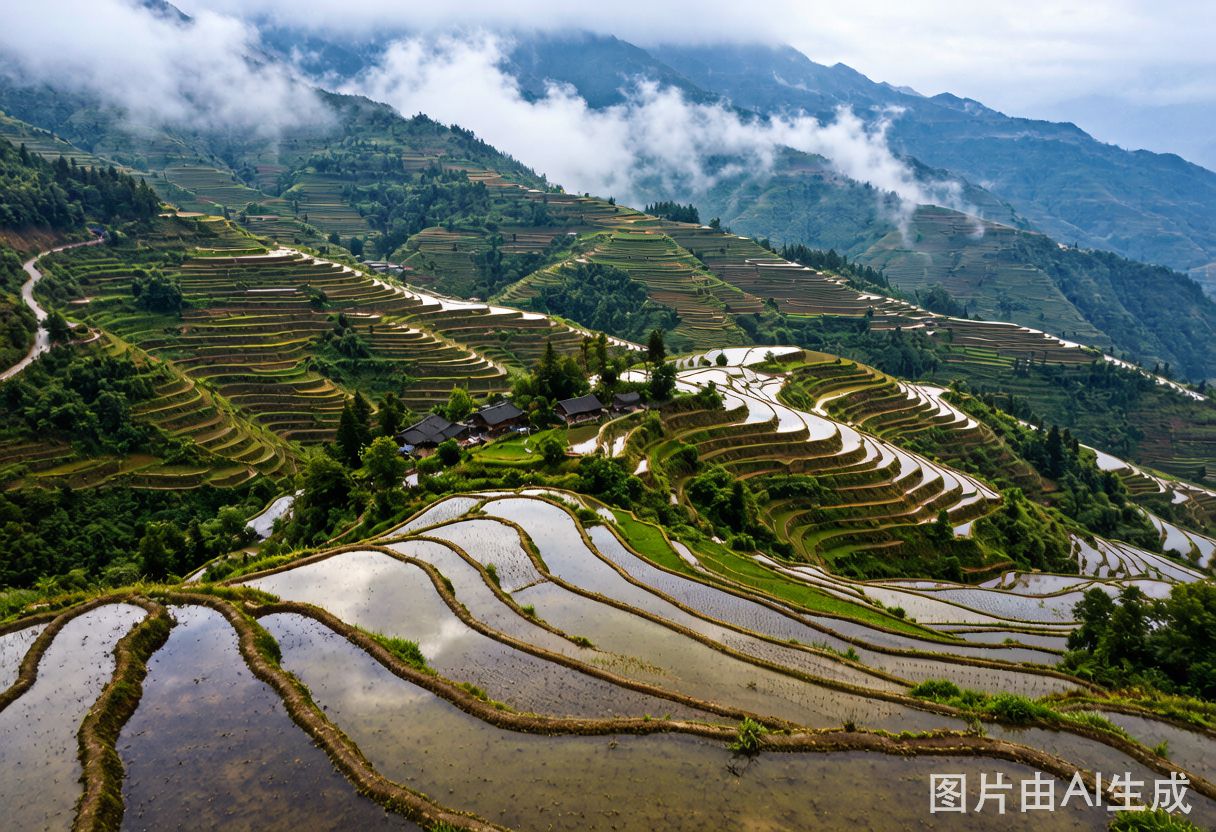
The terraces were started around 650 years ago during the Yuan dynasty and finished in the early Qing, built by the Zhuang and Yao ethnic minorities who still farm them today. The scale is the point: in the Jinkeng area alone there are roughly 20 square kilometers of terraces climbing from 300 meters to over 1,100 meters above sea level. When I visited, I kept trying to find where the fields ended and the sky began — the neat ridges are so continuous that distant tiers blur into contour lines.
Beyond the scenery, this is one of the easiest places in China to meet minority cultures without it feeling staged. In Ping’an you will see Zhuang women in indigo embroidered dress; up in Jinkeng/Dazhai the Red Yao women are famous for letting their hair grow uncut for life and winding it into elaborate headdresses. Tourism is real here, but the farming is real too — people are still planting, weeding, and harvesting by hand.
The Two Main Areas: Ping’an vs Jinkeng/Dazhai
Longji is a big scenic zone with several villages. First-time visitors should pick between the two marquee areas, because they feel different and you do not want to rush both in a single day.
Ping’an Village (the classic postcard)
Ping’an is the original tourist terrace village and the easiest to reach. Its signature spots are two wooden viewing platforms: Nine Dragons and Five Tigers (Jiulong Wuhu) and Seven Stars with the Moon (Qixing Bandeng). The paths between them are paved and short, so Ping’an suits travelers who want a big view with minimal walking. It is also the most commercialized, with guesthouses, restaurants, and souvenir stalls lining the single stone lane. In my experience, Ping’an is best for a relaxed half-day and a sunset shot, not for solitude.
Jinkeng / Dazhai (the bigger, wilder one)
Jinkeng, centered on Dazhai village, is larger and less crowded, with three main viewpoints: Golden Buddha Peak (the highest, reachable by cable car), West Peak, and Thousand Layer Staircases. The terraces here are broader and the hiking between hamlets is more rewarding. If you want to trek, stay overnight, and watch the light move across a huge bowl of fields, choose Jinkeng. The cable car to Golden Buddha Peak is worth the fee if your knees are not up for the 2-hour climb.
My honest take: if you only have one day, do Ping’an for convenience; if you can spend a night, Jinkeng is the better reward.
Best Time to Go
Timing is everything at Longji, because the terraces change completely with the farming calendar. There is no “wrong” month, but the two headline windows are:
- Late April to mid-June — flooded fields. After the spring ploughing, the paddies are filled with water and reflect the sky like mirrors. This is the most photogenic season for that glassy, sculptural look. Visit in May, and you catch the fields at their emptiest and most abstract.
- Mid-September to early October — golden harvest. The rice ripens into a carpet of gold, and you will see families cutting and carrying sheaves by hand. The light at this time is warm and the color contrast is spectacular. The catch: Chinese National Day (October 1–7) brings huge domestic crowds, so aim for mid-to-late September or after October 7 if you can.
I went once in early June (mirror fields, misty mornings) and once in late September (gold, crisp air). Both were fantastic; I slightly preferred September for the comfort and the color. Avoid January–February if you want green or gold — the fields are brown and fallow then, though the winter fog has its own quiet beauty. For a broader seasonal overview of the region, see our guide on the best time to visit China.
How to Get There from Guilin and Yangshuo
From Guilin (the easy base)
The most practical route is the direct tourist bus. Buses leave Guilin’s main bus station (and some hotels) for Longji, usually in the morning, taking about 2.5–3 hours and costing roughly 50–75 RMB one way. A private car or Didi will run 400–600 RMB round trip and lets you stop at viewpoints en route — worth it if you are a group of three or four.
If you are relying on public transport, take a bus from Guilin to Longsheng county (about 1.5 hours), then transfer to a local minibus up the mountain to the terrace ticket office (another hour). The scenic-area entrance fee is around 80 RMB (100 RMB in peak season), and you then ride a shuttle or walk to your village.
From Yangshuo
Yangshuo has no direct bus, so you first return to Guilin (1 hour by bus or train) and connect, or book a private transfer straight from your Yangshuo hotel — figure 3.5–4 hours and 600–900 RMB. I did the private transfer once with a driver who doubled as a guide, and the flexibility to leave at 7 a.m. and beat the tour buses was worth every yuan.
Book your intercity legs in advance during holidays using our high-speed train guide for foreigners — even the Guilin-to-Longsheng hop sells out around National Day.
Hiking Between Villages
The real magic of Longji is on foot. A well-graded trail connects Ping’an to the Jinkeng/Dazhai area, passing through smaller Zhuang hamlets like Zhongliu and Tiantouzhai. The full Ping’an-to-Dazhai walk is about 5–6 hours of rolling ridge walking; most people do a shorter section (2–3 hours) and arrange a pickup at the far end.
I hiked from Ping’an to Jinkeng one morning and it was the highlight of my trip. The path stays on the terrace edges, so you are never far from a family working their plot, and the descent into Dazhai at the end opens onto the widest view in the whole park. Wear proper shoes — the stone steps get slick after rain — and start before 9 a.m. to avoid the heat and the bus groups.
Where to Stay
Both Ping’an and Dazhai have guesthouses ranging from bare-bones homestays (120–200 RMB/night) to comfortable boutique inns with terrace-view balconies (400–800 RMB). Staying overnight is the single best decision you can make, because the tour buses leave by late afternoon and the villages go quiet and golden. My rule: book a room with a balcony facing the fields and shoot sunset and sunrise without leaving your seat.
If you want culture plus comfort, base in Dazhai and eat at a Yao family restaurant — the sticky-rice dishes cooked in bamboo tubes are genuinely good. For a different minority-architecture experience elsewhere in the southwest, our Lijiang Old Town guide and Dali, Yunnan guide cover two more of China’s best-preserved ethnic towns.
Photography Tips
Longji rewards patience more than gear. A few things that worked for me:
- Shoot at the edges of the day. Sunrise (around 6–7 a.m.) and the hour before sunset give soft, directional light. Midday flattens the terraces.
- Use the water. In May–June the flooded paddies act as mirrors — get low and frame a reflection of the sky and ridges.
- Bring a polarizer. It cuts glare off wet fields and deepens the September gold.
- Include a person for scale. A farmer or a Yao woman in traditional dress turns an abstract pattern into a story. Always ask before photographing individuals, and offer to buy a woven bracelet or a snack in thanks.
- Pack a light tripod. Mornings are misty and slow-shutter fog shots need stability.
What to Bring and What It Costs
Longji is a mountain environment, not a city park. Pack accordingly:
- Sturdy walking shoes with grip — the stone lanes and trails are steep.
- Layers and a rain shell. It is cooler and wetter than Guilin; mornings can be 10°C cooler than the valley.
- Cash in small notes. Many homestays and snack stalls outside the main lanes do not take cards or mobile pay reliably.
- Water and snacks for hikes; prices rise the higher you climb.
Ballpark daily costs per person: entrance 80–100 RMB, transport 50–150 RMB, guesthouse 150–500 RMB, meals 40–80 RMB. A comfortable overnight trip from Guilin runs roughly 500–900 RMB all-in, less if you backpack.
A Simple One-Night Plan
- Day 1: Morning bus or private car from Guilin to Longji (arrive ~noon). Check into a Dazhai guesthouse, lunch, then hike to Golden Buddha Peak for sunset.
- Day 2: Sunrise from your balcony or West Peak, a 2–3 hour ridge walk toward Ping’an, lunch in the village, shuttle back to the entrance and on to Guilin or Yangshuo.
If you are coming from Yangshuo, add a half-day buffer or simply combine the terraces with a Li River cruise on another day — the river and the mountains are the yin to Longji’s yang.
Final Thoughts
Longji is not a quick checkbox; it is a place that rewards slowing down. Go for the mirror fields or the golden harvest, stay a night, walk the ridges, and let the Dragon’s Backbone do what the best landscapes do — rearrange your sense of scale. For background on the wider region and responsible visiting, Lonely Planet’s Guangxi coverage is a solid companion read: Lonely Planet – Guilin.