

I’ve lost count of how many mornings I’ve woken up in Yangshuo to the sound of a rooster and the sight of mist peeling off a limestone peak. If the Li River cruise gets all the postcard glory, the countryside around Yangshuo is where the real magic lives — quiet, pedal-powered, and full of the kind of views that make you stop mid-ride just to stare. This guide is built from my own trips: the bike routes I actually rode, the bamboo rafts I actually floated on, and the mistakes I made so you don’t have to.
Yangshuo sits in Guangxi, about 65 km south of Guilin. The town itself is touristy and a little loud at night, but you only need to ride 15 minutes in any direction to find rice paddies, buffalo, and karst towers rising straight out of the green. That contrast — convenience plus wilderness — is exactly why I keep coming back.
Getting from Guilin to Yangshuo
Most international travelers fly into Guilin Liangjiang International Airport, then make their way south. You have three realistic options.
The high-speed train from Guilin North (Guilinbei) or Guilin Station to Yangshuo Station takes about 25–40 minutes and costs roughly ¥30–¥45. It’s the fastest and most comfortable choice. One catch: Yangshuo Station is actually in Xingping, about 30 km from Yangshuo town, so you’ll still need a 40-minute shuttle or taxi (around ¥50–¥80) to reach the town center. I usually book the train in advance using the official 12306 system — see my notes on booking China train tickets and the high-speed train guide for foreigners.
The Li River cruise from Guilin to Yangshuo is the scenic option — a 4-hour boat ride past the famous peaks. It lands you right in Yangshuo and doubles as your first big sightseeing hit. I cover the full route and ticket logistics in the Li River cruise guide.
The bus is cheapest (around ¥25) but slowest and least comfortable; I only recommend it if trains are sold out. If you want a broader picture of the region before you go, the Guilin–Yangshuo travel guide lays out the whole area.
Biking the Karst Countryside
Renting a bike is the single best decision you’ll make in Yangshuo. Rental shops line West Street and the riverside; a decent mountain bike runs ¥20–¥40 per day, an e-bike ¥60–¥100. I always negotiate a little and confirm the brakes work before riding off — some of the cheaper bikes have sketchy stopping power on the downhills.
There’s no single “official” route, but here are the three I ride most:
1. Yangshuo town → Yulong River → Gongnong Bridge loop (easy, ~12 km). Flat, paved, and packed with photo stops. You’ll pass through tiny hamlets where old men play cards under banyan trees and women wash vegetables in the canal.
2. Yangshuo → Xingping (the classic, ~25 km one way). Follow the river road south. It’s mostly flat with a few gentle rollers, and the payoff is huge: you arrive at Xingping old town and the 20-yuan viewpoint (more below). I did this as a one-way ride and took a bus back, which saved my legs.
3. The “Ten-Mile Gallery” (Shili Hualang). A scenic stretch northwest of town dotted with peaks like Moon Hill and Big Banyan Tree. It’s touristy but genuinely pretty, and you can rent a battery cart if you don’t want to pedal.
Carry water, sunscreen, and a phone with offline maps — signal is fine near town but fades in the valleys. The roads are shared with tractors and scooters, so ride defensively.
Yulong River Bamboo Rafting
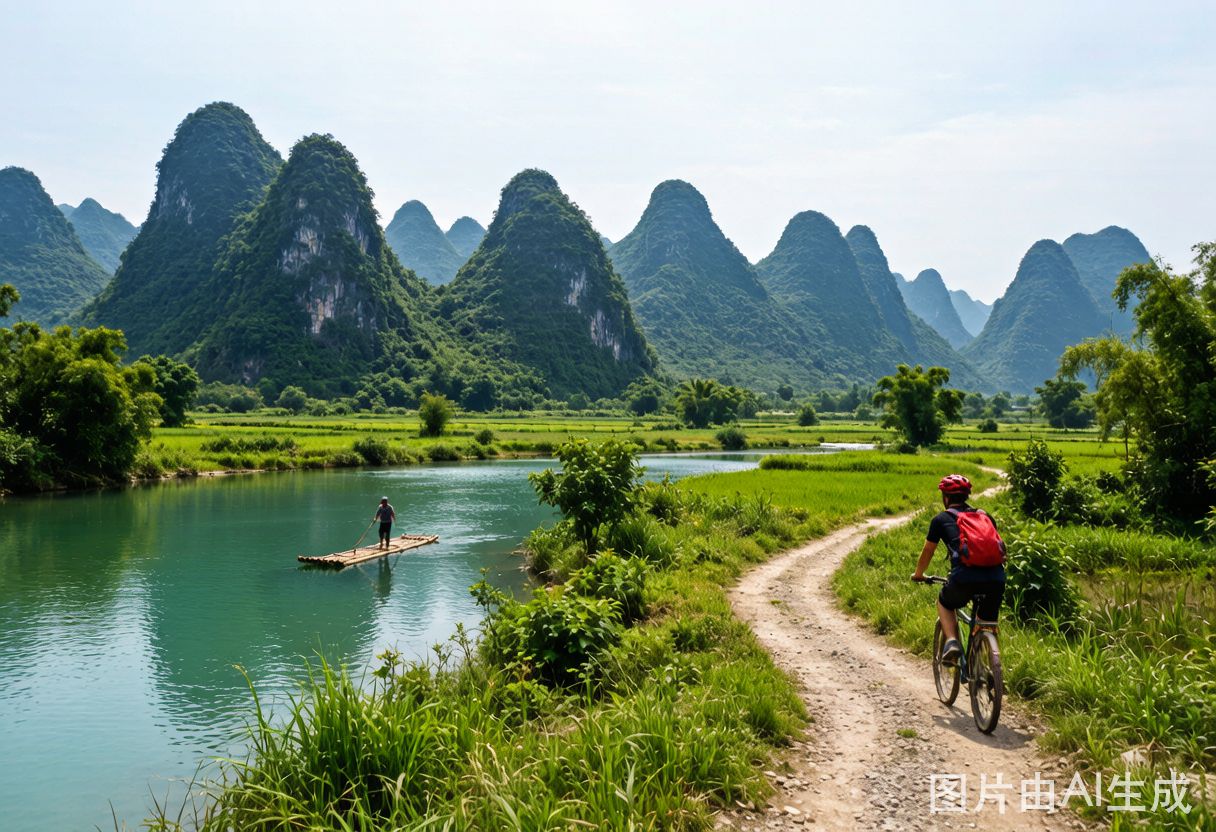
If you only do one water activity, make it the Yulong River, not the main Li River. The Yulong is a tributary — narrower, quieter, and lined with bamboo and old stone bridges. The bamboo raft is the traditional kind: a real wooden raft poled by a boatman, usually for two people, no motor. You drift under arched bridges and between vertical green hills while cormorants dive nearby. It’s intimate in a way the big cruise ships can’t touch.
There are several boarding points; I like the stretch from Jinlong Bridge to Jiuxian, about 90 minutes of pure calm. Price is around ¥200–¥300 per raft depending on the section, and children under 1 meter typically aren’t allowed for safety. Go early — by 10 a.m. the popular sections get busy and the light gets harsh.
The main Li River is broader and better for the big panoramic “Guilin scenery” shots, especially the stretch near Xingping. So my rule of thumb: Li River for the epic vista, Yulong for the peaceful float. Both are worth it if your schedule allows.
Xingping Old Town & the 20-Yuan Viewpoint
Xingping is the highlight of the southern ride, and it’s where China’s old ¥20 banknote was photographed. The 20-yuan note viewpoint is a real spot — walk to the river bend near Xingping and you’ll see the exact composition: a cluster of rounded peaks, a fisherman’s bamboo raft, and often a cormorant perched on the bow for the tourists. Local boatmen will offer to pose with a bird for a small tip; I paid ¥20 and got the shot in five minutes.
The old town itself is small, half-abandoned in places, and far more authentic than Yangshuo’s West Street. I spent an afternoon just wandering the Ming-era lanes, drinking sweet osmanthus tea, and watching the light move across the hills. There’s a low-key guesthouse scene here too if you’d rather stay overnight and catch the sunrise over the river without the crowds.
A practical note: if you arrive by train at Yangshuo Station (in Xingping), you’re already here — just grab a local bus or taxi the few kilometers into the old town rather than backtracking to Yangshuo town first.
Rural Villages & Everyday Life
What keeps me in the countryside isn’t any single sight — it’s the texture of daily life. On the back roads you’ll pass water buffalo knee-deep in paddies, women hanging laundry on bamboo poles, and whole families sorting mandarin oranges in autumn (Yangshuo’s oranges are excellent; buy a kilo from a roadside stand for ¥4).
A few villages worth a deliberate stop:
– Jiuxian: a quiet riverside hamlet with an old city gate and surprisingly good cafés.
– Chaolong Village: near Yulong, known for its cooking schools and homestays.
– Fuli: a riverside town famous for painted fans; you can watch artisans hand-paint them.
Don’t be shy about waving hello — rural Guangxi is friendly, and a smile goes a long way even if you share no language. I’ve been invited for tea more than once just by stopping to look interested.
Cooking Classes in the Countryside
This is one of my favorite things to do in Yangshuo, and it beats another bar on West Street every time. Several family-run schools near Yulong and in Chaolong Village offer half-day classes where you shop at the morning market, then cook 3–4 Guangxi dishes — think beer fish (pisun), stuffed tofu, and stir-fried greens with garlic. Expect to pay ¥120–¥200 including the meal you cook.
I took a class in Chaolong where the host’s grandmother showed me how to fold a dumpling properly, and we ate on a rooftop with the karst peaks as a backdrop. You’ll leave full and with recipes you can actually recreate at home. Book through your guesthouse or directly at the school; classes usually start around 9 a.m. or 4 p.m. to dodge the heat.
Best Season to Visit
Yangshuo is a year-round destination, but timing changes the experience a lot. I’ve been in three seasons and here’s my honest take:
- April–June (spring/early summer): My favorite. Lush green terraces, rising river mist, and comfortable temps (20–28°C). It can drizzle, which actually makes the peaks more atmospheric. Bring a light rain jacket.
- September–November (autumn): Clear skies, harvest season, and the orange stands are open. Great for biking. This is also peak-ish tourism, so book ahead.
- July–August: Hot (often 35°C+), humid, and busy with domestic summer tourists. Doable if you ride early and raft midday, but I’d avoid it if you can.
- December–February: Cool and quiet, occasional fog. Cheapest hotels, fewest crowds — good for photographers who love moody mist, less so for swimmers.
For a regional overview on timing, my best time to visit China piece covers the climate across provinces.
Practical Tips Before You Go
- Cash vs card: Small village stalls and raft boatmen often prefer cash (¥). I keep ¥200 in small bills for exactly this.
- Stay options: Sleep in Yangshuo town for nightlife and convenience, or in a Yulong riverside homestay for silence and stars. I split my trip — two nights each — and it was the right call.
- Get lost on purpose: The best moments came from turning down a random lane. Download an offline map first.
- Respect the farmland: Don’t walk through paddies for a photo; use the paths. Locals tolerate tourists but appreciate courtesy.
Yangshuo’s countryside isn’t a checklist of sights — it’s a pace. Slow down, rent the bike, float the river, and let the hills do the rest. After a dozen visits, it’s still the place in China where I feel most like I’ve properly exhaled.
For official park, rafting, and conservation information on the Li River and Yulong River scenic areas, the Guilin Tourism Bureau publishes seasonal notices and ticketing updates in English.