

Somewhere around the third hour of a long ride, the trolley comes rattling down the aisle and you have to make a decision you did not prepare for. Food on Chinese trains is a genuine sub-culture: hot boxed lunches wheeled past every ninety minutes, an app that delivers a bowl of Lanzhou beef noodles to your seat number at a station you will occupy for four minutes, dining cars with white tablecloths on overnight sleepers, and the sound of a hundred instant noodle lids being peeled back at once. None of it is signposted in English, which is why most visitors end up eating nothing but a bag of crisps across six provinces. Here is how to do better.
The Four Ways to Eat on a Chinese Train
Before the details, the landscape. On any medium- or long-distance service you have four options: the trolley that circulates through the carriage, a meal pre-ordered through the railway app and handed to you at an intermediate station, the dining car (on sleepers and some long high-speed routes), and whatever you carried on board yourself. Most experienced travellers use a combination — app-ordered noodles for the main meal, station snacks for the gaps.
Which options exist depends on your train type. The G-series high-speed trains have a small hot-food counter and app delivery; the older green-skinned K and T trains have a proper dining carriage and a much livelier trolley. Our guide to Chinese train types explains the letter codes, and the high-speed rail guide for foreign travellers covers boarding, luggage and seat classes.
The Trolley and the Boxed Meal
The standard offering on a high-speed train is the boxed lunch (盒饭, hé fàn) — a sealed tray with rice on one side and two or three braised dishes on the other, heated in an onboard oven and handed over steaming. Typical fillings are braised pork with potato, sweet-and-sour chicken, scrambled egg with tomato, and a green vegetable. It is honest canteen food: soft, slightly over-sauced, salty, and much better hot than lukewarm.
Prices are regulated in tiers. The basic box is ¥15 (about US$2) and by law must be available on every service, though staff sometimes claim it has sold out; ask for the shíwǔ yuán de (十五元的, “the fifteen-yuan one”) and it usually reappears. Mid-range boxes run ¥30–45 (US$4–6) and the premium ones with a bigger protein portion reach ¥60 (US$8.50).
The trolley also carries fruit cups, sausage sticks, dried tofu, roasted chicken legs, canned coffee, beer and the ubiquitous packet of chicken feet. Payment is by mobile wallet almost everywhere, though staff on long-distance trains still accept cash.
Ordering Food to Your Seat with 12306
This is the trick that changes long journeys, and almost no visitor uses it. Through the official 12306 railway app, run by China Railway, you can order food to be delivered to your exact seat — either from the onboard kitchen or, more interestingly, from a restaurant at an upcoming station. The staff collect it during the brief stop and walk it to you.
The mechanics: log into 12306 with the same account that holds your ticket, open the “order meal” section, select your train and seat, and browse by station. You will see chain restaurants and local specialities — Lanzhou hand-pulled beef noodles (兰州拉面, lánzhōu lāmiàn) at Lanzhou West, roast duck sets at Beijing South, Yangzhou fried rice heading east. Orders usually close two hours before the relevant station, and you pay in the app.
Realistically, this works best if you have a Chinese phone number and a linked mobile wallet, which most travellers now do; the account setup is the same one described in our 12306 booking walkthrough. The English interface has improved considerably but the restaurant menus are frequently Chinese-only, so a translation app pointed at the screen helps. Expect ¥35–80 (US$5–11) per meal, delivered hot, and considerably better than the trolley.
The Dining Car: Worth Finding on Overnight Trains
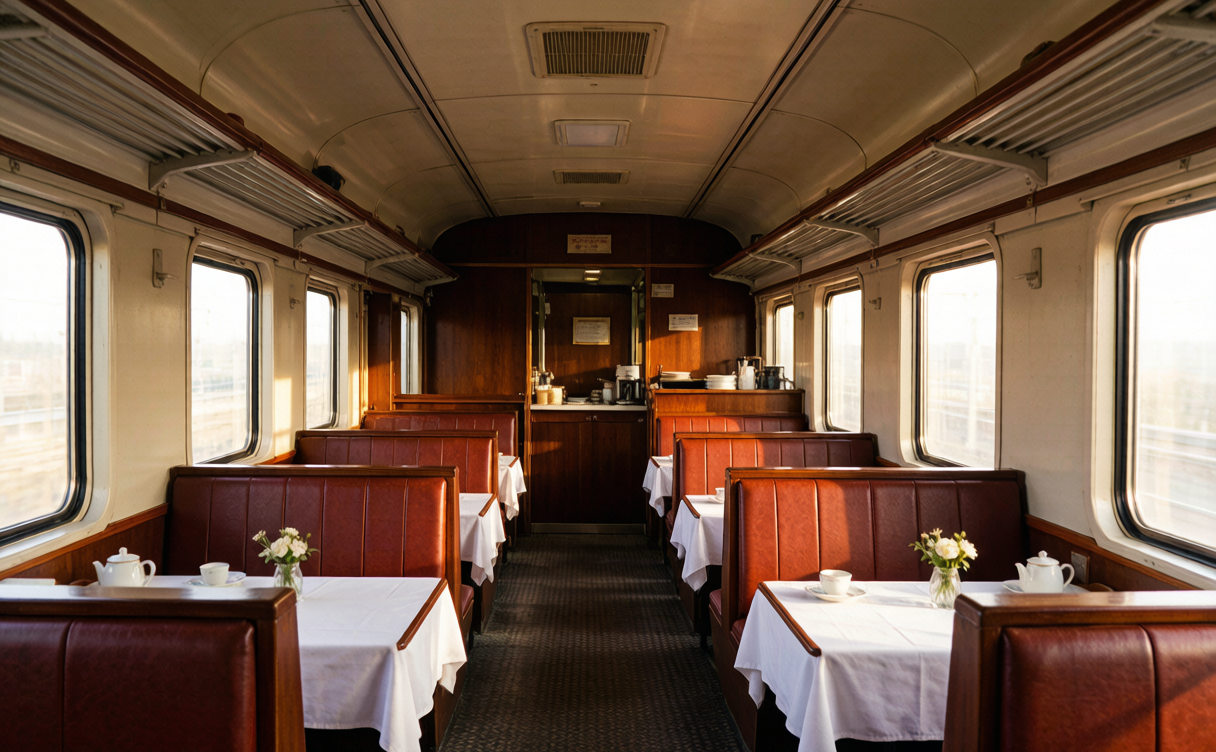
On the slower overnight services — the K, T and Z trains that still cross the country in eighteen or thirty hours — there is a real dining carriage, usually in the middle of the train between hard sleeper and soft sleeper. It has fixed booths, a kitchen with woks, and a menu of stir-fries cooked to order.
Dishes run ¥30–70 (US$4–10): shredded pork with green pepper (青椒肉丝, qīngjiāo ròusī), scrambled egg with tomato (西红柿炒蛋, xīhóngshì chǎodàn), braised eggplant (红烧茄子, hóngshāo qiézi), a whole steamed fish on the better trains. Rice is a couple of yuan. Beer is cold and cheap. Service runs in sittings around 11:30 and 17:30, and between meal times the car becomes a de facto lounge where you can nurse a beer and watch Gansu go past — the single best thing about long-distance Chinese rail travel.
Two notes. The kitchen genuinely does close, often by 20:00, so a late dinner is not guaranteed. And on some crowded routes the dining car is partly used to seat standing-ticket passengers, in which case you may be asked to order something to keep the table.
Instant Noodles and the Boiling Water Tap
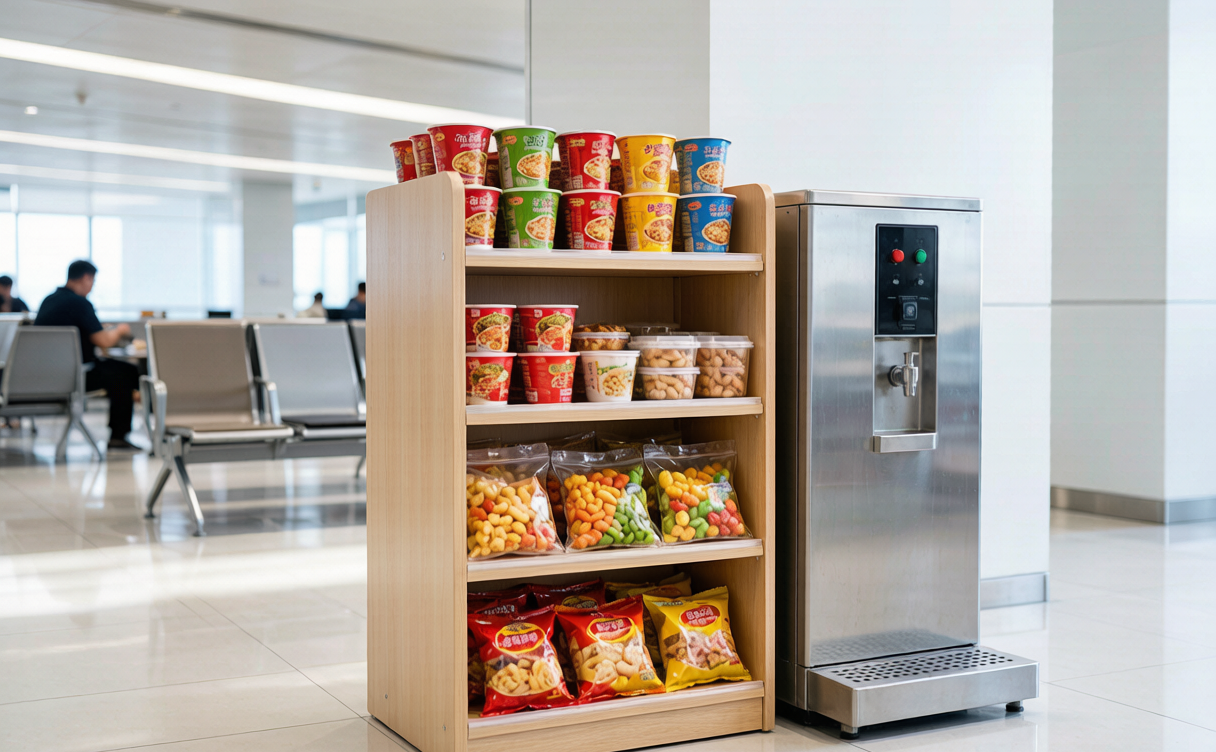
Every carriage on every Chinese train has a boiling water dispenser (开水, kāishuǐ) at the end of the aisle, free and running all day. This is why instant noodles are the national train food. Buy a cup at the station convenience store for ¥5–12 (US$0.70–1.70), peel the lid, fill to the line, wait three minutes.
The good brands are worth knowing: Master Kong (康师傅) braised beef is the default, Uni-President (统一) old-Beijing beef is richer, and the fat-noodle “artisan” cups at ¥12–18 are a real step up. If you cannot handle chilli, avoid anything with 麻辣 (málà) or a red flame on the packaging — the mild ones are usually 红烧牛肉 (hóngshāo niúròu, braised beef) or 鲜虾鱼板 (shrimp and fish cake).
Bring your own cup or thermos and you also get free tea all journey. Most Chinese passengers carry a lidded flask and refill it three or four times; it is the cheapest comfort on board.
What to Buy Before You Board
Station food halls have improved enormously, and the big hubs now carry regional specialities that make better sense than a sad sandwich. Look for baozi (包子, steamed buns) at ¥3–6 each, shāobǐng (烧饼, sesame flatbreads), vacuum-packed braised duck neck, mandarin oranges by the bag, and cold sweet soy milk. The layout of the big stations, including where the food concessions sit relative to security, is covered in our China railway stations guide.
A sensible carry-on kit: a lidded cup, a packet of tissues (some train toilets run out), wet wipes, one instant noodle cup, some fruit, and a bar of chocolate for the hour when everything has shut. If you are counting costs across the trip, our budget eating guide puts train food in context, and the Chinese breakfast guide is useful for early departures.
| Option | Price | Hot? | Availability |
|—|—|—|—|
| Basic boxed meal | ¥15 (US$2) | Yes | All trains, by regulation |
| Standard boxed meal | ¥30–45 (US$4–6) | Yes | Most trains, trolley |
| App-ordered station meal | ¥35–80 (US$5–11) | Yes | G/D trains, book 2h ahead |
| Dining car stir-fry | ¥30–70 (US$4–10) | Yes | Sleeper and older trains |
| Instant noodles | ¥5–18 (US$0.70–2.50) | Yes, free hot water | Everywhere |
Vegetarian, Halal and Other Dietary Needs
This is the honest weak point. Fully vegetarian options on trains are limited: the boxed meals almost always contain meat, and even the vegetable dish may be cooked with pork fat or oyster sauce. Your reliable choices are plain rice with a vegetable stir-fry ordered in the dining car, vegetarian instant noodles, packaged dried tofu, corn on the cob from the trolley, bread and fruit. The phrase to memorise is 我不吃肉 (wǒ bù chī ròu, “I don’t eat meat”), and it helps to add 也不吃鸡蛋 if eggs are out too.
Halal meals do exist. Many long-distance routes through the northwest carry clearly marked qīngzhēn (清真) boxed meals, and Lanzhou beef noodle outlets in the app are halal-certified. Ask the attendant for qīngzhēn cān. Gluten-free is essentially unsupported — plan to self-cater.
Manners, Smells and the Unwritten Rules
Eating on Chinese trains is a communal, cheerfully noisy activity, and nobody will judge you for slurping. A few local conventions do apply. Durian and strongly fermented foods are banned or heavily frowned upon. Alcohol is permitted on most services in moderation, though behaviour is monitored. Rubbish goes into the attendant’s bag when they sweep through, not on the floor or the seat pocket. Feet stay off the table, and on sleepers you eat on the small fold-down table rather than the bunk.
The last unwritten rule is the most pleasant one: if you are sharing a sleeper compartment and someone offers you a mandarin, a handful of sunflower seeds or a slice of their cured sausage, take it. Then offer something of your own on the next round. Half the good conversations on Chinese railways start with food changing hands across a fold-down table somewhere in the dark between two provinces.