

You will smell it before you see it. Somewhere down a side street in Liuzhou, a warm, sour, faintly barnyard aroma drifts out of a shopfront and stops you mid-step. That is luosifen snail noodles — the most divisive bowl in Chinese cooking, a dish that has turned a mid-sized industrial city in Guangxi into a food pilgrimage site and spawned a packaged-noodle industry worth billions of yuan a year. Locals eat it for breakfast. Visitors either flee or become evangelists. There is very little middle ground, and this guide is written to get you safely onto the right side of it.
What Luosifen Actually Is
Luosifen (螺蛳粉, luósīfěn) means “river snail rice noodles”. The name is honest about the broth and misleading about the bowl, because there are usually no snails in what you are served.
The base is a stock simmered for hours from small freshwater river snails, pork bones, and a battery of aromatics — star anise, cassia, fennel, white pepper, dried chilli, tangerine peel. The snails give it depth and a mineral, almost oceanic savouriness, then they are strained out. Into that broth go round rice noodles (米粉, mǐfěn), thick and springy and slightly chewy, quite unlike the flat noodles of neighbouring provinces. On top comes the crucial cast of toppings: sour bamboo shoots, wood-ear fungus, dried tofu skin, fried peanuts, blanched green beans or lettuce, pickled long beans, and a slick of red chilli oil.
The dish is barely sixty years old — it emerged from Liuzhou’s late-night worker canteens in the 1970s and 1980s — but it is now recognised on the national intangible cultural heritage list administered by China’s Ministry of Culture and Tourism, and it has done more for the city’s profile than anything else. If you are building a wider picture of regional Chinese cooking, our eight great cuisines overview shows where Guangxi’s sour-and-spicy palate sits relative to Sichuan and Cantonese.
The Smell: Let’s Deal With It Now
The famous stink is not the snails and not the broth. It is suān sǔn (酸笋), sour bamboo shoots — young bamboo fermented in brine for weeks until it goes soft, translucent and pungent in a way that reads to unfamiliar noses as drains, old socks or ripe cheese.
Two things are worth knowing. First, the aroma and the flavour are almost completely decoupled. What smells aggressive tastes bright, sour and crunchy, functioning in the bowl the way sauerkraut does in a sandwich — a sharp counterweight to fat and chilli. Second, the intensity is adjustable. You can ask for fewer bamboo shoots or none at all, and the bowl still works.
My advice is to order a normal bowl, breathe through your mouth for the first thirty seconds, and eat three mouthfuls before deciding. Almost everyone who bails out does so on smell alone, before tasting anything.
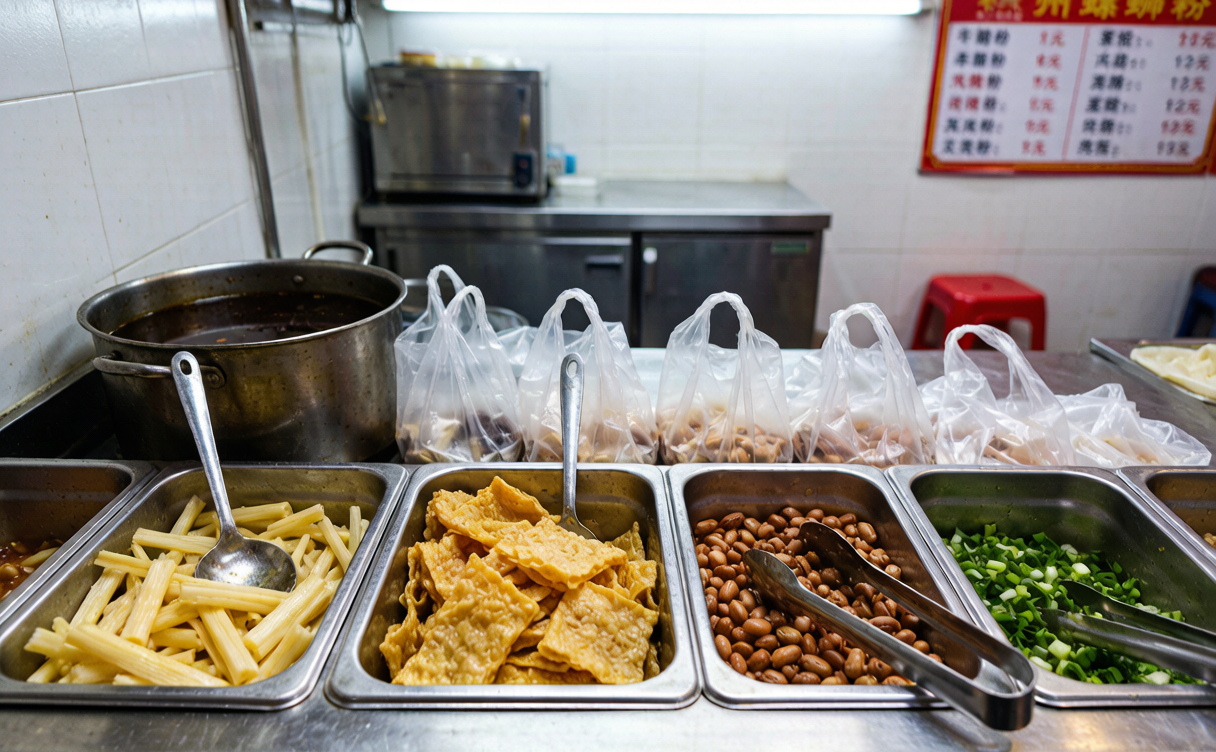
Anatomy of a Bowl
| Component | Chinese | What it does |
|—|—|—|
| River snail broth | 螺蛳汤 | Deep savoury base, faintly sweet |
| Round rice noodles | 米粉 | Springy, chewy, holds the soup |
| Sour bamboo shoots | 酸笋 | The smell; sharp sour crunch |
| Wood-ear fungus | 木耳 | Slippery, cool texture contrast |
| Fried tofu skin | 腐竹 | Absorbs broth, goes custardy |
| Fried peanuts | 花生 | Crunch and richness |
| Pickled long beans | 酸豆角 | Second layer of sourness |
| Chilli oil | 辣椒油 | Heat and colour |
Standard add-ons, each ¥3–8 (US$0.40–1.10), include a marinated egg (卤蛋, lǔdàn), duck feet (鸭脚, yājiǎo), pork crackling (猪脚 or 腐竹卷), quail eggs and extra tofu skin. Regulars almost always add at least one.
How to Order, and What It Costs
Most shops in Liuzhou work the same way: you pay at the counter first, tell them the size and the spice level, take a numbered ticket, and collect your bowl when the number is called.
The phrases that matter:
- 一碗螺蛳粉 (yī wǎn luósīfěn) — one bowl of luosifen
- 微辣 (wēi là) — mildly spicy
- 不辣 (bú là) — not spicy
- 中辣 (zhōng là) — medium
- 变态辣 (biàntài là) — “abnormal” spicy, do not
- 少酸笋 (shǎo suān sǔn) — fewer sour bamboo shoots
- 加卤蛋 (jiā lǔdàn) — add a braised egg
- 打包 (dǎbāo) — takeaway
A useful note on heat: “not spicy” in Liuzhou still arrives with a red sheen, because the chilli oil is part of the base. If you are genuinely chilli-averse, say 不辣 and ask them to serve the oil on the side — 辣椒油另外放 (làjiāo yóu lìngwài fàng). Conversely, 中辣 in Guangxi is roughly what a Sichuan shop would call mild.
On price: a standard bowl in Liuzhou runs ¥12–18 (about US$1.70–2.50), a large bowl with add-ons ¥22–30 (US$3–4.20), and a chain outlet in Shanghai or Beijing ¥28–45 (US$4–6.30) for something noticeably tamer. Payment is by mobile wallet in nearly every shop; almost none accept foreign cards, so set up Alipay or WeChat Pay before you go looking.
Where to Eat It in Liuzhou
Liuzhou is a river city wrapped in a loop of the Liu River, and the noodle shops cluster in a few identifiable zones.
Qingyun Street and the Qingyun food market (青云菜市) is the classic destination — a dense block of stalls where the sour bamboo is fermented on site and the turnover is fast enough that everything tastes fresh. Go before 10am for the breakfast rush.
Gupai Road and the Wuyi area hold several of the long-running shops that locals name when pressed, most of them small, tiled, fluorescent-lit rooms with plastic stools. Yifen Street near the city centre is the convenient option if you are staying downtown.
For the evening version, the riverside night markets add grilled skewers and duck neck to the equation; our China night markets guide covers how these operate. For everything else in the city — the karst hills, the industrial museums, the river lights — see the Liuzhou travel guide.
Choose shops by the crowd, not the decor. A queue of construction workers and office staff at 8am is a better signal than an English menu.
Beyond Liuzhou: Where Else to Find It
Luosifen has gone national. You can eat a decent bowl in almost any large Chinese city now, though the versions sold outside Guangxi are usually milder and less sour, having been calibrated for a broader audience.
Nanning, the provincial capital two hours away by high-speed rail, has plenty of good shops alongside its own signature old-friend noodles; the Nanning travel guide has the details. Guilin sells luosifen too, but the local pride there is a different and much gentler dish — see our Guilin rice noodle guide for the distinction, which locals take seriously. Anyone doing the karst landscape circuit will pass through anyway, and the Guilin and Yangshuo guide covers how to slot Liuzhou into that route by train.
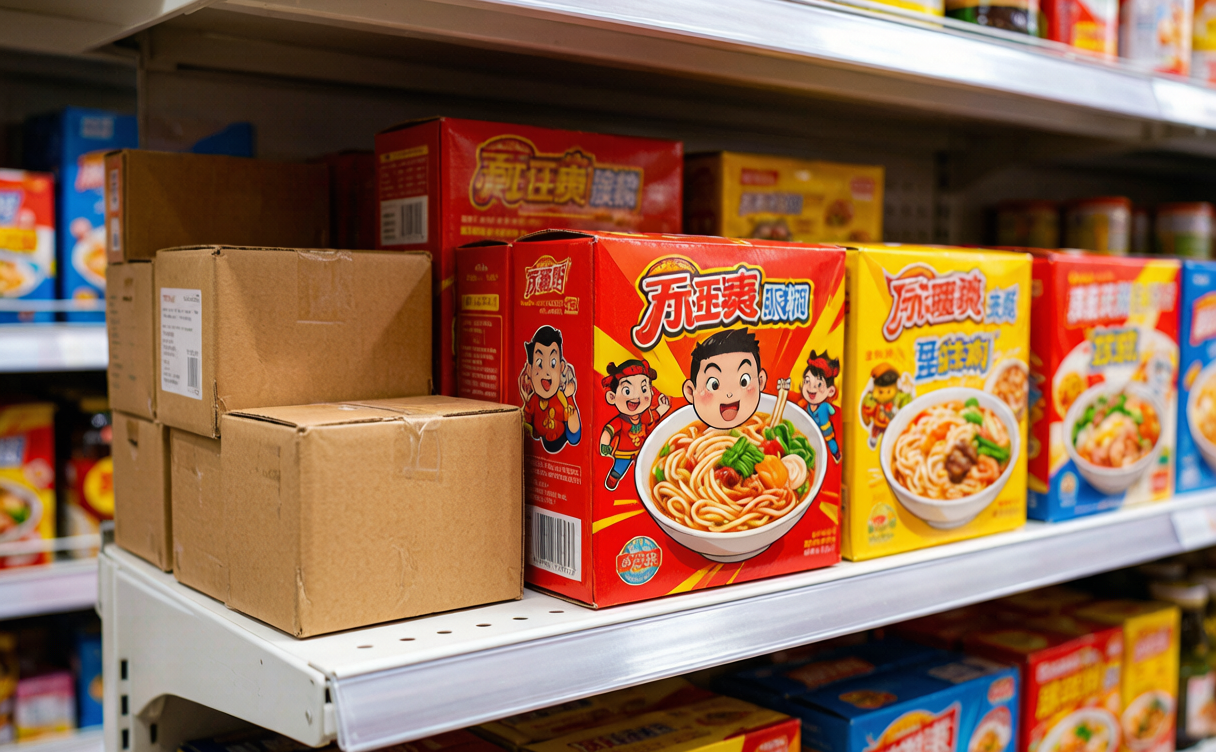
Then there is the packet. Instant luosifen boxes — a brick of dried rice noodles plus six or seven sachets of broth concentrate, bamboo shoots, peanuts and chilli oil — are stacked in every supermarket in the country at ¥8–15 (US$1.10–2.10) each. They are surprisingly faithful, they make a fantastic souvenir, and they will absolutely perfume your luggage. Double-bag them, and check your home country’s import rules on meat-derived products before packing a suitcase full.
Vegetarian Versions and Dietary Realities
A true vegetarian luosifen is difficult, because the broth is built on snails and pork bones. However, a growing number of shops make a 素螺蛳粉 (sù luósīfěn), a mushroom-and-soy-based broth that keeps the sour bamboo and the chilli, and several instant brands now sell vegetarian sachets. Ask 有没有素的? (yǒu méiyǒu sù de? — “do you have a vegetarian one?”).
If you avoid shellfish, be direct: the broth itself is the issue, not just visible ingredients. Peanut allergy sufferers should be very careful indeed — fried peanuts are standard and cross-contamination in a small shop is likely. The phrase is 我对花生过敏 (wǒ duì huāshēng guòmǐn), but with a serious allergy, this is a dish to skip entirely.
Mistakes to Avoid, and the Verdict
The commonest error is ordering it as a shared dish. Luosifen is a single-serving bowl, eaten fast; the noodles go soft within ten minutes. Order one each and eat immediately.
The second is over-ordering heat. The chilli in Guangxi is fragrant rather than numbing, but the oil floats and concentrates as you get lower in the bowl, so the last third is always hotter than the first.
The third is worrying about hygiene in the wrong direction. The broth is boiled for hours and the noodles are cooked to order, so a busy shop is safe. Riskier are the cold pickled side dishes sitting at room temperature on the counter. Skip those on your first day while your stomach adjusts, drink bottled or boiled water, and carry tissues — the tiny shops rarely provide napkins. And do not eat it in a white shirt; the chilli oil splashes and stains permanently.
So is it worth it? Yes, provided you give it a fair hearing. The broth is genuinely complex, the texture play between springy noodles, crunchy peanuts and slippery fungus is superb, and at under two dollars a bowl it is one of the great value meals in China. Eating snail noodles on a plastic stool while a factory shift lets out is a truer picture of contemporary China than most things on a standard itinerary.