

At 6:40am on a Wuhan side street, a woman is holding a paper bowl of hot sesame noodles in one hand and steering a scooter with the other, eating as she rides. Nobody looks twice. Three blocks away a queue of thirty people has formed for a steamer of buns that will be gone by eight. This is the meal most visitors sleep through and then eat as a hotel buffet omelette, which is a genuine loss — Chinese breakfast is the most regionally varied, cheapest and most local meal of the day, and it is over by 9:30. This Chinese breakfast guide covers what to eat in which city, when the stalls open, what it costs, and how to order when there is no menu and no English.
Why Breakfast Is the Meal to Get Right
Dinner in China gets internationalised: hotel restaurants, tourist-strip menus, photo menus. Breakfast does not. The zaocan (早餐) trade runs on locals walking to work, so the stalls sit in residential lanes rather than tourist streets, close before the sightseeing crowd is awake, and charge ¥5–20 for something a chef in another country would call a technique demonstration. It is also the safest introduction to regional Chinese cooking, because almost everything is cooked to order in front of you.
The clock matters. Most street breakfast operates 05:30 to 09:00, with the best items selling out first. Wuhan and Guangzhou are the two exceptions where you can eat well until 10:30 or later.
Chinese Breakfast Guide: City by City
Beijing. Steamed buns (包子) and soy milk are the everyday standard, but the local badge of honour is douzhi (豆汁儿) — fermented mung bean liquor, sour, grey and genuinely difficult, served with a fried dough ring called jiaoquan (焦圈). Try it once at a Huguosi-style shop for ¥3. If it defeats you, chaogan (炒肝), a garlicky stew of pork liver and intestine thickened with starch, is a much easier win at ¥10.
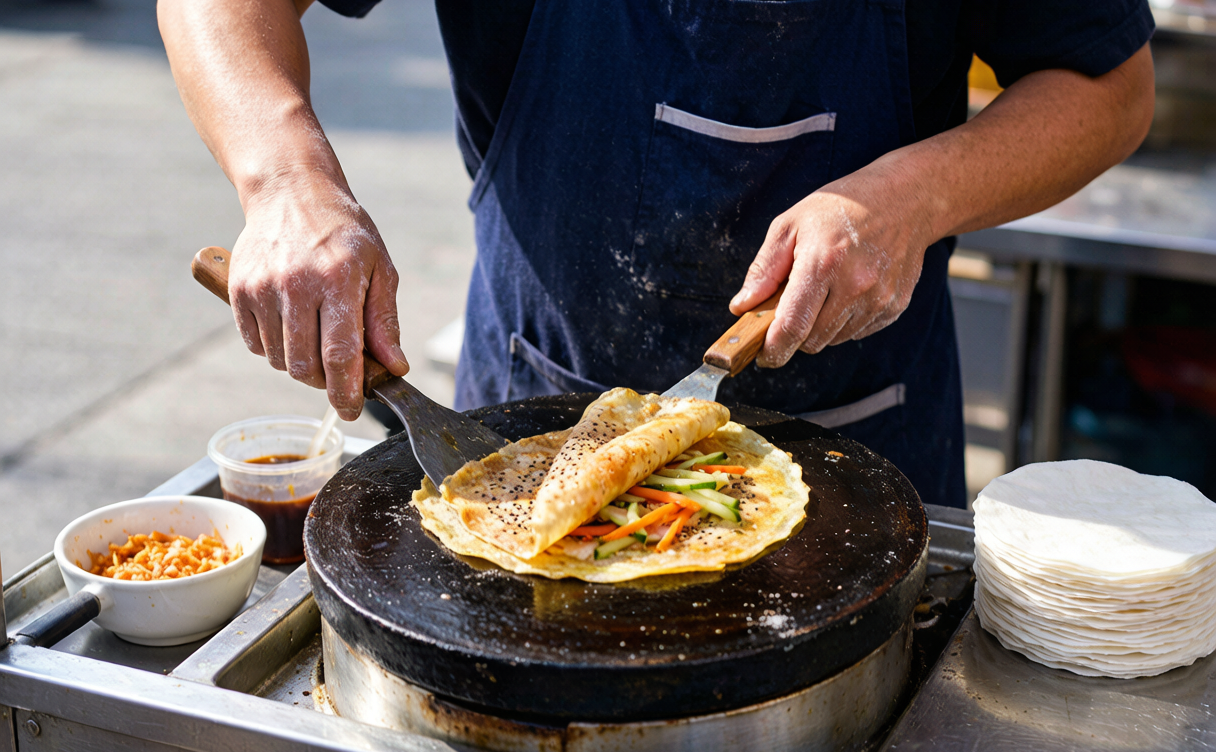
Tianjin. The home of proper jianbing guozi (煎饼馃子): mung bean batter spread on a hot plate, egg cracked on top, brushed with fermented bean sauce and chilli, then folded around a sheet of crisp fried cracker. Tianjin purists insist on the cracker (馃箅儿) rather than the fried dough stick, and on no lettuce, no sausage, no ham. ¥8–12.
Shanghai. The “four warriors” (四大金刚): dabing flatbread, youtiao fried dough sticks, cifantuan sticky rice rolled around a youtiao and pickles, and hot doujiang soy milk. Order the savoury soy milk (咸豆浆), curdled with vinegar, dried shrimp and scallion — it’s better than the sweet version and a Shanghai particularity. Add shengjian bao (生煎包), pan-fried pork buns, ¥8 for four.
Guangzhou. Breakfast is yum cha (早茶), and it is a two-hour institution: tea first, then shrimp dumplings (虾饺), char siu buns, rice-noodle rolls (肠粉), chicken feet, egg tarts. Old teahouses open at 06:30 and fill with retirees reading newspapers. ¥50–90 (US$7–13) a head.
Wuhan. The word here is guozao (过早), “passing the morning”, and the city takes it more seriously than anywhere else. Reganmian (热干面) — hot dry noodles with sesame paste, pickled radish and chilli oil, ¥6 — is the emblem. Also doupi (豆皮), a crisp egg-and-bean-skin pancake over glutinous rice, and mianwo, a savoury doughnut.
Xi’an. Roujiamo (肉夹馍), shredded braised pork in a griddled bun, ¥10, plus hulatang (胡辣汤), a peppery starch-thickened soup, or silky doufunao tofu pudding.
Chengdu. Sweet-spicy noodles (甜水面), fat-intestine rice noodles (肥肠粉) for the brave, and danhonggao (蛋烘糕), small custardy pancakes folded around fillings, ¥3 each.
Lanzhou. Beef noodle soup for breakfast is normal here, and the good shops open at 06:00 and stop pulling noodles by 14:00. ¥12–18 for a bowl.
Nanjing, Changsha, Guilin, Kunming. Duck blood and vermicelli soup; rice noodles with pickles; Guilin mifen with fried peanuts and sour beans; crossing-the-bridge rice noodles in Yunnan. All under ¥20.
Where to Find It
| City | Signature breakfast | Where to look | Price | Hours |
|—|—|—|—|—|
| Beijing | Douzhi, jiaoquan, chaogan, baozi | Huguosi St, Nanluoguxiang lanes | ¥5–20 (US$1–3) | 06:00–09:30 |
| Tianjin | Jianbing guozi | Nanshi food street, residential lanes | ¥8–14 (US$1–2) | 05:30–09:00 |
| Shanghai | Four warriors, shengjian bao | Huanghe Rd, Tianzifang back lanes | ¥8–25 (US$1–4) | 06:00–09:30 |
| Guangzhou | Yum cha dim sum | Liwan district teahouses | ¥50–90 (US$7–13) | 06:30–11:00 |
| Wuhan | Reganmian, doupi | Hubu Alley (户部巷), Jiqing St | ¥6–18 (US$1–3) | 05:30–10:30 |
| Xi’an | Roujiamo, hulatang | Muslim Quarter, Sajinqiao | ¥8–20 (US$1–3) | 06:00–10:00 |
| Chengdu | Danhonggao, fat-intestine noodles | Yulin, Kuanzhai side streets | ¥5–18 (US$1–3) | 07:00–10:00 |
| Lanzhou | Beef noodle soup | Anytown shop with a queue | ¥12–18 (US$2–3) | 06:00–14:00 |
Hubu Alley in Wuhan is touristy but still good; the better rule anywhere is to walk two streets away from the sight you came to see and join the longest queue of people in work clothes.
What to Order
If you remember five things, make it these.
- Jianbing (煎饼) — ¥8–12. The best portable breakfast in the world. Say 不要香菜 (bú yào xiāngcài) if you dislike coriander, and 微辣 (wēi là) for mild.
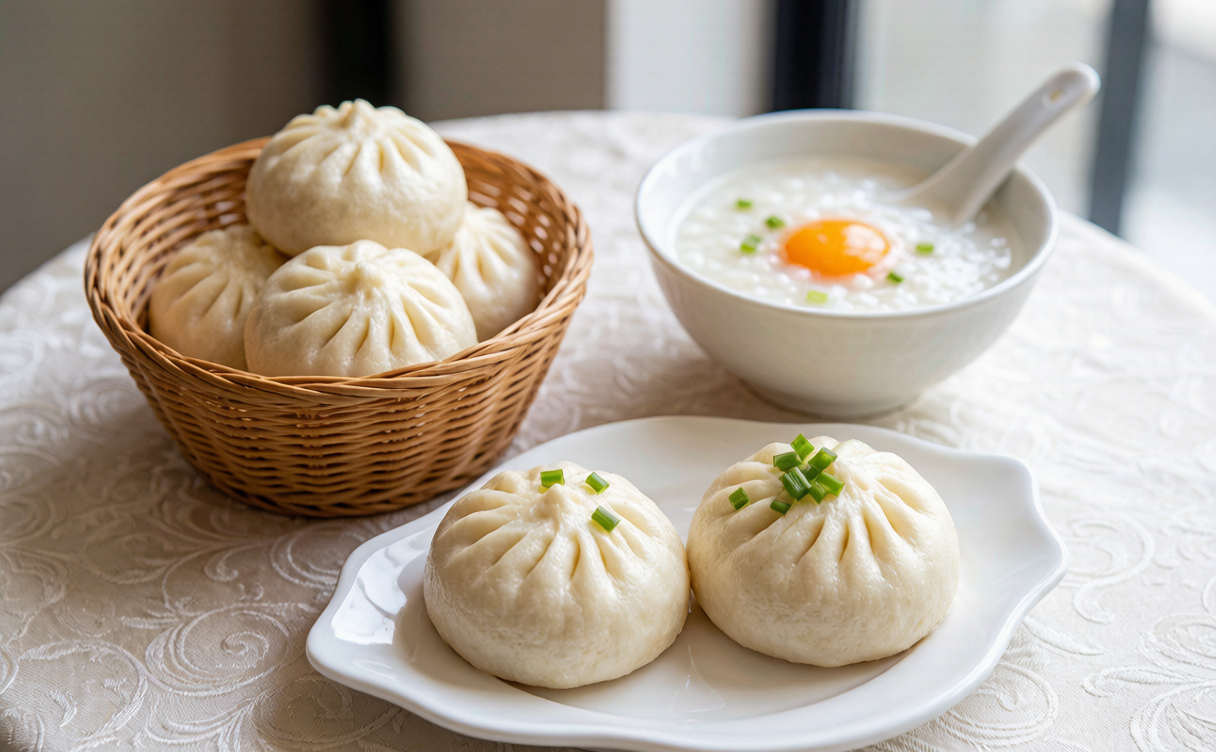
- Congee (粥, zhōu) — rice porridge, plain at ¥3 or loaded with preserved egg and pork (皮蛋瘦肉粥) at ¥12. The default settling food.
- Baozi (包子) — steamed buns, ¥2–3 each: pork and scallion, beef and onion, or vegetarian with mushroom and glass noodle (素馅).
- Youtiao and doujiang (油条 + 豆浆) — fried dough stick dunked in soy milk, ¥6 the pair. Ask sweet (甜) or savoury (咸).
- Shengjian or xiaolong bao — pan-fried or soup-filled dumplings, ¥8–20. Bite the top, sip, then eat; the soup inside is scalding.
Regional wildcards worth chasing: Wuhan’s reganmian, Tianjin’s jianbing guozi, Guangzhou’s rice-noodle rolls, Xi’an’s hulatang, and Yunnan’s rice noodles. Drinks are soy milk, rice congee water, thin millet porridge or, in Wuhan, danjiu (蛋酒) — sweet fermented rice wine with egg.
Sample Itinerary: A Wuhan Breakfast Crawl
Wuhan is the best city in China to do this, because “passing the morning” is a civic sport and everything is within a metro ride.
06:30 — Hubu Alley. Start with a bowl of reganmian standing up, ¥6. Do not sit; nobody sits.
07:00 — same alley. A portion of doupi, ¥10, cut from a wok the size of a bicycle wheel.
07:40 — walk to the river. Cross toward Tanhualin on foot, twenty minutes, to burn off some sesame paste.
08:15 — Tanhualin lanes. Mianwo doughnut and a cup of danjiu, ¥8 total.
09:00 — a proper sit-down. Beef noodle soup or a bowl of sanxian doupi, if you still can.
09:45 — metro Line 2 to Jiqing Street for one last bag of buns to take away.
Total spend: about ¥45 (US$6). You will not need lunch.
Best Time to Visit
Breakfast is seasonal in small ways worth knowing. Spring and autumn (April–May, September–October) are the pleasant months for eating outdoors on a plastic stool at 7am, with mornings around 14–22°C. Winter is arguably the better food season: hot congee, soup noodles and steamed buns make far more sense at 2°C, and northern cities add wheat-based warmers that vanish in summer. Summer mornings are the coolest hours of a brutal day in the Yangtze cities — 26–29°C at 7am versus 37°C at 3pm — so breakfast is when you should be outside anyway.
The one time to adjust is Chinese New Year, when family-run stalls shut for a week or more and whole breakfast streets go dark. Check the dates in our best time to visit China guide before booking a food-led trip.
Practical Tips
Cash still helps at the smallest carts, though QR payment works almost everywhere. There is rarely a menu in English; photograph what the person ahead of you gets and point. Nobody expects conversation at 6am — you queue, you say a number, you pay, you go. Sitting is optional and often unavailable. Hygiene is generally fine at busy stalls; the food is cooked hot to order. Vegetarians should learn 素 (sù), meaning meatless, and be aware that “vegetable” buns may contain pork fat. For deeper background on how these regional habits developed, the Encyclopaedia Britannica overview of Chinese cuisine is a solid primer.
FAQ
What time does breakfast start and finish in China?
Stalls open 05:30–06:30 and most are finished by 09:00–09:30. Guangzhou’s teahouses run to 11:00 and Wuhan to about 10:30. If you get up at nine, you have missed it.
How much does a Chinese breakfast cost?
¥5–20 (US$1–3) for street food in most cities. A full dim sum breakfast in Guangzhou is ¥50–90 (US$7–13) per person, which is the outlier.
Is street breakfast safe for foreign stomachs?
Yes, at busy stalls where everything is cooked in front of you. The things to approach carefully are unrefrigerated cold dishes, raw garnishes and, for anyone unused to it, the intestine and blood dishes — delicious, but not a day-one order.
What should a first-timer order?
Jianbing, a pork bun and hot soy milk. That combination exists in almost every city, costs under ¥15, and is a good baseline before you start on douzhi or fat-intestine noodles.
Are there vegetarian options?
Plenty: plain congee, vegetable buns, youtiao, soy milk, scallion pancakes, tofu pudding, rice-noodle rolls without filling. Confirm with 我吃素 (wǒ chī sù), and check that congee is not pork-stock based.
Is hotel breakfast worth it?
Rarely. Four-star buffets serve a flattened pan-Chinese spread plus bad croissants for what a week of street breakfasts costs. Book room-only and go outside.