

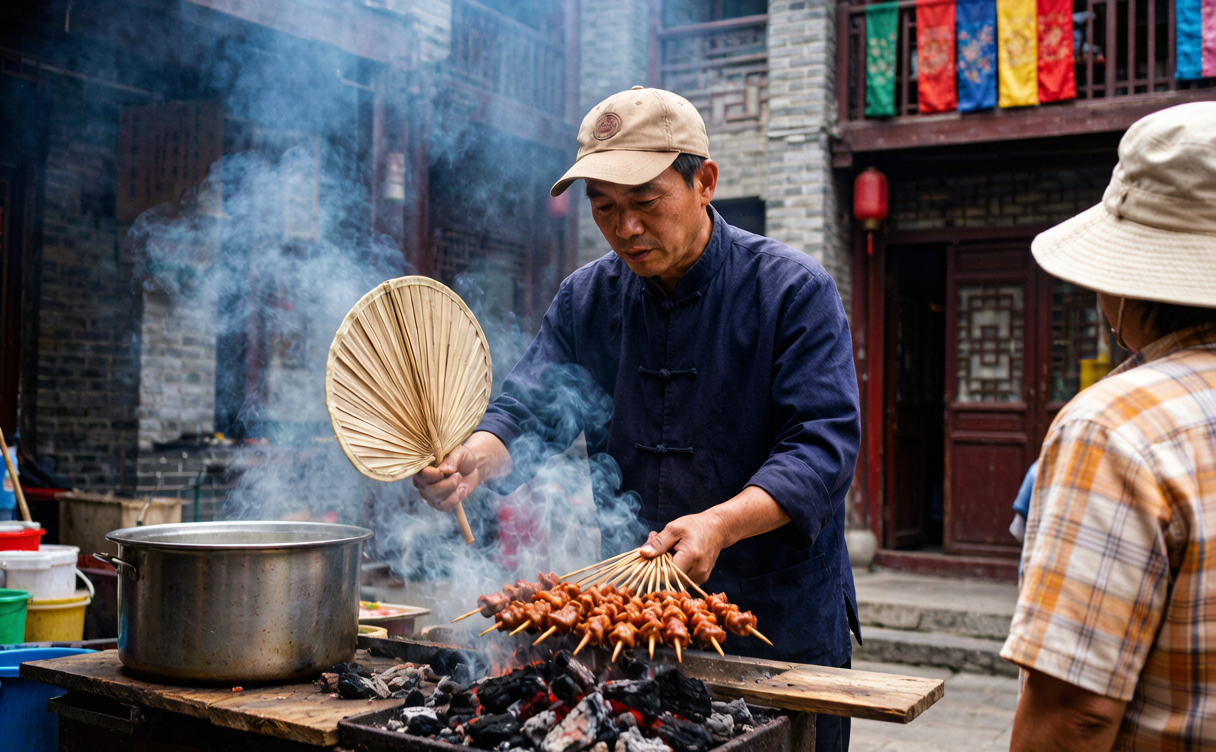
It starts around nine at night. A cart rolls out onto the pavement, someone tips a bag of charcoal into a long steel trough, and within twenty minutes the whole block smells of cumin and mutton fat hitting fire. Plastic stools appear. Beer arrives in crates, not bottles. By midnight there are forty people eating outdoors on a street that was a car park at dinnertime. This is shaokao (烧烤) — Chinese barbecue — and it is the most democratic food in the country, eaten by construction crews and venture capitalists at the same red table. This China BBQ skewers guide runs through the regional styles that actually differ from one another, what to order, what things cost, and how not to wreck your stomach on night one.
China BBQ Skewers Guide: The Regional Styles
Foreigners tend to assume all Chinese barbecue is lamb skewers with cumin. That is one style out of six or seven, and not even the dominant one.
Northeast China (Harbin, Shenyang, Changchun, Jinzhou). The heartland. Northeasterners grill everything: pork belly, chicken hearts, gizzards, whole garlic cloves, tofu skin, enoki mushroom bundles, quail eggs, wheat gluten. Jinzhou in Liaoning is the pilgrimage city — grilled clams, chicken wings and crucian carp over a narrow charcoal box, with a garlic-heavy dip. Portions are absurd and beer is compulsory. Winter grilling happens indoors, with the exhaust hood over your table.
Xinjiang, China style. Lamb, and specifically the fat-and-lean alternation on a flat iron skewer, seasoned with nothing but cumin (孜然, zīrán), chilli powder and salt. You find this everywhere in China, cooked by vendors from the northwest; the best versions are in Urumqi, Kashgar and the northwestern food streets of any big city. Order it with nang flatbread and a Wusu beer.
Zibo, Shandong. The style that went nationally viral in 2023 and is still going. Each table gets its own small charcoal grill, and the skewers arrive part-cooked for you to finish. The ritual is the point: pull the meat off with a thin pancake (小饼), add raw spring onion and sweet bean sauce, roll, eat. Locals call it the “holy trinity”. Roughly ¥60 (US$8) a head, absurd value.
Sichuan and Chongqing. Grilling meets numbing chilli. Skewers get a heavy dust of chilli, Sichuan pepper and MSG, and the range widens: grilled brain flower (烤脑花), aubergine split and buried in garlic, whole grilled fish. In Wanzhou and Chongqing, kaoyu (烤鱼) — a grilled fish finished in a tray of bubbling chilli oil at the table — is a two-hour meal in itself.
Coastal grilling (Qingdao, Dalian, Xiamen, Zhanjiang). Seafood over charcoal: oysters with minced garlic and glass noodles, scallops, squid, razor clams. Qingdao pairs it with draught beer sold in plastic bags. Zhanjiang in Guangdong grills oysters better than anywhere else in China, and I will argue about that.
Yunnan and Guizhou. Different again. Jianshui grilled tofu (建水烧豆腐) — small fermented tofu cubes puffing up on a wire rack while the cook counts your tally with corn kernels — plus grilled leeks, mint, whole tilapia in the Dai style around Xishuangbanna, and Guizhou’s sour-spicy dipping powders.
Best Time to Visit
Skewers are a warm-weather ritual. Late April to early October is the outdoor season nationwide, and the sweet spot is May–June and September, when evenings sit at 20–28°C and you can eat outside without sweating into your beer. July and August in Wuhan, Chongqing or Jinan mean 33–38°C at 9pm and a genuine endurance test — go later, around 22:00, when it drops a few degrees.
In the Northeast the season is shorter but the culture is stronger: Harbin’s outdoor grills run roughly June to September, then move indoors, where they are arguably better in January with the windows fogged and −20°C outside.
Zibo’s peak is May to October and weekends are chaotic — a Tuesday costs the same and saves you two hours of queueing. Plan around the wider seasons using our best time to visit China guide.
Where to Find It
| City | Where to go | Signature order | Per person | Hours |
|—|—|—|—|—|
| Jinzhou (Liaoning) | Linghe district street stalls | Grilled clams, chicken wings | ¥60–90 (US$8–13) | 17:00–02:00 |
| Harbin | Shifu Rd, Guogeli area | Pork belly, garlic, gluten | ¥70–110 (US$10–15) | 18:00–03:00 |
| Zibo (Shandong) | Bagualou market, Muzi area | Skewers + pancake + scallion | ¥50–70 (US$7–10) | 16:00–24:00 |
| Beijing | Ghost Street (簋街), Dongzhimen | Lamb chuanr, grilled leeks | ¥80–130 (US$11–18) | 18:00–04:00 |
| Xi’an | Muslim Quarter, Sajinqiao | Cumin lamb, grilled naan | ¥50–80 (US$7–11) | 17:00–01:00 |
| Chengdu / Chongqing | Yulin; Jiaochangkou | Brain flower, grilled fish | ¥70–120 (US$10–17) | 19:00–03:00 |
| Qingdao | Taidong night market | Oysters, squid, bag beer | ¥70–120 (US$10–17) | 17:00–01:00 |
| Kunming / Jianshui | Xiangyun St; Jianshui old town | Grilled tofu, leeks, mint | ¥40–70 (US$6–10) | 16:00–24:00 |
Note the hours. Almost nothing worth eating fires up before 17:00, and the good stalls hit their stride after 21:00.
What to Order
Skewers run ¥3–8 (US$0.40–1.10) each, seafood ¥8–25. Ordering is usually a paper tick-list or a plastic basket you fill yourself from the fridge. Six to ten skewers per person plus two or three non-skewer dishes is about right.
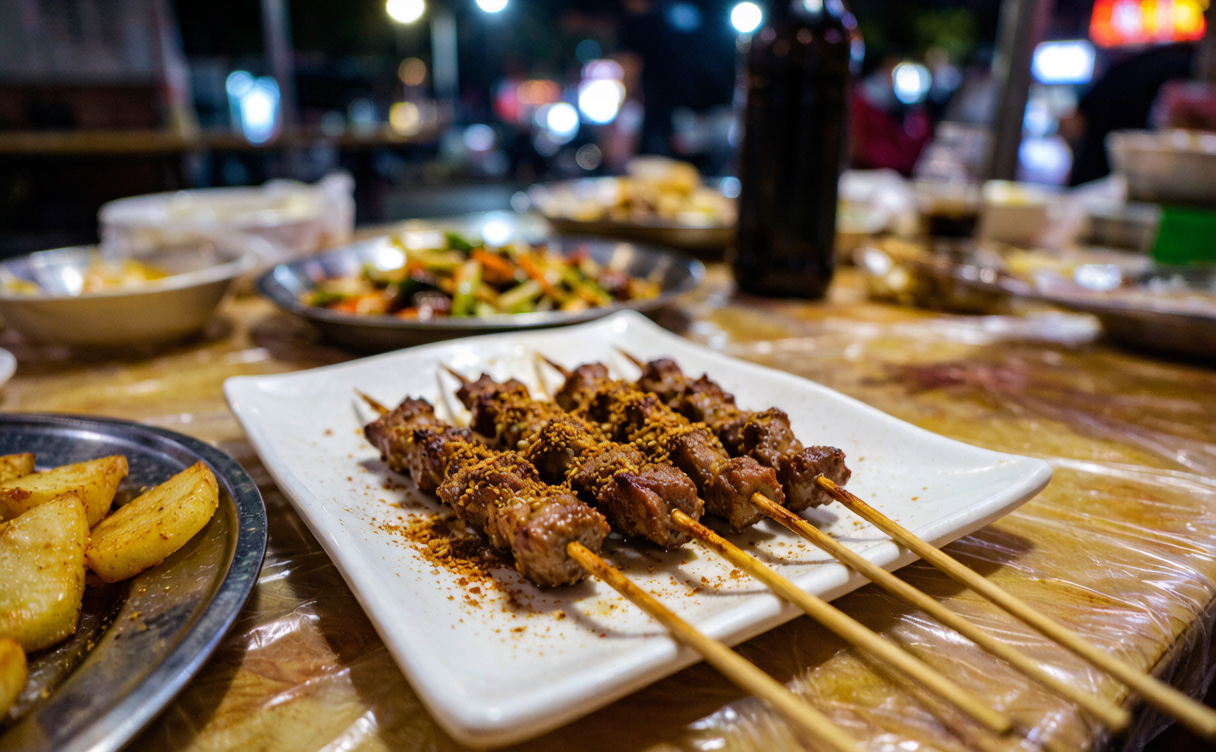
- 羊肉串 (yángròu chuàn) — lamb skewers. The baseline. Ask for 多辣 (duō là) for extra chilli.
- 羊肉筋 (yángròu jīn) — lamb tendon, chewy, better than it sounds.
- 烤五花肉 (kǎo wǔhuāròu) — pork belly, the Northeast staple.
- 烤生蚝 (kǎo shēngháo) — oysters with garlic and glass noodles, ¥10–18 each.
- 烤茄子 (kǎo qiézi) — a whole aubergine split open and loaded with garlic, chilli and coriander. The best vegetarian order on any grill.
- 烤韭菜 (kǎo jiǔcài) — grilled garlic chives, a bundle for ¥5.
- 烤面筋 (kǎo miànjīn) — wheat gluten, brushed with sweet-spicy sauce. Vegan and addictive.
- 烤馒头片 (kǎo mántou piàn) — grilled bread slices, the thing you order at 1am.
- 烤腰子 (kǎo yāozi) — kidney. Order it once so you can say you did.
Drink: local beer, always. Harbin, Tsingtao, Yanjing, Snow — ¥6–12 a bottle. In the northwest, Wusu (乌苏) at 4 percent and 620ml has taken down better people than you.
Sample Itinerary: One Night, Done Properly
19:30 — arrive hungry. Skip lunch-sized expectations; this is a three-hour meal.
19:45 — first round. Ten skewers between two people, one aubergine, one plate of grilled chives. Two beers. Watch what the next table ordered and copy it.
20:45 — second round. Now go strange: gluten, tofu skin, chicken hearts, and whatever the sign advertises that you cannot read. Ask by pointing.
21:45 — the carbs. Grilled bread, or a bowl of cold noodles (凉皮) to cut the fat. In Zibo this is where the pancake ritual starts; in Chongqing, order the fish now.
23:00 — walk it off. Every grill street has a fruit stall at the end selling watermelon by the slice for ¥5. That is the correct ending.
Budget ¥80–140 (US$11–20) a head including beer, which in most cities buys more food than two people can finish.
Practical Tips
Hygiene. Pick busy stalls with high turnover — a grill that sold out yesterday is a grill with fresh meat. Ask for everything well done (要熟一点), avoid raw garnishes if your stomach is unproven, and be careful with cold pre-dressed side dishes sitting unrefrigerated. Oysters and shellfish should go on the fire in front of you, not arrive from a back room.
Ordering. Most stalls have no English. Photograph the skewer fridge, point, hold up fingers for quantity. The tick-sheet system is easy: write a number next to each line. Pay at the end by QR code; a few very small carts are cash-only.
Volume and smoke. Grill streets are loud, smoky and often unregulated in the best way. Wear clothes you can wash. Some cities have moved outdoor grilling into designated night-market zones for air-quality reasons, so the stall you read about last year may now be indoors two blocks away.
Context. China’s food scene has serious institutional backing — Chengdu, Yangzhou, Shunde, Huai’an and Macau, China are all designated UNESCO Creative Cities of Gastronomy, which tells you something about how seriously eating is taken here, barbecue included.
FAQ
Is street barbecue safe to eat?
Generally yes, with judgement. High-turnover stalls, meat cooked through in front of you, hot food only, and bottled or canned drinks. The risk is not the grill, it is the room-temperature side dishes. In three years of eating this way I have been caught out twice, both times by cold noodles rather than skewers.
How much should a meal cost?
¥50–70 (US$7–10) per person in Zibo or Kunming, ¥80–130 (US$11–18) in Beijing, Chengdu or Qingdao with beer. If a stall in a tourist zone quotes more than ¥15 a skewer, walk on.
Is there anything for vegetarians?
More than you would expect: grilled aubergine, garlic chives, enoki mushrooms, tofu skin, wheat gluten, potato slices, corn, lotus root, grilled bread. Say 我吃素 (wǒ chī sù) — but note that shared grills cook everything over the same coals.
Which city has the best skewers?
Jinzhou for depth and variety, Zibo for the ritual and value, Urumqi for pure lamb quality. If you only get one night, make it a Northeast grill in Harbin or Shenyang.
Do I need to book?
Not for street stalls. For famous sit-down grill houses in Zibo on a summer weekend, yes — or expect a 60–90 minute wait, which the locals treat as part of the evening.
What time do they close?
Between midnight and 3am, later on weekends. Beijing’s Ghost Street runs essentially all night, which is how it earned the name.